DC voltage sampling circuit

Thread Starter

fx5

Joined Feb 5, 2022
10
hello friends
I am looking for a practical circuit where I can give it a momentary dc voltage as a sample by pressing a switch, and this sampler circuit can hold it in itself so that I can use that voltage if needed. This sample voltage should change only if I define a new value for it by pressing the (start) key.
The amount of voltage I mean is from zero to a maximum of 24 direct volts, which can be even lower, and the consumption current, if needed, in the consumer I mean is a few milliamps.

It is preferable not to use a microcontroller.

thank you
 

crutschow

Joined Mar 14, 2008
38,316
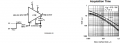
An analog sample and hold cannot accurately hold a voltage for more than a few tens of seconds (if that) due to the inherent leakage currents of such circuits.
But you could conceivably have the switch trigger an A/D converter to convert the voltage to a digital value and store this in a latch register (if the A/D doesn't have a built-in output latch), which could then be held indefinitely.
A D/A converter would generate the DC voltage from this held value.

The bit resolution of the converters would determine the analog resolution of the held voltage (and also the cost of the components).
For example 8-bits will give 0.39% resolution, and 10-bits will give about 0.1% resolution.

For 24V, you would need to use a voltage divider to reduce the voltage to the input range of the A/D, and then use an amp at the output of the D/A to convert it back to the original value.

This could all be done rather more simply, of course, with a microprocessor that has a built-in A/D and D/A.
 
Last edited:

MisterBill2

Joined Jan 23, 2018
27,164
I made just such a system about 35 years ago! It used an A/D converter to take a measurement of a voltage, and then latched that voltage in a digital memory that fed a D/A converter that controlled a DC amplifier. It worked well within the limitations of the resolution and accuracy of the converters , their reference sources, and the stability of the amplifier and it's power supply.
So the concept is valid but the implementation is rather tedious. Also expensive and inefficient.
 

sparky 1

Joined Nov 3, 2018
1,218
Less expensive novel approach uses a capacitor on dmm leads. Safety is always a serious concern.
If you safely hold an electrolytic capacitor to a test point it gives you a momentary average DC voltage. DMM tells you when the cap is full.
The low leakage capacitor should then be discharged safely through an appropriate resistor.
Circuit might display a steady voltage for 2 -1/2 seconds then discharge 1-1/2 seconds, the dmm reads zero until the next button press.
depending on how much current, the inrush current may need a resistor let say 1-1/2 seconds for maximum capacitor charge time.
The timing diagram may need revision. low voltage RC timing circuit uses a transistor as a switch operation: press and charge/display/discharge
 
Last edited:

MisterBill2

Joined Jan 23, 2018
27,164
Less expensive novel approach uses a capacitor on dmm leads. Safety is always a serious concern.
If you safely hold an electrolytic capacitor to a test point it gives you a momentary average DC voltage. DMM tells you when the cap is full.
The low leakage capacitor should then be discharged safely through an appropriate resistor.
Circuit might display a steady voltage for 2 -1/2 seconds then discharge 1-1/2 seconds, the dmm reads zero until the next button press.
depending on how much current, the inrush current may need a resistor let say 1-1/2 seconds for maximum capacitor charge time.
The timing diagram may need revision. low voltage RC timing circuit uses a transistor as a switch operation: press and charge/display/discharge
From the description in post #1 it seems that what the TS wants is a sample/record/deliver power source. That would be a glorified version of what I described in post #4. The bad news is that such a system is neither simple nor at all efficient. Much easier and less expensive, and more useful, would be a DVM with display hold, and then an adjustable power supply with a similar digital voltmeter, able to cover the same voltage range.
And now it is a challenge to imagine a practical use for such a system.
 

BobTPH

Joined Jun 5, 2013
11,463
Much easier and less expensive, and more useful, would be a DVM with display hold, and then an adjustable power supply with a similar digital voltmeter, able to cover the same voltage range.
Reading the original post again, this sounds like exactly what he is asking for. Problem solved!
 

Thread Starter

fx5

Joined Feb 5, 2022
10
Hello teachers and friends.
As I said in my question, I want to sample and save the DC voltage from the circuit with a momentary push switch, and its change happens when a new value of the voltage level is defined again with the momentary switch.

Thank you for your time
 

MisterBill2

Joined Jan 23, 2018
27,164
Interestingly, that sort of feature has not been offered in a piece of equipment that I have been aware of. Regulated power supplies that can hold a constant voltage very well are common, and have been around for years. Also very accurate digital voltmeters.
But the functionality requested is something that I have never seen presented.
So I am asking now, "What is the purpose of such a function???" What sort of process would use such a feature???
I already own a nice power supply that includes a digital voltmeter that permits the voltage to be set in advance of switching on the output.
Of course, it is always important to verify that the voltage setting is correct prior to applying power to a circuit.
 

MisterBill2

Joined Jan 23, 2018
27,164
Certainly such a sample and hold circuit is capable of holding a voltage long enough for an accurate measurement, but how long? I see times in microseconds and even in Milliseconds. Nothing in minutes or hours. .
So the device is certainly able to hold long enough for an accurate measurement, but not for minutes, hours, or days.
So my suggestion is add a printer to the DVM that measures the voltage, , and add an automatic "reset to ZERO" function to the power supply, to avoid the error of hitting five volt logic with 24 volt power, after others have used the power supply for a different application.
 
Last edited:

Thread Starter

fx5

Joined Feb 5, 2022
10
dear friends

I translate with Google, so I apologize if I did not say what I meant correctly.

I am thinking of a circuit that can sample and store power like some power supplies by pressing a push button, and this DC voltage value can be from 0 volts to a maximum of 24 volts DC, something like a hold button, but if needed, it can be done by pressing Pressing the same key again will record the new amount.

I am grateful to all my friends and professors who have been kind and guided me with their opinions
 

MisterBill2

Joined Jan 23, 2018
27,164
Both of my digital multimeters have this. Maybe we are interpreting what he is asking for differently?
Holding a reading is indeed a common feature on many of the more advanced level meters. BUT then USING that reading to program a DC power supply is quite different. THAT is what I se the TS as requesting.
 

Tonyr1084

Joined Sep 24, 2015
9,744
Here's what throws me:
so that I can use that voltage if needed.
Use that voltage? How? For what purpose? If you want to sample - say - 12 volts, by any means I can't see you having 12 useful volts for anything other than reading what that voltage was when you sampled it. Converting that sampled voltage to a digital value that can then be converted back to an analog voltage will give you a voltage that will remain constant. But that's merely a "reference" voltage. If you're thinking about using it to power a motor or a lamp or something that draws more than milliamps then you're going to need a power supply that can replicate that voltage. Yes, AD then DA has already been mentioned. But if you're working with potentially 24 volts then you need to find a chip that can hold that high a potential charge.

I come back to asking what do you mean by having a "Useful" voltage?
 

Tonyr1084

Joined Sep 24, 2015
9,744
Another question for you: Does this 0 - 24 V DC change that rapidly that you want to know what a voltage was at a given moment even though that moment may pass and the very next moment it can be something else? If all you want to know is what that voltage was at that particular instant of time then get a memory scope. Then you can analyze the voltage in real time at any specific moment. But as for having a useful voltage - {shaking his head}
 

sparky 1

Joined Nov 3, 2018
1,218
Some digital Multimeters connect to a PC, much of it started by reading into a comma delimited data base using basic.
An integrated circuit that has capability of interfacing a pc and software.
Microsoft Word - FS9922-DMM4-DS-13_EN (ic-fortune.com)

You can find blue tooth humidity temperature recorders some cost $18USD and others $500USD
Why does'nt an op amp automatically scale voltage like the hacker electronic website said.
Really, much of it started by reading into a comma delimited data base using basic.
It is not an analog circuit but it is software that crunches the numbers.
either read the values sequencially or read them into a matrix and call them out as you wish.
Use a sorting algorithm and many other functions that can operate on a data file

A teardown of an inexpensive blue tooth temperature humidity sensor unit.
There is nothing to see unless you are specially trained.
most that tryed it tossed it and started from scratch, others bought a data logger.
some had microsopes and saw lots of microcircuits but understanding takes a fair amount training.
 
Last edited:
Top