Thanks. This is important because there are two common conventions of the passive sign convention.Thank you for your time and reply.
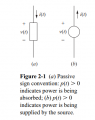
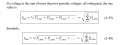
As per the textbook this is the sign convention
View attachment 362561
View attachment 362562
It falls under case b but current direction is reverse so i am concluding it is absorbing.
Yes i will start following the units from the next works.
Yes.Thank you for clarification. One doubt i have on passive sign convention is which i am trying to solve a problem, suppose inductor is getting charged during ON time and during OFF time power source is disconnected from the circuit, now inductor will supply current / power, should i now consider Inductor as source and accordingly determine if it is absorbing or delivering?

If you are talking about changing your current assignments depending on whether it is charging or discharging, you can certainly to this if you want. You just have to be very careful that you are consistent in all of your work, which basically means treating the analysis as two different problems with unrelated variable assignments. Sometimes this can make the analysis simpler, but you have to be very careful not to mix things up.Thank you for clarification. One doubt i have on passive sign convention is which i am trying to solve a problem, suppose inductor is getting charged during ON time and during OFF time power source is disconnected from the circuit, now inductor will supply current / power, should i now consider Inductor as source and accordingly determine if it is absorbing or delivering?
Hi,
Few doubts i have as per the text bookHi,
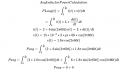
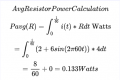
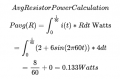
Where did you get that average power expression for the resistor from?
With a current of 2 amps and resistor of 4 Ohms, we've already got 2^2*4=16 watts average power.
When dealing with sinusoidal waveforms you can't always integrate over the full period, sometimes you have to go over one-half period and adjust the period also.
Even more to the point, DC power is i^2*R not i*R. If time dependent, it is i(t)^2*R over the appropriate period.
See if that matters with your problem.


Note how the starting equation in all three parts of your work aren't dimensionally consistent -- every one of them has units of power·time because of not dividing by the total time. Tracking units would have caught each of them -- and just catching one would have been a red flag that would probably have led you to fix the others.View attachment 362557
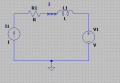
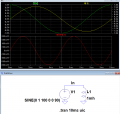
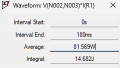
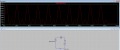
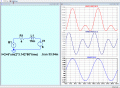
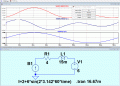
I have done the calculations as below, but my major question is following the passive sign convention the power of the DC source is negative, so it is delivered, but in reality, i think it is absorbed.
View attachment 362558
View attachment 362559
The average inductor power is 0 as the inductor current is periodic.
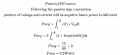
View attachment 362560
Hi,Few doubts i have as per the text book
View attachment 362724
The current is \[ i(t) = 2 + 6\sin(2\pi60t) Amps \]
Hence can i consider I1 = 2 Amps DC component, I2 = \[ 6\sin(2\pi60t) Amps\] , the RMS value of I1_rms = 2 Amps same as DC value, I2_rms = \[ \frac{6}{\sqrt2} = 4.24Amps \]
Avg Power (Watts) = \[ (I1_{rms}^2 +I2_{rms}^2)*R Watts = (2^2 + 4.24^2)Amp^2*4Ohms = 88 Watts \]
Can you please confirm if it is correct or not? I avoided integration this time.
Hi,