DC ceiling fan controller hack

Thread Starter

PatrickAdams_NZ

Joined Dec 26, 2023
7
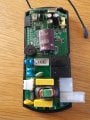
Hi team, here I have a remote operated ceiling fan, which I would like to add manual control. This is the unit, the lower connectors in pic 1 are, on the right hand side, 3 wire to the motor and 2 wire to the light.
The left hand connector the AC power input, Live, Neutral, Earth.
At the top are two other unused connectors, a small white 2 pin unit and the black one to the upper left which has 6 pins. These are close to the radio receiver board and am hoping are connected to the receiver some how...
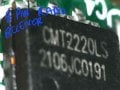
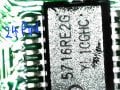
I have tried searching some of the chip numbers and such, as well as searching for a circuit diagram and found only Chinese pages relating to the chips, and other makes of fans seemingly using similar boards and features.
Is it even possible to decipher the board and add the manual control of some sort.20231227_102332.jpg20231227_103034.jpg
 

Ya’akov

Joined Jan 27, 2019
10,226
Hi team, here I have a remote operated ceiling fan, which I would like to add manual control. This is the unit, the lower connectors in pic 1 are, on the right hand side, 3 wire to the motor and 2 wire to the light.
The left hand connector the AC power input, Live, Neutral, Earth.
At the top are two other unused connectors, a small white 2 pin unit and the black one to the upper left which has 6 pins. These are close to the radio receiver board and am hoping are connected to the receiver some how...
I have tried searching some of the chip numbers and such, as well as searching for a circuit diagram and found only Chinese pages relating to the chips, and other makes of fans seemingly using similar boards and features.
Is it even possible to decipher the board and add the manual control of some
Welcome to AAC.

At first glance, it seems you are far more likely to succeed by providing mains voltage outside the board to the fan and light than providing low voltage signals to the board to control it. If you added a circuit to the outputs that allowed you to override the remote, that would be the simplest.

More sophisticated and more difficult—though probably much more acceptable—is a circuit that takes the mains output of the current board and uses it as signals to control your own board which would manage the mains output to the motor and light in a way that let local and remote control override each other.

Your approach is all but impossible without datasheets for the key parts, in particular the MCU that the radio board talks to, and then some guess and try reverse engineering. It is possible that black header offers access to chain another control of some sort to the board, or even that the white one is a serial interface to allow the same thing programmatically, but it is all conjecture.

Can you provide your notes on the chip numbers and what you found (Chinese or not)? That could help to give a more specific answer.

By the way, that is a very nicely made board. There are a lot of protective components and appropriate anti-tracking slots in the PCB. But it is very tight quarters and the mains voltages will never be far away. Poking around in there could easily be hazardous to the board and to you so be very circumspect about probing around with the mains supply connected.
 

Thread Starter

PatrickAdams_NZ

Joined Dec 26, 2023
7
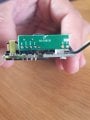
I have had it working with the appropriate AC wiring, the remote is very unreliable, so is the reason to try and tap a manual control into it. Without a magnifying glass it is very hard to reliably read the chip numbers. 20231228_080745.jpg This is the radio receiver board and could be a possible tapping point, I will try and get access to a microscope and decipher the chip numbers.
 

LesJones

Joined Jan 8, 2017
4,511
While looking for information on your FB-RX51B receiver module I came across this link which may be some help to you. Those receiver modules are availble in two frequencies 433 Mhz and 315 Mhz. You don't say in what way it is unreliable. I will assume it is not working well when the remote is situated near the maximum rated range. If you plan to hard wire the remote unit to the fan you would probably need to use opto isolators as the signal common may not be at the same potential. I have used some of the 4 channel remote control uints thst are sold on ebay and they are quite reliable. They use a receiver module that looks the same as yours but is a different model. (RXB12)

Les.
 

Thread Starter

PatrickAdams_NZ

Joined Dec 26, 2023
7
I'm not sure which radio band it uses either, but reliability in transmitting from the remote is continuously failing. This is why I would like to bypass the remote and have a simple rotary switch to control it. Thanks for the link there is alot of relevant info there, but probably a bit over my experience level.
 

LesJones

Joined Jan 8, 2017
4,511
It looks like there are two relays on the board which probably control the mains supply to the windings on the fan motor. If that is the only control there is for the fan (Which would only give the option of off and two fan speeds.) then Ya’akov's sugestion is probably the best approach.
Can you provide more information. Is this a new fan ? If so return it to the supplier as faulty.
If not did it originally work correctly ?
Can you post the manual on the fan so we have some idea of what the remote control controls other than on / off ?
Can you post a oscilloscope traces of the input signal to the transmitter section of the remote control so that we can see how fast the pulses are so that we have an idea of the required bandwidth of the serial link ?
One posible solution I was thinking about is using a TOSLINK fiber connection between the fan and the remote controller. This would provide electrical isolation.
Is the remote controller a hand held battery powered device or is it mains powered ?

Les.
 

Thread Starter

PatrickAdams_NZ

Joined Dec 26, 2023
7
Sorry the pics are not great... I've had no success in finding the receipt for proof of purchase and therefore cannot make any warranty claim. It is not well explained in the manual...but this fan is using a Brushless DC motor which I have found out needs critical timing to operate the 3 phases precisely. For this reason I would like to keep that part of the circuit in factory form and add a simple manual interface hardwired to the control circuit
 

LesJones

Joined Jan 8, 2017
4,511
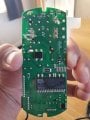
I suspect from the picture in post #1 that the receiaver module is NOT isolated from the mains. This is because the way the antenna wire seems to be carfully insulated. For this reason I don't think a wire link between the remote and the control box (Which the manual calls the receiver.) would be a safe option. I think you would have to use optical fibre. Now that we now know it is a ceiling fan it is unlikely that you need the remote to be very far from the fan. I have a cheap 4 channel remote relay unit which uses a similar receiver module to the one that your fan uses. This works reliably between the garage and the back of the house and from inside a car in the road outside the house. I suggest that you measure the voltage in the remote (On the board and not directly on the battery contacts while pressing buttons on the remote so the battery has to provide some current. If the voltage drops when a button is pressed then clean the battery contacts and try a new battery. I think you should do this before invesigating the possibility of using an optical fibre link.

Les.
 

Thread Starter

PatrickAdams_NZ

Joined Dec 26, 2023
7
I was hoping to add a secondary manual control wired directly to the receiver and run to a wall by the light switch...I hadn't thought of testing the voltage on the remote, but batteries are not the issue...I'm also not losing reception from being too far away...it won't work at any distance. You are correct it isn't isolated from the mains. There is a step-down transaction with rectification and motor control all on the one board
 
Top