DC 2 way switch help

Thread Starter

gerryr1gerryr

Joined May 24, 2011
20
I need a switch or circuit which can help with solar panel tracker.

12 VDC max 1A.

I need to turn on power when the panels rotate to the maximum sunset direction at the end of the day.

This power would operate a 12 VDC motor which would rotate the panels back to the sunrise direction and then reset the "Power On" condition ready to continue the cycle the next day.

I have been looking at "Flip Flop" switch circuits but this doesn't seem to be my answer.

Appreciate any help.
 

Thread Starter

gerryr1gerryr

Joined May 24, 2011
20
How about micro switches at the limits of travel?
Tx pwdixon but as I see it my problem is what type of switch?
How about micro switches at the limits of travel?
Tx PWD switch activation is not really a problem its how i can get the results from them,

My basic thinking is to let switch A activate a Mosfet then the power through then Mosfet would continue to power the motor even though power was removed from Switch A. I think what I need is a way to make Switch B turn off the Mosfet.I think I can do it manually by applying resistance between the GATE and the SOURCE pins of the Mosfet but I cannot figure out how to get Switch B to do it
 

EM Fields

Joined Jun 8, 2016
583
I need a switch or circuit which can help with solar panel tracker.

12 VDC max 1A.

I need to turn on power when the panels rotate to the maximum sunset direction at the end of the day.

This power would operate a 12 VDC motor which would rotate the panels back to the sunrise direction and then reset the "Power On" condition ready to continue the cycle the next day.

I have been looking at "Flip Flop" switch circuits but this doesn't seem to be my answer.

Appreciate any help.
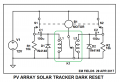
This might work for you:

PV array solar tracker dark reset.png
S1 and S2 are single-pole-single-throw normally open (form "A") switches, and K1 is a dual coil latching relay.

S2 is the sundown switch and is shown with its contacts momentarily closed because the tracker has physically activated S2 when it's gotten dusk outside and S2 has pulsed K1L2, attracting K1's armature.

When that happens, the motor will start to turn the array back toward the east, opening S2 and disengaging K1L2.

However, since K1 is a latching relay it'll stay made until the motor drives the array to the point where K1L1 is energized.

When that happens, the drive to the motor will be cut and the array will be positioned to respond to first light
 
Top