Facebook
 Google
 GitHub
 Linkedin
Thank you for the explanation.You don't need a voltage divider to feed voltage to the base of an emitter-follower. The base of an emitter-follower also does not need a current-limiting resistor.
A transistor has a base-emitter diode that has a voltage drop of about 0.6V to 0.7V. If 4.8V is applied to its base then 4.1V to 4.2V will appear at its emitter.
But a darlington transistor has two transistors with their base-emitter diodes in series. Each base-emitter diode also has a voltage drop of 0.6V to 0.7V.
If 4.8V is applied to the base then about only 3.6V will appear at the emitter.
I have a question here:
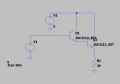
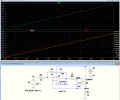
I'm planning to use the darlington circuit for current increment, but I have also seen the voltage drop in my simulation. I would like to increase the current and maintain the voltage without drop. So, in this case, which configuration is better to use and to meet my requirements (maintain constant base voltage 5V at the emitter of darlington and also the current needs to be increased from few micro AMPs to 300mA).
Thank you!