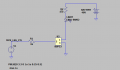
Darlington transistor for low side switching of LED lighting

Thread Starter

jai123

Joined Aug 12, 2024
3
Hi there,

I have a circuit that is aimed to switch on a 48V LED light (front/rear) for a bike.
Basically a low side switch using a darlington transistor to be controlled by a 3.3V microcontroller.
On my simulation with LTSpice, I am seeing ~2.3A current on my transistor which is more than the transistor can handle.
May I ask what am I doing wrong here?
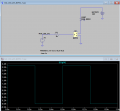
1723820057164.png
 

dl324

Joined Mar 30, 2015
18,220
Welcome to AAC!
May I ask what am I doing wrong here?
No current limiting resistor. 2.3A is more than the LED or transistor can handle.

That symbol for the transistor is terrible. The datasheet for the LED is also terrible.

Is this modification for a motorized vehicle subject to government regulations?
 

Attachments

MrChips

Joined Oct 2, 2009
34,628
What you are doing wrong is not limiting the LED current with a resistor in series.
You don't need a darlington. A MOSFET would be a better choice.
 

Thread Starter

jai123

Joined Aug 12, 2024
3
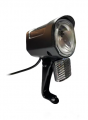
The LED device I picked was only for simulation, but the actual light was something like this.
https://es.aliexpress.com/item/1005004382601102.html?gatewayAdapt=glo2esp
1723821776060.png
Sorry for the terrible transistor symbol.
No, the modification for a motorized vehicle is not subject to government regulations.

The light draws somewhere about 50-80mA.
Each time the light is blinked, there is too much current (~2.3A) on the transistor.
The 48V supply provides 500mA current to the LED light.

I tried with a MOSFET but the gate voltage goes over 3.3V (which is not safe for the 3.3V microcontroller) even with a 10k gate pull down to GND.
 

MrChips

Joined Oct 2, 2009
34,628
The LED device I picked was only for simulation, but the actual light was something like this.
https://es.aliexpress.com/item/1005004382601102.html?gatewayAdapt=glo2esp
View attachment 329395
Sorry for the terrible transistor symbol.
No, the modification for a motorized vehicle is not subject to government regulations.

The light draws somewhere about 50-80mA.
Each time the light is blinked, there is too much current (~2.3A) on the transistor.
The 48V supply provides 500mA current to the LED light.

I tried with a MOSFET but the gate voltage goes over 3.3V (which is not safe for the 3.3V microcontroller) even with a 10k gate pull down to GND.
The transistor alone does set the current. You still need a series resistor to limit the current.

The gate voltage of 3 V is what the MCU puts out. You need to select a MOSFET with low VGS. For example IRLZ44 has VGS = 2 V max.

For 100 mA, you can use a lower power MOSFET.
 

panic mode

Joined Oct 10, 2011
4,866
what you are doing is insane. LED has Vf of couple of Volts and you are powering it directly from much higher voltage source - 48V. if you want this to work, add 620 Ohm 5W resistor, in series with your LED. that will work. but most of the power will be wasted on resistor. to reduce wasted power and heat, use lower supply voltage source, something that is only a bit higher than Vf of the LED. or use different circuit...
 

MrChips

Joined Oct 2, 2009
34,628
Use a series resistor to test the LED (without the driver transistor). Then measure the voltage across the LED and the voltage across the resistor in order to calculate the LED operating current and voltage. Only then we can suggest alternative solutions.
 

Thread Starter

jai123

Joined Aug 12, 2024
3
Use a series resistor to test the LED (without the driver transistor). Then measure the voltage across the LED and the voltage across the resistor in order to calculate the LED operating current and voltage. Only then we can suggest alternative solutions.
The LED light when connected to the power supply draws 50mA.
Power supply voltage: 48V
 

ronsimpson

Joined Oct 7, 2019
4,647
The light said 6 to 60 volts. It probably has a power supply built into the light.
Not in simulation but in the real world, the wires might be connected backwards. It will not light and will pull large amounts of current.
 

MrChips

Joined Oct 2, 2009
34,628
The LED light when connected to the power supply draws 50mA.
Power supply voltage: 48V
Vary the supply voltage and find out the lowest voltage that the LED will operate.

If you do not have a variable PSU, insert a series resistor and determine the largest resistance you can use. Measure the voltage across the resistor.
 

MisterBill2

Joined Jan 23, 2018
27,186
Is that 470 ohm resistor selected to provide the desired forward current?? AND, what model are you using for the LED in the simulation? Understand that for many simulators having an incorrect model will result in having incorrect results. That is why you can run many amps thru a 100 milliamp max transistor in the simulator, but not in the real world.

And I am glad to be back! And I have no idea about how I got where I was!
 

sghioto

Joined Dec 31, 2017
8,633
The LED in the simulator is what the TS listed, a LXHL-BW02 high power unit with an average forward voltage drop of 3 volts.
A series 470 resistor should limit the current to appx 96ma in the simulator.
 
Top