Custom PCB drawing too much current when devices are in shutdown

Thread Starter

freeflyer

Joined Sep 9, 2016
162
Nice meters are not always low burden uA meters. It's common problem measuring low voltage circuits.
https://www.eevblog.com/projects/ucurrent/
Thanks nsaspook this is very useful and interesting to know.

It explains why I was unable to use the uA range and confirmed my suspicion it was due to the shunt resistor.

Its also interesting to read the difficulties of trying to measure shutdown currents at low voltages, exactly like I am trying to do.

I'm surprised that even top end meters like Flukes aren't even capable of measuring low currents at low voltages. Presumably its not an issue when measuring low currents at higher voltages ?

Its a shame the µCurrent GOLD is not available anymore.

So after all this, my circuit might not be drawing too much current.

But without an accurate way of measuring low current at low voltages, I will never know.

I have access to current clamps and a Rogowski coil, but I doubt these will be suitable for my measurements...

https://www.pemuk.com/products/cwt-range/cwt-ultra-mini

https://www.i-prosys.com/cp-305/
 
Last edited:

Pyrex

Joined Feb 16, 2022
510
There is a good method to determine which component is consuming high current without damaging the PCB.
A microvoltmeter is needed for that.
The voltage drop on the PCB trace is measured; if any component draws a high current, it will be evident from the increased voltage drop.
If you have a good microvoltmeter, it can be tried, although the 1.5 mA current is relatively very small, accordingly, the voltage drop will be small.
 

panic mode

Joined Oct 10, 2011
5,039
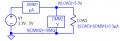
the subtracted 0.3uA is due to internal resistance of DMM2 (usually 10MOhm).
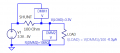
if you do not have DMM capable of measuring uA, don't despair, just put some resistor in series and measure voltage across resistor. the smaller the current, the larger resistor can be. since your circuit draws some 1.5mA, 100Ohm resistor will mean voltage drop of 150mV. This is small enough to not affect the circuit but large enough to be measured easily using voltmeter:
1756303289024.png
 

Thread Starter

freeflyer

Joined Sep 9, 2016
162

panic mode

Joined Oct 10, 2011
5,039
you can use just one...

have circuit powered through resistor. connect it in place of DMM2, take the measurement of voltage and if needed (optional) adjust supply to get perfect voltage for the MCU.
then connect DMM across 100 Ohm resistor and take the reading. you do not need to subtract 0.3uA anymore.
 
Top