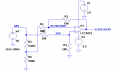
Yes, it is High side monitoring but according to your circuit is not high side monitoring, it is low side monitoring. Why you use the 50ohms before shunt?.
The 50 ohms before the shunt simply sets the current. In this case 50V/50 or sets the current around 1Amp for the test. The reason the 'high side monitoring' circuit is not working: There is equal to or more than 25V on the inverting and non-inverting inputs to the op-amp.
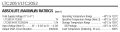
Per the absolute maximum rating for the chip, taken from the datasheet:
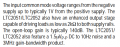
Note the input voltage is not allowed to exceed V++0.3V or in your case 2.8V. Absolute maximum ratings are typically ratings that if you exceed them you will destroy the chip. The 'operational' maximum voltage is less than this per the description first sentence:
1V from the positive supply in your case would be a maximum of 1.5V.
By changing the circuit to low side monitoring. The inverting and non-inverting inputs never see a voltage greater than 0.1V.
I'm need to measure the current from 100uA to 20A, for that I have design the circuit by using the differential amplifier. As I know the operation of this amplifier is to amplifying the differential signal which is present at the input stage. But, according to my circuit (which is attached below), I designed the circuit with gain=1 even though the output voltage of the amplifier is double. Please can you see the circuit and let me know If I did any mistakes?.
At first glance i see a wide ratio of resistor values, 0.001 Ohms to 500k Ohms which is huge. That brings up questions right off the bat.
The other ratio i see has been mentioned previously in this thread and it has to do with the range of currents to be measured, which is 100ua to 20 amps. Wow, that's huge too.
As others have mentioned, it is hard to measure that wide range of currents with just one range of measurement precision. For example, if you had a regular 3 and 1/2 digit high quality LCD current meter to do it all in one range setting you'd have to set it to 20 amps to be able to handle the highest current. In 3 and 1/2 digits that 20 amps would appear as:
20.0 amps
or if you were lucky and it was really 19.99 then it would give you four digits:
19.99 amps.
Now ever with that, where does 100ua show up? To be able to measure 100ua on the same range it would have to show up as:
00.0001 amps
and note you cant eliminate that first '0' because you need that to measure 20 amps.
This of course means you would need AT LEAST a meter that could show 6 digits. They are very very expensive. Not only that, but to measure 0.0001 amps with any accuracy you really need one more digit to the left: 0.00010 amps, so that you can be at least somewhat certain that a reading of 0.0001 amps is reasonably accurate.
All this tells us that you have to be able to switch ranges. That's not only the only way, it's the best way. It is best because then you can ensure better accuracy over the entire range of measurements.
Take that same 3 and 1/2 digit meter and switch to a lower range like "micoramps" so we can read:
100.0 microamps
and not only do we have that extra '0' to the right as we did above, we have three such '0's to the right which tells us we can have much more confidence in the measurement accuracy.
There are several ways to switch measurement ranges. For one, you can swap out the current sense resistor, or just add resistor(s) in parallel to get to a higher range. The software has to be sync'd to this change of course so you get the right scaling.
Another way is to use a set of precision current sources where you compare those to the measurement current.
Now to the circuit itself.
One of the things you have to watch out for with high impedance loads is that the measurement circuit does not attempt to power the load as well as try to make the measurement. In the circuit shown in the .asc file it looks like the 10k resistors will also power the 500k load and so the load could be over powered and maybe even blow out while making the first measurement.
So there are a number of things to talk about yet i hope this all makes sense to you.

 Facebook
 Google
 GitHub
 Linkedin