Current monitoring using a reed switch

Thread Starter

ronsimpson

Joined Oct 7, 2019
4,661
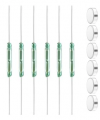
There are sever posts on sensing current. One of the thoughts that came up is that a 14mm reed switch takes about 10amp turns to close the switch. (2A at 5T, 10A at 1 turn) Not accurate! For a 10A ac load you probably need 20 turns of wire, so you are not triggering at the very peak of the cycle.
At appears this works both AC and DC.
My plan is to monitor if the freezer comes on several times a day or if it failed.
Something I just learned, is these switches respond very fast. They can pass 5.5khz.
Passing 60hz current around the switch will cause it to respond 120 times/second. Something I had not thought of. Most relays only pass 10hz.
In my plan the switch drives an input to a small computer. Placing a capacitor across the switch will make it appear closed over the entire cycle, as long as the RC time is greater than 60hz by some big margin.
1762623537088.png
Do you think the switch is going to last for 10 years if it opens/closes at 120hz and switching 1mA on the contacts?
 
Last edited:

Jon Chandler

Joined Jun 12, 2008
1,571
Interesting approach to be sure.

Would a hall-effect sensor provide the same result with no wear?

Or a CT transformer with the hot lead passed through it? Maybe with an opto-isolator to accomodate voltage swings?
 

crutschow

Joined Mar 14, 2008
38,408
Do you think the switch is going to last for 10 years if it opens/closes at 120hz and switching 1mA on the contacts?
Possible, but you are likely pushing it.
Reducing the current will increase its electrical lifetime.
Adding a capacitor across it may reduce it.

The mechanical lifetime of a reed relay can reach 10^9 operations.
 

Thread Starter

ronsimpson

Joined Oct 7, 2019
4,661
CT transformer with the hot lead passed through it? Maybe with an opto-isolator to accomodate voltage swings?
The CTs I have are small and saturate before 1.5V that is needed for an isolator. I have tired it. I can get much larger devices but I just don't have them in my hand. I tried even removing the burden resistor but can't get it to fire a LED.
hall-effect sensor
Have not thought of that. The Hall needs power, and several other options take power.
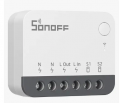
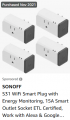
I have a box of these Sonoff smart switches. I read the condition of the switch from S1 to S2 over the network.
I see some (switch) Halls that need only 3uA to run. I might be able to steel some power from the computer. I have only used linear Halls that ate power.
1762633618425.png
The mechanical lifetime of a reed relay can reach 10^9 operations.
That number suggests about 1 year of 24/7 at 120hz.
 

MisterBill2

Joined Jan 23, 2018
27,315
The cheap trick to prevent a reed relay operated by a current sense coil from chattering (buzzing) is to add a bit of steel lamination AND a "shading coil" like all AC relays include. OR look in a reed relay catalog for an AC current sensing reed relay assembly. OR, just use an AC reed relay!!
 

MisterBill2

Joined Jan 23, 2018
27,315
R is right about plain reed relays. DC relays on AC also buzz, at least quite a few of the styles do. THAT isthe reason that most AC relays have partial Pole shading coils. Just that one-turn coil changes everything.
 

AnalogKid

Joined Aug 1, 2013
12,087
I don't think you can get more simple / reliable / safe than a current sense transformer with a 3.3 V zener diode across its secondary. UL-rated isolation, true galvanic isolation, inherent energy-limiting. Something like the device in post #6 with the LED replaced by a zener.

An LED takes several mA for any reasonable brightness. Presumably, the digital signal input to your "small computer" has a fairly high input impedance, and can be driven to 3 V by the CT. Let the software do the filtering. Running 60 Hz into the computer rather than DC actually improves system noise immunity.

ak
 

Thread Starter

ronsimpson

Joined Oct 7, 2019
4,661
and can be driven to 3 V
There is my problem. My CTs cannot be driven to 3V.
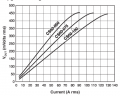
I have many different types. The large ones will not go above 500mV and the little one flatten at 150mV. The cores do not have enough (Volt X Time) to work at a larger voltage.
1762725544158.png1762725688965.png
My calculations indicate I need three times the correctional are of the larger one, to get 1.5V I need to fire off an LED (isolator) or at least twice the size to turn on a simple Base-Emitter junction.

I see larger cores but the cost jumps to 10 or $16usd. I think I will get some new parts.
 

AnalogKid

Joined Aug 1, 2013
12,087
What is the load on the secondary for that chart?

Separate from that, is a small circuit an option? CMOS rail-to-rail opamp, two AAA cells or a wall wart. If you have old bipolar parts, an LM358 will do this because its input stage voltage range includes its own negative rail. 1/2 as gain stage and noise filter, 1/2 as comparator to drive the computer input.

ak
 

MisterBill2

Joined Jan 23, 2018
27,315
You could use a "current relay" that was not a reed device. Or use a suitable current transformer to power an optoisolator. to produce the logic level signal.
It might even be useful to contact a company that makes the reed switches and see what they have already done. CERTAINLY a reed switch driven by a current winding is not a new concept.
 

pmr390

Joined Nov 3, 2025
1
There are sever posts on sensing current. One of the thoughts that came up is that a 14mm reed switch takes about 10amp turns to close the switch. (2A at 5T, 10A at 1 turn) Not accurate! For a 10A ac load you probably need 20 turns of wire, so you are not triggering at the very peak of the cycle.
At appears this works both AC and DC.
My plan is to monitor if the freezer comes on several times a day or if it failed.
Something I just learned, is these switches respond very fast. They can pass 5.5khz.
Passing 60hz current around the switch will cause it to respond 120 times/second. Something I had not thought of. Most relays only pass 10hz.
In my plan the switch drives an input to a small computer. Placing a capacitor across the switch will make it appear closed over the entire cycle, as long as the RC time is greater than 60hz by some big margin.
View attachment 358508
Do you think the switch is going to last for 10 years if it opens/closes at 120hz and switching 1mA on the contacts?
That's > 3.7Million operations in 1 year ( 120 *3600*24*365) I think the mechanical contacts would wear out.
 

MisterBill2

Joined Jan 23, 2018
27,315
There are certainly current operated relays that are not fast response reeds, which could also work for that application. In addition, a small current transformer could easily operate a small AC relay directly connected, or a small DC relay connected thru a half-wave rectifier . OR an opto-isolator, except that then a power source is required.
 

Thread Starter

ronsimpson

Joined Oct 7, 2019
4,661
More news.
I have some WiFi sensors with "TTL" type inputs. There is no easy source of power for an amplifier.
I now have some LARGE CTs that can make volts out. But at $20.00 I am thinking this is the wrong way to go.

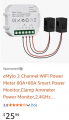
eMylo and Tuya make a two CT WiFi monitoring box for $26. Also one-CT versions.
1762880836201.png
This might be closer to what I want. Watch out this company makes many different products that look like this. I want the "energy monitoring" one. I do not want the switch and that is a problem. I do not know if it works with Home Assistant.
1762880984959.png
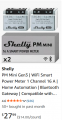
Shelly makes many smart switches with energy monitoring. Here is no switch, just monitoring. $14 each.
1762881371737.png
Last night I found out why I could not read current out of S40 and S31 from SonOff.
I cannot put a switch on the freezer or Fridge. I will go inside and short out the relay to make it monitor power, only. $9.00 each and I have a box of them.
1762881626426.png
Bottom line is that I can get a WiFi computer with a CT for less than the price of a CT alone.
 

schmitt trigger

Joined Jul 12, 2010
2,056
[QUOTE="ronsimpson, post: 2009365,
Bottom line is that I can get a WiFi computer with a CT for less than the price of a CT alone.
[/QUOTE]

The wonders of Chinese manufacturing
 

MisterBill2

Joined Jan 23, 2018
27,315
Another option is to use a cheap current transformer with several turns of wire thru, feeding a diode and capacitor filter to provide a higher voltage out for the relay.. That would be an isolated trigger to reset the warning timer.

But still, the coils of wire around the reed relay, with some steel nails along side, around the outside, to lengthen the magnetic field time so that the reed does not vibrate. Certainly this approach merits a bit of experimenting just because it is so simple and reliable. I suspect that it was immediately considered to be far out because it is an uncommon concept.
 

Sensacell

Joined Jun 19, 2012
3,780
Possible, but you are likely pushing it.
Reducing the current will increase its electrical lifetime.
Adding a capacitor across it may reduce it.

The mechanical lifetime of a reed relay can reach 10^9 operations.
I have killed a few cheap low-quality reed switches by placing a capacitor across the terminals, the current spikes seem to erode the contacts rapidly.
 

Ian0

Joined Aug 7, 2020
13,112
How about rectifying the current through the coil? I don't know how much current your freezer uses, and whether the voltage drop across a bridge would create too much heat for it to be viable. You could use Schottky diodes.
 
Top