Current measurment

Thread Starter

anditechnovire

Joined Dec 24, 2019
105
Please am just a young beginner, and am confuse a bit while measuring both short circuit current and load current.
I first decided to use a half dead 9v battery (now measuring 6v) for a transistor project.I initialy measured the short circuit current and it was 40mA. I hooked up a 12k resistor in series with the base of the transistor, expecting to get 0.5mA current flowing at the base, but i only got 0.3mA. I again tried it with a 6k resistor, expecting to get 1mA current at the base, but i only measured 0.52mA, I again tried it with a 3k resistor, but only got 0.9mA (instead of 2mA).
I thought it was because of the transistor so i disconnected the resistor from the base of the transistor and connected them directly to the battery, but same result.
So what might have be the reason for these abnormalties.Could it be that the battery was half dead?. But it produced 40mA short circuit current afterall.
Or where did i went wrong? cause that situation make me look completely like a novice in electronics.
 

MrChips

Joined Oct 2, 2009
34,806
With any voltage source you have to take its internal resistance into account.
Every voltage source has internal resistance. The internal resistance of a perfect voltage source is 0Ω.
Any battery, particularly a 9V battery is not an ideal voltage source. The internal resistance rises as the battery ages.
Because the battery is a chemical cell, both the output voltage and its internal resistance change with the load and as the battery ages. If the no-load voltage is 6V then the battery is way past its useful life.
 

Thread Starter

anditechnovire

Joined Dec 24, 2019
105
In this circuit meter accuracy might be reassuring but not mandatory. The 434.3 uA is a significant value. micro amps nano amps ??? alot of conversion.
40 mA short a 12k ohm would work but a 6k puts a 96.5 mA load on the battery. However you found the base emitter current of the transistor for a collector voltage of 6V

Using a 12k Ohm resistor an accurate current measurement with and without the transistor gives:
500 uA - 434.274 uA = 65.726 uA = Ibe.
The current draw measured at the battery is 10.036 nA
I think it would be nice if it were 2 mA such as 2.5k between emitter and ground.
That would be enough to light a small led rated 1.5V. After all
does it matter if the voltage is 6V if the current is 2mA.
I can't understand anything your saying.
I said the battery voltage is 6v, and it was currently producing 40mA short circuit current(that is when I connected the DMM's probe directly to it terminals), but it was unable to provide me 0.5, 1 and 2mA of current when I connected 12k, 6k, and 3k resistor respectively in series with it.
So i wanted to understand these non ideal fluctuations, whether it came from the battery(because it was half dead) or what.
The transistor was just a reference story(I later disconnected the resistors from the transistor's base and connected them directly in series to the battery one after the other)
 

Travm

Joined Aug 16, 2016
363
A 9v battery at 6v is more than half dead.
If you don't understand that batteries have internal resistance you should read up on batteries. Actually on both accounts.
 

MrChips

Joined Oct 2, 2009
34,806
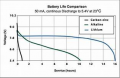
Here are some sample discharge curves for 9V battery.
Once the voltage drops below 7.2V the battery has passed its useful life.
You cannot get any meaningful information from your measurements except that the battery is dead.

1592532399226.png
 

sparky 1

Joined Nov 3, 2018
1,218
"current measurement question".
It might be a dead battery but there are persons new to electronics that can make it work.
Some circuits are not powerful however some can understand even when the battery is compromised.
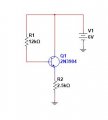
A schematic can help organize your current measurement issues that you are earnest in asking about ?
The concept here is use a practical value R2 so that the next battery will last a while longer. An estimate was made.
2 mA measured at V1 is one choice to start at. If a fresh battery is 9.6V Aiming for about 4.7 k for R2.
dead battery.JPG
 

Attachments

Last edited:
First of all, read the manual for the DMM.
If it's half way decent, you can figure out what resistance it uses.
Generally a cheap DMM measure the voltage across a resistor.
So, you are modifying the circuit big time for starters.

To make any sense out of I-V measurements you have to measure the current through it and the voltage across it. it's called a 4-terminal or Kelvin measurement for this type of load.

When your measuring pA, the rules change.

The battery will have an internal resistance.
 

Thread Starter

anditechnovire

Joined Dec 24, 2019
105
So
Here are some sample discharge curves for 9V battery.
Once the voltage drops below 7.2V the battery has passed its useful life.
You cannot get any meaningful information from your measurements except that the battery is dead.

View attachment 210113
So if the battery was 6v in nature, i.e. not discharged but originally 6v.
Would I still experience that?

Because I again use a 12v power supply circuit, regulated it to 6v and when I repeated the whole process, those fluctuations wasn't present. The readings was precisely according to OHMs law.
 

Travm

Joined Aug 16, 2016
363
So

So if the battery was 6v in nature, i.e. not discharged but originally 6v.
Would I still experience that?

Because I again use a 12v power supply circuit, regulated it to 6v and when I repeated the whole process, those fluctuations wasn't present. The readings was precisely according to OHMs law.
In this scenario the regulator will be compensating to keep the voltage steady and make your measurements match what you expect. You would not see the power supplies internal resistance in your measurements because the regulator is compensating at the output.

Read the textbooks on this site, they will help you understand lots of the little details in electronics.
 

MrChips

Joined Oct 2, 2009
34,806
Just to make it clear.
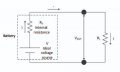
This is an electrical model of your battery.
Vout is the voltage measured at the terminals of the battery. It is the same voltage measured at the load RL.

The problem is we don't know the internal resistance of the battery Rs.
Both Rs and V will change depending on the current drawn from the battery.

1592592070607.png
 

Thread Starter

anditechnovire

Joined Dec 24, 2019
105
Just to make it clear.
This is an electrical model of your battery.
Vout is the voltage measured at the terminals of the battery. It is the same voltage measured at the load RL.

The problem is we don't know the internal resistance of the battery Rs.
Both Rs and V will change depending on the current drawn from the battery.

View attachment 210180
Ok can a battery's internal resistance also be varying, depending on the current drawn?
Never knew that, I thought it will be fixed, and will only increase if when the battery ages.
 
Top