Current limiting when charging gel batteries?

Thread Starter

Robobass

Joined Jul 18, 2024
4
A friend asked me to build him a battery powered bass amp. I used two small 12V 3Ah lead acid gel batteries in series. The thing worked perfectly. For awhile. I realized that the car charger puts out 4A at 24v, but the batteries say not to charge above .87A, so they don't last long. If I put a power resistor in the circuit will that be enough? The electronics in the charger will certainly find it confusing. Otherwise, is there a current limiting chip I could use with a simple power supply?
 

Thread Starter

Robobass

Joined Jul 18, 2024
4
The audio board is pretty cool. Specs are below.
26V/6Ah from the batteries works really well. Plenty of playing time. I have one in my shop running on a 24V wall wart and it sounds great!

Features:
High output power digital amplifier.
Sound quality is very good by using this module.
Two-channel stereo, 2*160W.
DC 15-36V power supply, with reverse polarity protection.
When heat sink temperature is high to a certain extent, the cooling fan will work.
Support BTL mode (on the back of amplifier board J1, J2, J3, J4 shorted), 36V 3ohm for mono 220W output.
Applicable speaker impedance: 4/6/8 ohm(8 ohm is the best).
Specifications:
Amplifier Chip: TDA7498E
Working Voltage: DC 15-36V(Recommend 32V, 8A)
Output Power: 2*160W
Number of Channels: Two-channel Stereo
Efficiency: 85%
Applicable Speaker Impedance: 4/6/8 ohm(8 ohm is the best)
PCB Board Size: 108 * 78mm / 4.25 * 3.1in
Weight: 170g / 6.02oz
Package List:
1 x Digital Amplifier Board
 

crutschow

Joined Mar 14, 2008
38,316
A power resistor in series would work to limit the charging current, but the value would best be experimentally determined when charging a dead battery.
Buy a bunch of 1Ω, 5W resistors (example), and then you can connect them in series/parallel to get the right value.
 

Thread Starter

Robobass

Joined Jul 18, 2024
4
I have already estimated that a 50 Ohm, 25W resistor will reduce the charging current to an acceptable level. The trouble is that the car charger may not be able to deal with this. Will it still charge at 30V, what I need for the serial wiring? I concede that this is an unusual problem.
 

BobTPH

Joined Jun 5, 2013
11,463
I have already estimated that a 50 Ohm, 25W resistor will reduce the charging current to an acceptable level. The trouble is that the car charger may not be able to deal with this. Will it still charge at 30V, what I need for the serial wiring? I concede that this is an unusual problem.
How did you estimate that?

At 0.87A, a 50Ω resistor would drop

V = IR = 0.87 * 50 = 43.5V.

To charge a 24V battery at 0.87A would require an input voltage of about 70V and the resistor would dissipate 37W.
 

crutschow

Joined Mar 14, 2008
38,316
I have already estimated that a 50 Ohm, 25W resistor will reduce the charging current to an acceptable level.
Your math is off.
I doubt you will need more than 10 ohms.
And it won't dissipate anywhere near 25W.
The trouble is that the car charger may not be able to deal with this. Will it still charge at 30V,
Should not be a problem.
Yes it will likely try to charge at 30V, but the low current, due to the added resistance, is typical of the battery current as it becomes close to being fully charged so that won't bother the charger.
As the battery voltage reaches 30V or so, the charge current will then naturally taper off to a trickle value.

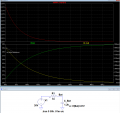
Below is the LTspice sim of a simple charging circuit with a 30V charging voltage:
The large capacitance is a simple model of the 3Ah battery capacity.
Note that with a series 10Ω, the maximum charging current (yellow trace) is 0.9A for a discharged battery (21V) and rapidly drops as the battery voltage goes up as it charges.
The maximum resistor dissipation (red trace) is 8W.
The sim shows a full charge in about 12 hours.

1721317685674.png
 
Last edited:

MisterBill2

Joined Jan 23, 2018
27,159
When recharging those gell-cell batteries, if battery life matters, it is important to limit the charging currents to the published limits.
So you can use that mains operated charger to power the amplifier and use a much lower rated supply to recharge the batteries,
Set the charger voltage to limit the current to less than the recommended 0.87 amps. There should also be a float-charge voltage specification that will be safe for the condition where the charging is not stopped when a full charge is reached.
 

Ian0

Joined Aug 7, 2020
13,097
A friend asked me to build him a battery powered bass amp. I used two small 12V 3Ah lead acid gel batteries in series. The thing worked perfectly. For awhile. I realized that the car charger puts out 4A at 24v, but the batteries say not to charge above .87A, so they don't last long. If I put a power resistor in the circuit will that be enough? The electronics in the charger will certainly find it confusing. Otherwise, is there a current limiting chip I could use with a simple power supply?
If it puts out 24V, it will never get the batteries charged. It needs 29.5V for a cyclic battery.
Most lead acid batteries will take as much charge current as discharge current during the bulk charge phase. It is only during the absorption charge phase that the current must be limited, and it gets limited because the absorption charge phase is constant voltage. If the batteries don't get warm during the bulk charge, it doubt it is doing them much harm, although it will reduce the life a bit. I suspect the charge voltage being too low is the problem.
 

crutschow

Joined Mar 14, 2008
38,316
If it puts out 24V, it will never get the batteries charged.
If it's a standard battery charger it outputs more than 24V.
I think the TS said 24V because the charger is designed to charge a 24V battery.
Most lead acid batteries will take as much charge current as discharge current during the bulk charge phase.
On what do you base that statement?

The usual recommended charge current for a lead-acid battery is no more than 30% of its Ah rating, which would be 0.9A for the 3Ah battery, so I would not exceed that.
 

crutschow

Joined Mar 14, 2008
38,316
LM317 in current limit mode will charge at 870mA, reducing as battery reaches full charge.
That works as long as the 1.5V or so minimum drop of the LM317 allows the battery to fully charge with the maximum output voltage of the charger.

Note that the LM317 may have to be on a heat-sink.
 

Ian0

Joined Aug 7, 2020
13,097
On what do you base that statement?
A discussion (quite a while ago) with the technical department at Exide on VRLA batteries. Well before the days of the Lithium battery, we were discussing ways of rapid charging batteries for electric go-karts.
The gist of it was that the recombination part of the process was the limiting factor. Whilst there was no gassing, the current limit was entirely thermal in both directions.
 
Last edited:

crutschow

Joined Mar 14, 2008
38,316
A discussion (quite a while ago) with the technical department at Exide on VRLA batteries. Well before the days of the Lithium battery, we were discussing ways of rapid charging batteries for electric go-karts.
The gist of it was that the recombination part of the process was the limiting factor. Whilst there was no gassing, the current limit was entirely thermal in both directions.
That would imply that a series resistor to limit the current might be better than a constant-current circuit, unless the constant-current circuit switches to a lower current when the battery voltage goes above the recombination voltage.
 

Ian0

Joined Aug 7, 2020
13,097
That would imply that a series resistor to limit the current might be better than a constant-current circuit, unless the constant-current circuit switches to a lower current when the battery voltage goes above the recombination voltage.
The most relevant factor is, as you said, whether he is charging it with a power supply at 24V or a proper battery charger which will get to 29.5V. A float charger which limits at 27.1V might not do the job for cyclic use.
Going back to my discussions with Exide. .
During discharge, the Peukert effect happens, because each peroxide has to be replaced by a much larger sulphate, so the active plate area can soon get blocked at high discharge currents, even though there might be plenty of PbO2 remaining.
During charging, the sulphate is replace by the much smaller peroxide, so the process is rather less current-limited than during discharge.
However, when it starts gassing, anything above C/5 will rapidly dry the battery out because recombination can't happen fast enough to prevent the loss of water.
The other effect that happens when it starts to gas is that the area of plate that is in contact with the electrolyte is much reduced, increasing the effective resistance, and causing it to heat rapidly if the current is not reduced.
 

MisterBill2

Joined Jan 23, 2018
27,159
I have use the circuit shown in post #12 with an LM7805 as well. The resistor value would be different but the circuit is identical. It works very well, but it does waste some power. The 0.1mfd capacitors are still required, though.
 
Top