Current flow to a battery

Thread Starter

jethro99

Joined Oct 31, 2020
66
With a constant voltage power supply connected to a battery, I can observe that the current flow diminishes with time.

Is this a function of the internal resistance of the battery changing, is it a function of the battery voltage rising or perhaps a bit of both?

Am I somewhat correct in thinking that Ohms law might not apply to an electrical load (a battery) who's voltage value is changing over time?

Thanks for any comments.
 

MrChips

Joined Oct 2, 2009
34,627
Ohm's Law still applies. What you do not realize is that power supplies and batteries also have internal resistance. Hence when applying Ohm's Law, you have to take into account the resistance of the power supply, battery, and connecting cables.

In a nutshell, the power supply charges with a voltage Vs.
The battery has a voltage Vbatt.
The difference in potential (Vs - Vbatt) is what drives the charging current. Hence, as Vbatt raises, the charging current falls, assuming that the total circuit resistance remains the same.
 

wayneh

Joined Sep 9, 2010
18,087
The battery voltage may also called the electromotive force, or EMF. The EMF opposes the supply voltage, and the resulting net voltage drives the current in the circuit. The combined internal resistance of the circuit, which is usually mostly from the battery, limits the current according to Ohm's Law.

Note that the battery internal resistance is not necessarily constant. But I think the current drop you are observing is much more due to the increasing EMF than to any change in the battery internal resistance.
 

Thread Starter

jethro99

Joined Oct 31, 2020
66
Thank you for the replies.

I should have premised my scenario as the power supply resistance and the wiring resistance as being fixed. With the only variables being the battery voltage and battery internal resistance.

In a simple DC circuit, are there other loads that may and can vary?
 

MrChips

Joined Oct 2, 2009
34,627
Thank you for the replies.

I should have premised my scenario as the power supply resistance and the wiring resistance as being fixed. With the only variables being the battery voltage and battery internal resistance.

In a simple DC circuit, are there other loads that may and can vary?
In a charging circuit, the total internal resistance of the power supply and wiring resistance is very likely very low compared to the battery internal resistance. Hence they can be ignored in this scenario.
 

boostbuck

Joined Oct 5, 2017
1,032
Is this a function of the internal resistance of the battery changing, is it a function of the battery voltage rising or perhaps a bit of both?
A bit of both, in that in a charging battery they are the same thing. As the current flowing into the battery converts the battery chemistry to a charged state the battery voltage rises and correspondingly it's resistance to current flow increases as well.

Ohms Law always applies, but in this case the relevant circuit values are a moving target.
 

MrAl

Joined Jun 17, 2014
13,667
With a constant voltage power supply connected to a battery, I can observe that the current flow diminishes with time.

Is this a function of the internal resistance of the battery changing, is it a function of the battery voltage rising or perhaps a bit of both?

Am I somewhat correct in thinking that Ohms law might not apply to an electrical load (a battery) who's voltage value is changing over time?

Thanks for any comments.
Hi,

It is actually both yes.

What happens is that the internal series resistance limits the current just like using Ohm's Law but now there are two voltage 'sources' not just one.
The charging voltage is one source, the internal battery voltage is the 2nd source.

When we have just one source V1 and one resistance the current using Ohm's Law is:
i=V1/R

When we have two voltage sources the current is:
i=(V1-V2)/R

So now it is the difference between the two sources rather than just one source. It's still like one source if we consider the difference first:
Vd=V1-V2

and then the current is:
i=Vd/R

The only difference is we have to consider the DIFFERENCE between the two voltage sources.

This would be similar if we were charging a capacitor. If the voltage across the cap is Vc and the source Vs and we use a resistor R between the two, then the current would be:
i=(Vs-Vc)/R

As the capacitor voltage Vc rises, the current gets lower and lower until the cap voltage Vc becomes equal to the source Vs voltage. Then we end up with:
i=(Vs-Vc)/R
i=(0)/R

and now since the current 'i' is zero the charging phase is over and Vc=Vs.

With a battery the internal resistance acts as 'R' above, so it's the same thing with battery voltage Vb:
i=(Vs-Vb)/R
 

Thread Starter

jethro99

Joined Oct 31, 2020
66
Hi,

It is actually both yes.

What happens is that the internal series resistance limits the current just like using Ohm's Law but now there are two voltage 'sources' not just one.
The charging voltage is one source, the internal battery voltage is the 2nd source.

When we have just one source V1 and one resistance the current using Ohm's Law is:
i=V1/R

When we have two voltage sources the current is:
i=(V1-V2)/R


So now it is the difference between the two sources rather than just one source. It's still like one source if we consider the difference first:
Vd=V1-V2

and then the current is:
i=Vd/R

The only difference is we have to consider the DIFFERENCE between the two voltage sources.

This would be similar if we were charging a capacitor. If the voltage across the cap is Vc and the source Vs and we use a resistor R between the two, then the current would be:
i=(Vs-Vc)/R

As the capacitor voltage Vc rises, the current gets lower and lower until the cap voltage Vc becomes equal to the source Vs voltage. Then we end up with:
i=(Vs-Vc)/R
i=(0)/R

and now since the current 'i' is zero the charging phase is over and Vc=Vs.

With a battery the internal resistance acts as 'R' above, so it's the same thing with battery voltage Vb:
i=(Vs-Vb)/R
In my limited and layman's studies of Ohms law I had never seen it expressed in that manner.

Thanks much for the detailed and clear reply. Makes much more sense now.
 

WBahn

Joined Mar 31, 2012
32,702
Thank you for the replies.

I should have premised my scenario as the power supply resistance and the wiring resistance as being fixed. With the only variables being the battery voltage and battery internal resistance.

In a simple DC circuit, are there other loads that may and can vary?
Ohm's Law only applies to those things that it applies to.

That sounds flippant, but it's not. The definition of an "ohmic" material is one for which Ohm's Law applies, namely that the current and voltage are directly proportional to each other -- double the voltage and you get double the current. If this is not the case, then the material is not ohmic and Ohm's Law doesn't apply.

A key -- and often misunderstood and misapplied concept -- is that "voltage" and "current" in Ohm's Law is very specific -- is the voltage difference across the device and the current flowing through the device between the points at which the voltage difference applies.

There are far more non-ohmic materials than there are ohmic materials. Also, there are few (if any) perfectly ohmic materials. So, when we claim that a material is ohmic, what we are really claiming is that it is ohmic "enough" for our current purposes. Also, we are willing to be a bit handwavy on this point. For instance, materials that we consider ohmic enough to make resistors out of have a resistance that changes with temperature. Often, we can ignore this, but frequently we can't and we have to take it into account (or, sometimes it is something that we are actually relying on to make the circuit work -- such as using a resistor as the temperature sensing element of a thermometer). Yet, the changes are small enough that, even when we have to take them into account, we often still think of the material as being ohmic. In fact, whether we do or not often depends on the application. If I have a resistor that I would really like to be fixed but I have to deal with its temperature dependence, I would like call it ohmic, but not ideal. Someone else using that same resistor as a temperature sensor might very well call it non-ohmic because a truly ohmic material would be useless to them. An extreme example of temperature dependence is the filament in an incandescent lightbulb. Virtually no one would describe such a filament as being ohmic, even though, like most fixed resistors, if you manage to hold the temperature constant, the I-V curve is quite linear. But we don't interact with these filaments that way and so the temperature dependence of the I-V relationship is so dominant that we don't even pretend that it is ohmic.

These are all cases, arguably, of materials that "want" to be ohmic but are just not ideal, albeit it non-ideal in very useful ways at times. But there are also devices that are fundamentally non-ohmic. Capacitors and inductors are probably the two most common examples. Telling me the voltage across a capacitor tells me nothing about the current through it -- the current could large or small, it could be positive or negative, it could be zero. The same with an inductor.
 

Tonyr1084

Joined Sep 24, 2015
9,744
A 12-volt battery can’t be charged with a 12-volt source because it won’t reach a full charge. The full charge voltage of a 12-volt battery (car battery, for example) is 12.6 to 12.7 volts, depending on different factors. Even with a 12.7-volt source, it won’t reach a full charge in a year or two. So, a battery is charged with a higher voltage, like 13.8 volts, which is considered a float charge. However, in an automobile, the charging voltage can go up to 14.5 volts, depending on the battery condition.

This is important because if a battery is down at 10.5 volts and you’re charging it with 13.8 volts, the voltage difference (3.3 volts) creates a high charging current. But as the voltage in the battery increases, the difference drops, and the current decreases. Others have already told you that.

Energy always flows from a higher potential to a lower potential. The greater the potential difference, the faster the energy transfer (higher current). But as the two levels equalize, the flow of energy drops to almost zero. It can take a long time for energy to equalize. In truth, the battery voltage will never be exactly the same as the charge voltage. You might measure both and read 13.8 volts, but most meters can’t read such small differential values.

Do you know how a capacitor charges? It’s measured in time (T). At 1T, the voltage is 66% of the charge voltage. 2T is around 80%, 3T is around 90%, 4T is around 98%, and 5T is around 99.999%. 6T is closer to full charge, but 5T is considered fully charged. Discharging a capacitor works similarly. Energy moves from the higher potential to the lower potential. 6T is greater than 99.999% discharged, but it never reaches zero volts. We call it zero volts, but a more accurate term is “approaching zero.” You can’t reach absolute zero unless you negatively charge the cap, but we’re talking about a battery, and who would willingly charge a battery negatively?
 

MrAl

Joined Jun 17, 2014
13,667
Ohm's Law only applies to those things that it applies to.

That sounds flippant, but it's not. The definition of an "ohmic" material is one for which Ohm's Law applies, namely that the current and voltage are directly proportional to each other -- double the voltage and you get double the current. If this is not the case, then the material is not ohmic and Ohm's Law doesn't apply.

A key -- and often misunderstood and misapplied concept -- is that "voltage" and "current" in Ohm's Law is very specific -- is the voltage difference across the device and the current flowing through the device between the points at which the voltage difference applies.

There are far more non-ohmic materials than there are ohmic materials. Also, there are few (if any) perfectly ohmic materials. So, when we claim that a material is ohmic, what we are really claiming is that it is ohmic "enough" for our current purposes. Also, we are willing to be a bit handwavy on this point. For instance, materials that we consider ohmic enough to make resistors out of have a resistance that changes with temperature. Often, we can ignore this, but frequently we can't and we have to take it into account (or, sometimes it is something that we are actually relying on to make the circuit work -- such as using a resistor as the temperature sensing element of a thermometer). Yet, the changes are small enough that, even when we have to take them into account, we often still think of the material as being ohmic. In fact, whether we do or not often depends on the application. If I have a resistor that I would really like to be fixed but I have to deal with its temperature dependence, I would like call it ohmic, but not ideal. Someone else using that same resistor as a temperature sensor might very well call it non-ohmic because a truly ohmic material would be useless to them. An extreme example of temperature dependence is the filament in an incandescent lightbulb. Virtually no one would describe such a filament as being ohmic, even though, like most fixed resistors, if you manage to hold the temperature constant, the I-V curve is quite linear. But we don't interact with these filaments that way and so the temperature dependence of the I-V relationship is so dominant that we don't even pretend that it is ohmic.

These are all cases, arguably, of materials that "want" to be ohmic but are just not ideal, albeit it non-ideal in very useful ways at times. But there are also devices that are fundamentally non-ohmic. Capacitors and inductors are probably the two most common examples. Telling me the voltage across a capacitor tells me nothing about the current through it -- the current could large or small, it could be positive or negative, it could be zero. The same with an inductor.
I wonder if we should call a diode "exponentially ohmic" because it can be ohmic over a small region but changes exponentially if we look at another region, and it dissipates power like a resistor which is unlike storage elements. Maybe the more general "dynamically ohmic".
 

MrAl

Joined Jun 17, 2014
13,667
In my limited and layman's studies of Ohms law I had never seen it expressed in that manner.

Thanks much for the detailed and clear reply. Makes much more sense now.
Hi again,

If you stick with it a lot of this stuff gets a lot easier. Takes a little time, and if you experiment you can gain a lot of experience not only in the study of this alone but also experience in developing experiments for testing other things.
 

WBahn

Joined Mar 31, 2012
32,702
I wonder if we should call a diode "exponentially ohmic" because it can be ohmic over a small region but changes exponentially if we look at another region, and it dissipates power like a resistor which is unlike storage elements. Maybe the more general "dynamically ohmic".
The slope of the V-I curve, dv/di, is the dynamic resistance or incremental resistance. The term resistance is used because of the units involved, not because it is "ohmic" on a small scale.

The impedance of reactive elements also has units of ohms, but that doesn't make them ohmic. Similarly, for the transimpedance of various devices and circuits.

Ohmic devices dissipate power in proportion to the square of the voltage across them and/or the current through them, while diodes are exponential with respect to voltage and closer to linear with respect to current.
 

MrChips

Joined Oct 2, 2009
34,627
I wonder if we should call a diode "exponentially ohmic" because it can be ohmic over a small region but changes exponentially if we look at another region, and it dissipates power like a resistor which is unlike storage elements. Maybe the more general "dynamically ohmic".
For non-linear devices such as diodes, the following three equations still apply at a fixed point on the I-V relationship.

I = V / R
V = I x R
R = V / I

I use the term "static resistance" or "DC resistance".

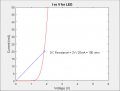
1764077765600.png


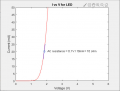
"Dynamic resistance" or "AC resistance" is dV / dI at the given V and I and will be different from "static resistance" V / I.

1764077817624.png

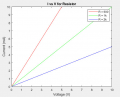
In the graphs above, the slope if the blue lines represent the reciprocal of the resistance, i.e. 1 / R, since the graphic depicts I / V.
Hence a steeper slope indicates a lower resistance.

1764078141334.png

Reference: https://forum.allaboutcircuits.com/ubs/why-you-need-a-series-resistor-when-driving-an-led.1651/
 

MrAl

Joined Jun 17, 2014
13,667
The slope of the V-I curve, dv/di, is the dynamic resistance or incremental resistance. The term resistance is used because of the units involved, not because it is "ohmic" on a small scale.

The impedance of reactive elements also has units of ohms, but that doesn't make them ohmic. Similarly, for the transimpedance of various devices and circuits.

Ohmic devices dissipate power in proportion to the square of the voltage across them and/or the current through them, while diodes are exponential with respect to voltage and closer to linear with respect to current.
I think the reason this comes up sometimes is because for a given operating point the power is that of an ohmic device.
Maybe this is better described in terms of energy. Some elements dissipate energy while others store energy.
For example, "AC resistance" dissipates energy even though it is dependent on frequency.

I was looking for a more general way to say this to distinguish from regular ohmic devices which puts them on some borderline. A way to describe them more quickly than the entire discussion of ohmic vs non-ohmic which goes on forever :)

It's ok if you want to go with the standard definitions.
 

MrAl

Joined Jun 17, 2014
13,667
For non-linear devices such as diodes, the following three equations still apply at a fixed point on the I-V relationship.

I = V / R
V = I x R
R = V / I

I use the term "static resistance" or "DC resistance".

View attachment 359465


"Dynamic resistance" or "AC resistance" is dV / dI at the given V and I and will be different from "static resistance" V / I.

View attachment 359466

In the graphs above, the slope if the blue lines represent the reciprocal of the resistance, i.e. 1 / R, since the graphic depicts I / V.
Hence a steeper slope indicates a lower resistance.

View attachment 359467

Reference: https://forum.allaboutcircuits.com/ubs/why-you-need-a-series-resistor-when-driving-an-led.1651/

Hi,

Yes, I don't disagree with any of that, I was just looking for a way to describe all of that in a nutshell so the meaning can be conveyed more quickly. It's hard to tell someone just starting out all of that.
 

MrChips

Joined Oct 2, 2009
34,627
I think the problem with Ohm's Law when characterizing a non-ohmic device is the proportionality between I and V in the equation,

I = V / R

Ohm's Law states that the current through a conductor is proportional to the voltage applied across the conductor and inversely proportional to its resistance.

Here we assume that R is constant. Since R is not constant the proportionality is no longer valid.
 

WBahn

Joined Mar 31, 2012
32,702
I think the reason this comes up sometimes is because for a given operating point the power is that of an ohmic device.
Huh?

The power is the voltage times current -- that's for any device.

Maybe this is better described in terms of energy. Some elements dissipate energy while others store energy.
For example, "AC resistance" dissipates energy even though it is dependent on frequency.
Huh?

The "AC resistance" of an ideal capacitor or inductor is its reactance. There's no energy dissipation involved, merely a conversion back and forth between forms.

I was looking for a more general way to say this to distinguish from regular ohmic devices which puts them on some borderline. A way to describe them more quickly than the entire discussion of ohmic vs non-ohmic which goes on forever :)

It's ok if you want to go with the standard definitions.
Not sure what borderline you are referring to. Or what a "regular" ohmic device is, which implies that there are ohmic decides that aren't regular.
 

MrAl

Joined Jun 17, 2014
13,667
I think the problem with Ohm's Law when characterizing a non-ohmic device is the proportionality between I and V in the equation,

I = V / R

Ohm's Law states that the current through a conductor is proportional to the voltage applied across the conductor and inversely proportional to its resistance.

Here we assume that R is constant. Since R is not constant the proportionality is no longer valid.
Yes, that's more or less the definition I go by, but there are gray areas when we talk to others about this.
I'm not sure if I want to get too deep into this again because I've had this conversation so many times and it takes a long time to get all the meanings out there. For example, the diode biased at a particular operating point. Is it ohmic then or not.
 

MrAl

Joined Jun 17, 2014
13,667
Huh?

The power is the voltage times current -- that's for any device.


Not really. That is only for some circuits. There are also:
P=i*v*cos(TH)
with TH the angle.
P(t)=V(t)*I(t)
instantaneous power varies with time.


Huh?

The "AC resistance" of an ideal capacitor or inductor is its reactance. There's no energy dissipation involved, merely a conversion back and forth between forms.
"AC resistance" is not the same thing as reactance. It is the resistance that is caused by an AC frequency in usually a conductor such as copper or aluminum.

Not sure what borderline you are referring to. Or what a "regular" ohmic device is, which implies that there are ohmic decides that aren't regular.
It might be hard to define this so we can skip it if you like.
I think we can call any ohmic device non-ohmic if we look deeper such as considering other parameters like temperature. If we accept that, then we'd have to eliminate the term 'ohmic' from our engineering vocabulary. Maybe that's the right thing to do instead of trying to come up with reasons why one thing is ohmic and another is not.

"Ohmic" is an idealized view of some properties, it is used when something varies in a very strict way which is ideally no variation. The strict view is that something is Ohmic when it obeys Ohm's Law, yet Ohm's Law is idealized itself.
What does this mean then.
It means that everything has to be defined according to a set of assumptions like constant temperature, voltage and/or current within some specific range, etc. So if there is really nothing really Ohmic, then we have to be sure the definition we are using is understood beforehand, which ironically, brings us back to square one where since the definition can vary, how do we nail it down.
If we say the device has to be 'linear' then we have to define linear, which means we are still in the dark because nothing is truly linear, it's still a concept. If we say "linear enough" then we are closer to the truth, but then we have to define what linear enough means in each context of the use of "Ohmic".

What this all means is that we have to be careful about how we use the term Ohmic I guess. I would think that we can use a default definition that the device in question has to approximately obey Ohm's Law within a LARGE part of its operating region. That's not to say that it cannot be Ohmic within a smaller subset of that region though, it seems.

How did we get onto this topic AGAIN anyway :)

Is there anything like:
[/DISCUSSION_ON_OHMIC]

ha ha.
 
Top