Current division for inductors

Thread Starter

Ramiel

Joined Feb 19, 2018
74
My eyesight isn't good enough to read that image. Try taking it again without the shadow across it and rotate it so that it can be read directly -- it's good practice to always try to make things easy for the people trying to give you free help.

Remember that when solving a differential equation the initial conditions either have to be given or there has to be additional information that can be used to determine them.

Take it step by step.

You have an inductor L1 that has a voltage, v(t), across it for all t >= 0 and has an initial current of i1(o) at t=0.

What is the current in this inductor, i1(t), at t > 0?

Give your answer in terms of v(t) and i1(0).
No inducter l1 does not have a voltage v(t), they are not parallel or am i wrong.
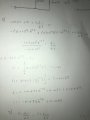
And here is the picture again. Ia m trying to first find the current entering both nodes

Ramiel_writings1.jpeg

Moderators note : cropped and enhanced image shown in full size
 

Attachments

Last edited by a moderator:

Thread Starter

Ramiel

Joined Feb 19, 2018
74
My eyesight isn't good enough to read that image. Try taking it again without the shadow across it and rotate it so that it can be read directly -- it's good practice to always try to make things easy for the people trying to give you free help.

Remember that when solving a differential equation the initial conditions either have to be given or there has to be additional information that can be used to determine them.

Take it step by step.

You have an inductor L1 that has a voltage, v(t), across it for all t >= 0 and has an initial current of i1(o) at t=0.

What is the current in this inductor, i1(t), at t > 0?

Give your answer in terms of v(t) and i1(0).
If the questiosn is as you said v(t) is parallel eith inductor 1, then it would be very easy but it is not
 

WBahn

Joined Mar 31, 2012
32,844
Focus here.

I pull an inductor, L1, off a shelf.

I put it into a circuit and let it run for a while.

At some point I start a clock and call that time t = 0.

I measure the current in L1 at t = 0 and call that I1(0).

I record the voltage across L1 for all time t >= 0 and call that v(t).

I give you the value of L1, the value of I1(0), and what v(t) is for all t starting at t = 0.

Can you determine what i1(t) is for all t >= 0 in terms of the information I give you?
 

Thread Starter

Ramiel

Joined Feb 19, 2018
74
Focus here.

I pull an inductor, L1, off a shelf.

I put it into a circuit and let it run for a while.

At some point I start a clock and call that time t = 0.

I measure the current in L1 at t = 0 and call that I1(0).

I record the voltage across L1 for all time t >= 0 and call that v(t).

I give you the value of L1, the value of I1(0), and what v(t) is for all t starting at t = 0.

Can you determine what i1(t) is for all t >= 0 in terms of the information I give you?
If i am given the voltage across l1, in your case v(t), i1(0), and the value of l1 then yes i would be able to do it. But it isnt the case here. Isnt it?
 

WBahn

Joined Mar 31, 2012
32,844
If i am given the voltage across l1, in your case v(t), i1(0), and the value of l1 then yes i would be able to do it. But it isnt the case here. Isnt it?
You keep asking about when you can and can't use that current division rule on two inductors in parallel. I explained why and you didn't follow it, so I am trying to walk you through, step by step, how to make that determination.

If you aren't interested in learning this anymore, just say so and I'll stop trying.
 

Thread Starter

Ramiel

Joined Feb 19, 2018
74
You keep asking about when you can and can't use that current division rule on two inductors in parallel. I explained why and you didn't follow it, so I am trying to walk you through, step by step, how to make that determination.

If you aren't interested in learning this anymore, just say so and I'll stop trying.
No I am with you I am not asking about any rule. I want to learn. i said yes i will be able to find i1(t) then, what i am saying is that in this case the voltage across inductor 1 is not v(t) as shown in the picture.
I really want to know how i can go through this question
 

Attachments

MrAl

Joined Jun 17, 2014
13,704
You are assuming that those equations are valid. They are NOT valid for the problem the TS is working with.
Hi,

Well maybe you would have to elaborate a little.
Did you try using that information to calculate the required expressions?
 

Thread Starter

Ramiel

Joined Feb 19, 2018
74
I
Hi,

Well maybe you would have to elaborate a little.
Did you try using that information to calculate the required expressions?
if i an able to find either i(0) or i2(0), i would be able to find the other using i= i1+ i2
But i am not able to find either
 

WBahn

Joined Mar 31, 2012
32,844
Hi,

Well maybe you would have to elaborate a little.
Did you try using that information to calculate the required expressions?
Just look at the solutions and you will see that your assumption that those equations work is wrong!

But let's assume they aren't.

You are claiming

i1=i*L1/(L1+L2)
and:
i2=i*L2/(L1+L2)

A direct consequence of this is that, at all time,

i2(t) = i1(t)·(L2/L1)

Since L1 = 6 H and L2 = 3 H, that means that

i2(t) = 2·i1(t)

What is i1(0)?

It is given that i1(t) = 0.6 A e^(t/0.5 s)

That means that i1(t=0) = 0.6 A.

Thus, you're claiming that i2(t=0) = 1.2 A

But we are also given that i(t=0) = 1.4 A.

Since

i(t) = i1(t) + i2(t)

i2(t = 0) = 1.4 A - 0.6 A = 0.8 A

Therefore, contrary to what you are assuming, those equations do not hold for this problem.

The reason why not is very simple and I have stated it repeatedly. I see no utility in stating it yet again -- go back and DO THE MATH!
 

Thread Starter

Ramiel

Joined Feb 19, 2018
74
Just look at the solutions and you will see that your assumption that those equations work is wrong!

But let's assume they aren't.

You are claiming

i1=i*L1/(L1+L2)
and:
i2=i*L2/(L1+L2)

A direct consequence of this is that, at all time,

i2(t) = i1(t)·(L2/L1)

Since L1 = 6 H and L2 = 3 H, that means that

i2(t) = 2·i1(t)

What is i1(0)?

It is given that i1(t) = 0.6 A e^(t/0.5 s)

That means that i1(t=0) = 0.6 A.

Thus, you're claiming that i2(t=0) = 1.2 A

But we are also given that i(t=0) = 1.4 A.

Since

i(t) = i1(t) + i2(t)

i2(t = 0) = 1.4 A - 0.6 A = 0.8 A

Therefore, contrary to what you are assuming, those equations do not hold for this problem.

The reason why not is very simple and I have stated it repeatedly. I see no utility in stating it yet again -- go back and DO THE MATH!
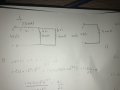
Can you check my attempt in post 28. I did the math but i cant find i2(0).
Any help?
 

Thread Starter

Ramiel

Joined Feb 19, 2018
74

Attachments

WBahn

Joined Mar 31, 2012
32,844
I only looked at the first one. I can make out the circuit with just a bit of effort, but I can't make out the first two lines of the work.
 

Thread Starter

Ramiel

Joined Feb 19, 2018
74
The firs
I only looked at the first one. I can make out the circuit with just a bit of effort, but I can't make out the first two lines of the work.
the first picture is only meants for the circuit
Look at the other pictures for the work
 

bertus

Joined Apr 5, 2008
22,925
Hello Ramiel,

The pictures have to less information to get them enhanced, as I did before.
Do you have a flatbed scanner?
My printer here at home has one.

Bertus
 

Thread Starter

Ramiel

Joined Feb 19, 2018
74
Hello Ramiel,

The pictures have to less information to get them enhanced, as I did before.
Do you have a flatbed scanner?
My printer here at home has one.

Bertus
Unfortunately i dont. You are not able to view the pictures clearly
 
Top