Crimp connector with hard insulation PVC - how am I supposed to crimp it?

Ian0

Joined Aug 7, 2020
13,306
WHEN YOU HAVE MADE A CONNECTION, GRAB IT WITH TWO HANDS AND GIVE IT A GOOD TUG TEST. If it stays, you win.
That's important.
Another thing that's easy to do, especially with thin wires, is get the wire in too far so that the metal part crimps on the insulation. It makes an excellent mechanical connection, but no electrical connection.
Stripping the wire to the correct length is important.
 

Thread Starter

dan_embedded_fun

Joined Aug 2, 2021
15
Thank you so much @bwilliams60 for your precious advice.

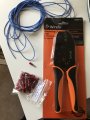
I've now got all the bits (see attachment).

It's try the crimping probably tomorrow.

The think I'm a bit worried about is that I've just realised the crimping tool says "for insulated nylon connectors", not PVC. I reckon nylon is stronger than PVC so it should work, hopefully. I don't think I'd damage the crimpers anyway. Or maybe I should get new crimp connectors with nylon insulation instead...
 

Attachments

Ian0

Joined Aug 7, 2020
13,306
I've seen the nylon ones. The PVC ones are the most common. The nylon ones seem to be an alternative which works with the same crimp tools. Are they the zero-halogen or low-smoke-and-fume option?
 

Ya’akov

Joined Jan 27, 2019
10,354
Thank you so much @bwilliams60 for your precious advice.

I've now got all the bits (see attachment).

It's try the crimping probably tomorrow.

The think I'm a bit worried about is that I've just realised the crimping tool says "for insulated nylon connectors", not PVC. I reckon nylon is stronger than PVC so it should work, hopefully. I don't think I'd damage the crimpers anyway. Or maybe I should get new crimp connectors with nylon insulation instead...
The tool is fine, those are the right dies. I use Wirefy brand terminals. Their products seem to be a very good value. The ones I use are heat shrinkable after crimping, which is nice. Practice on something sacrificial a couple of times so you get the hang of it, it's not hard.
 

shortbus

Joined Sep 30, 2009
10,049
@bwilliams60 Good list of things to do with crimp connectors, but think you missed one of the most important one whether they are insulated or not. Always make sure the crimp is on the correct side of the connector. Most crimpers have one side concave and one convex. The connectors themselves have one side that is where the hole for the wire is joined together when they are formed. You should always use the convex part of the jaw to crimp the unjoined side, to make sure the connector stays whole and doesn't split. The concave part of the jaw keeps the split from opening up. Or at least that's the way I was taught.

Seems like NAPA parts learned the same way. https://knowhow.napaonline.com/how-to-use-crimp-terminals-the-right-way/
 

Ya’akov

Joined Jan 27, 2019
10,354
Ratchet crimpers, like the ones on the tool the TS purchased, are symmetrical. The T&B style crimp, with the dimple, is really intended for uninsulated terminals and while many insulated terminals can tolerate it, some won't do well.

But certainly, if you are using a crimper like that, the point goes into the seamless side of the connector! That's important.

[EDIT: hit post too soon.]
 

MaxHeadRoom

Joined Jul 18, 2013
30,871
I use the Weidmuller products, I consider them the RR of hand tools, but usually out of reach, pricewise for the average user.
Page D16 shows the types of crimpers and the results of connectors followed in this thread.
 

Attachments

Thread Starter

dan_embedded_fun

Joined Aug 2, 2021
15
Just wanted to give you all an update. It is a bit disappointing maybe but I've returned the crimp unopened - I haven't used it at all.

The thing was that the female faston connectors I got didn't fit very well on the male - they were a bit loose - maybe it was a slightly different type.

In the end I've decided to go for uninsulated connectors that now fits perfectly. So I got a simpler single-die no-ratcheting crimp for those.

Thanks anyway for all your help - I've learned something new thanks to you
 

Ian0

Joined Aug 7, 2020
13,306
The thing was that the female faston connectors I got didn't fit very well on the male - they were a bit loose - maybe it was a slightly different type.
That’s par for the course - they often need to be tightened up with a pair of pliers to get a good fit. The blade thicknesses vary.
 
Top