Courtesy light delay dimmer project

Thread Starter

Rissy

Joined Nov 23, 2015
106
Hello out there.

I'm looking for a bit of assistance. I've been messing with a new project for the car. I'm trying to make a courtesy light dimmer from scratch as none of the pre-made stuff out there will suit my purpose. I'm aiming for making a PCB which i can enclose into a standard automotive relay shell and plug into the car as a plug and play item. There is a specific relay holder connection in play already, which i want to retain as is.

I've gotten quite far in, as I found a circuit online (in fact i found a few, but i've concentrated more on one, and had good results from it), but i have TWO problems. It's these two problems i'm hoping someone can help me wriggle free from.

PROBLEMS:
1. The LED's NEVER EVER fully go out, no matter what i try. If i put the ground path resistances up to high, so as to limit the drain current clearly keeping the LED's lit that little bit, then the circuit stops working properly.
2. The vehicle standard wiring has two diodes in circuit which stops cross contamination of other parts of the vehicle wiring and it's through these two diodes where the door switch completes the ground path for when the door it opened to make the courtesy lights come on. If i take these diodes out of circuit, the project works (all be it not fully putting the LED's out at the end of the dim operation), but with the diodes in play, the lights only go on and off according to door open/closed, and there is never any dimming!? I can't figure out why this is at all!? I obviously cannot remove these diodes, so i have to somehow work around this issue too.

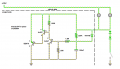
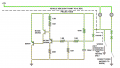
This is the circuit i have so far, but to be fair, if someone has a better one which they think will be better for my solution, then i'm open to changing tact no problem.

I made this video demonstrating what i've got (all be it for another audience than here) so maybe this will be of some use to demonstrate first hand...


Attachments

AnalogKid

Joined Aug 1, 2013
12,045
What is the DC voltage from the low side of the LEDs to GND when the LEDS are on? What is it after the delay period when they are mostly off?

Do the LEDs have internal current limiting?

Link to the original circuit?

ak
 

Thread Starter

Rissy

Joined Nov 23, 2015
106
What is the DC voltage from the low side of the LEDs to GND when the LEDS are on? What is it after the delay period when they are mostly off?

Do the LEDs have internal current limiting?

Link to the original circuit?

ak
Here's the link to the original circuit:

http://www.simplecircuitdiagram.com/1271-car-interior-light-extender/

I'd have to take some measurement to answer your questions i'm afraid.

The LED's are cheap chinese jobs, so i'd guess they'd be simple things, but to be honest i'm not sure how id even check for current limiting qualities.
 

Thread Starter

Rissy

Joined Nov 23, 2015
106
Okay dokey. Here's another video which should answer the questions being asked. I must add that I've made a mistake with my drawn circuit above. The 1.2M resistor is actually also a 1.5M resistor.

Link:


AnalogKid

Joined Aug 1, 2013
12,045
PROBLEMS: The LED's NEVER EVER fully go out, no matter what i try.
That is because at its heart, the circuit is not a power switch; it is an inverting linear amplifier complete with negative feedback. The current to run the circuit comes through the LEDs, and the LED current varies depending on the current to run the circuit. At some point an equlibrium is reached, where the current leaking through the LEDs is just enough to turn on the output transistor just enough to sink the leaking current through the LEDs. If that sounds a bit circular, it is; that's why it is called a feedback *loop*.

ak
 

sghioto

Joined Dec 31, 2017
8,633
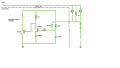
I breadboarded the circuit in post #1 and verified the problem. However by connecting the cathode of the 1N4148 to the high side of the door switch and adding a 10K resistor across the LEDs fixed the problem.
SG
EEE car dimmer.png
 
Last edited:

Thread Starter

Rissy

Joined Nov 23, 2015
106
Sghioto, thanks for your input and help! I really appreciate anyone's help with my puzzle.

Although your modification is an invalid one, because it means tampering with the existing vehicle wiring, it does perform to my requirements. So people can see it work, I made the following video of it quickly before I left for work this morning. Again, thank you for your help.

If anyone can suggest a solution which doesn't require interfering with the existing vehicle wiring, I'd be only too grateful to hear it.

Link:
 

sghioto

Joined Dec 31, 2017
8,633
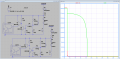
I had success with this modification. What's needed is to raise the turn on voltage of the first transistor by adding a diode in series with the emitter. Essentially the same as Bordodynov shows in his schematic using a BCX38B.
SG

EEE car dimmer.png
 
Last edited:

Thread Starter

Rissy

Joined Nov 23, 2015
106
There seems to be various ways of bringing the end current drain right down, in order to force the LED's to go almost right out, or completely out using a resistance in parallel with the LED's. This resistance inclusion would mean me having to literally "jam" in a resistor across one of the LED's in the car, as well as having the rest of the circuit within the proposed relay housing to plug in to the car. Not the best, but i could get away with that (i suppose), but the other problem i've got is those two diodes in circuit. sghioto suggested putting a diode from the internal circuit across to the output of the two inherent diodes, which i will admit solved the problem and allowed the dimming circuit to work, BUT, again, this would mean me putting in more wiring to the car to achieve this link, and moving away from the simple plug and plug philosophy. Is there no way around this? Is nobody able to rise to the challenge to figure out a way to fix this issue without moving away from my preferred plug and play philosophy?

I don't understand why these two diodes stop the rest of the circuit from operating as a dimmer!? Why is this?


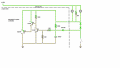
I'm having quite good results with the following:
 

Attachments

sghioto

Joined Dec 31, 2017
8,633
Obviously you have not tried my circuit in post #11. This will allow the dimmer to operate. The resistor does not have to be physically across the LED. You can connect the high side to any constant 12 volt source in the car.

 
I think part of the problem is that you have to treat the diode to the switch as an diode OR gate. Your circuit has to interface with a diode facing the same direction as the other one toward the switch. With LEDS, you can't rely on passing current in the reverse direction. If you had a switch to ground, a diode, an incandescent lamp connected to +12, you do have +12 with the door closed (switch open). With a LED, the +12 is blocked except for leakage current.

I did a headlights on reminder for an older car where I put a buzzer between the driver's door and the parking light +12 isolated with a diode. The car also had circuits isolated by a diode. So, buzzer went off when drivers door opened and lights were on.

LEDs pose a different problem. I upgraded the courtesy lamps to LEDs. Everything was OK until I upgraded the trunk lamp to a LED. the GM system would turn off the lights to the trunk, but when the trunk was closed and re-opened, the trunk was half bright.

To make it full bright, I would have to open and close a door.

the solution was?

Mount a power resistor in parallel with the trunk light. With all of the courtesy lights as diodes that posed an issue. I didn't look at the wiring diagram. I guessed at the appropriate resistor. Same lamp current as the original bulb. The resistor is above the deck and is a power package to reduce the temperature.
 

AnalogKid

Joined Aug 1, 2013
12,045
I don't understand why these two diodes stop the rest of the circuit from operating as a dimmer!? Why is this?
The two diodes form a 1.5 V voltage source, which is divided by the resistors to a lower voltage on the base of the first transistor. Low, but not low enough - when the lights are on, so is this transistor, and when this transistor is on, the transistor output is off. This is the exact opposite of what you want. What you want is for the output transistor to be on when the lights are on, in parallel with the door switch. Then when the switch opens, the circuit takes over holding the lights at full brightness (actually, a bit less because a darlington transistor does not saturate like a normal transistor). Then the output transistor slowly turns off as the capacitor charges up with current coming through the lights.

Bottom line, with those two diodes in place the circuit in post #1 will notwork as intended.

ak
 

Thread Starter

Rissy

Joined Nov 23, 2015
106
@ KeepItSimpleStupid & AnalogKid

Hmmm. I'm not as good at electronics as you guys. I just like dabbling now and then. It's difficult to understand.

Obviously you have not tried my circuit in post #11. This will allow the dimmer to operate. The resistor does not have to be physically across the LED.
sghioto, i DID try your circuit, but what it did was massively dimmed the LED's the second the "door" was closed, and it didn't dim through a long enough period either. The dimming effect also didn't work again through those diodes. Unless i did something wrong wiring it, it didn't suit.

You can connect the high side to any constant 12 volt source in the car.
Yes, i appreciate this, but the simplest place to do that would be within the LED housing in the roof of the car.

-----

I'm not sure what to do to achieve my goal now. I guess face the music of altering the car wiring....?
 

sghioto

Joined Dec 31, 2017
8,633
You must have connected something wrong the circuit holds the LED on and slowly dims out after about 15 seconds. How much time do you need? You can change the value of the 100uf cap to lessen or extend the delay time and yes it works using the two diodes as you have described.
SG
 

Thread Starter

Rissy

Joined Nov 23, 2015
106
Okay, thanks. I'll have to check again. Rebuild it and i'll video it for you. (do you enjoy the video's? Bit more entertaining than reading? :)
 
Top