Coupling Capacitors

MrAl

Joined Jun 17, 2014
13,711
Just to add a little here...

We don't usually use the coupling capacitor value to limit the input signal because for one reason I don't think you can actually do that in theory unless the frequency is limited already. If we did need a limit, we'd use a resistor in series or just design the input stage a little differently.

The input impedance works with the coupling capacitor as part of the high pass filter the two create (shown in other posts in this thread). If there is a previous stage, then the output impedance of that stage also affects the response and therefore factors in with the required value of the capacitor. If there is no previous stage then the output impedance of whatever does drive the input also plays in with the response of the resulting high pass filter.

So the impedance both before and after the capacitor play in with the required value of the capacitor.
We could do some calculations with some simple examples if anybody feels up to it.
 

rod-e

Joined Jun 17, 2016
22
well it has occurred 2-ce or 3-ce with huge gain or at upper banwidth of the transistor

the point is that the BE junction is a diode that will act sort of as a current pump (nonlinear)

means - your working point varies with frequency

if there is relatively large change at frequency - the working point needs to adjust a considerable step which (while running near the capabilities of the amplification stage) would distort the DC bias of the output temporarily

((if there is no willing to understand things - it does not matter how well something is described))
This claim might make some sense if the input is overdriven and the output becomes a squarewave, but with linear operation it doesn't happen. There's no sign of it in the linked simulation - the frequency changes but nothing untoward happens. The whole idea of linear circuits is that they ARE linear, and if operated outside the linear area then unexpected things may occur.
 

Thread Starter

sirwattsalot

Joined Oct 4, 2025
23
I have been studying and researching this for a while now and I have come across this a couple or so days ago. I have come across the formula for input capacitance for the common emitter amplifier. Xc< or 0.1×Zin or Rin. The formula for Zin for the voltage divider bias of the common emitter amplifier: Zin=R1||R2||Zin(base). Zin(base) is hfe(r'e + Re) without a bypass capacitor . With a bypass capacitor to bypass the emitter resistor RE is hfe×r'e.
Thank you for your help yeah I know about this temporal clipping about the two large coupling capacitance. Thank you for the response and this brings up another question, would you please tell me what are frequency jump points?
 
Last edited:

ci139

Joined Jul 11, 2016
1,995
Only possibly when near the capacitor low-pass rolloff frequency.
I'm quite willing to understand.
It's your description that makes little sense.
there are various cases where the output goes unstable - but - for a simplicity lets take a one in particular - a non-audio CE bjt amp. stg. where the output is a square wave - linearity is not expected , just the near R2R square wave a fixed frequency ← the working point has extremely tight bounds near upper BW - it's an exceptional case but if you choose too large input capacitor the the working point starts floating or drifting if you choose too little the ouput wont be a square wave . . . you can come up with all sort of irrelevant excuses why such is a bad example - but the truth remains = it's an CE amp within operational bounds of the bjt -- ? rarely used . . . perhaps . . . but then what = using a hig speed narrow voltage range comparator with 700x retail price or the single bjt is of course more viable option ? isn't it . . .
 

MrAl

Joined Jun 17, 2014
13,711
I have been studying and researching this for a while now and I have come across this a couple or so days ago. I have come across the formula for input capacitance for the common emitter amplifier. Xc< or 0.1×Zin or Rin. The formula for Zin for the voltage divider bias of the common emitter amplifier: Zin=R1||R2||Zin(base). Zin(base) is hfe(r'e + Re) without a bypass capacitor . With a bypass capacitor to bypass the emitter resistor RE is hfe×r'e.
If you know Zin of the next stage and Zout of the previous stage then you would find that if we set R1=Zin and R2=Zout:
w0=1/(C*(R2+R1))
and
Amplitude=Vin*(w*C*R2)/sqrt(w^2*C^2*(R2+R1)^2+1)

This relates the input voltage signal to the signal at the right side (output) node of the capacitor.
Once knowing the voltage you should be able to work out what the current to the next stage is if you need that.

Zin (R1) acts as the output resistance of the previous stage, and Zout (R2) acts as the shunt resistance equivalent of the next stage.
The capacitor (C) is in series with R1.
It's a simple high pass filter with an extra resistor R1 in series with C.
 

Thread Starter

sirwattsalot

Joined Oct 4, 2025
23
I have been studying and researching this for a while now and I have come across this a couple or so days ago. I have come across the formula for input capacitance for the common emitter amplifier. Xc< or 0.1×Zin or Rin. The formula for Zin for the voltage divider bias of the common emitter amplifier: Zin=R1||R2||Zin(base). Zin(base) is hfe(r'e + Re) without a bypass capacitor . With a bypass capacitor to bypass the emitter resistor RE is hfe×r'e.
A formula for the input coupling capacitor in relation to the input impedance of the common-emitter amplifier with voltage divider bias C=1/(2π×fclow×Zin×0.1).
But what does input impedance have to do with it. Are there other formulas that relate to this?
 
Last edited:

LvW

Joined Jun 13, 2013
2,030
But what does input impedance have to do with it. Are there other formulas that relate to this?
Did you read (and remember) my answers in post#5 and post#15 ?
In these contributions I have given an answer to your question above.

More than that: Do you know the background for the factor 0.1 in your formula?
 

Thread Starter

sirwattsalot

Joined Oct 4, 2025
23
I have been studying and researching this for a while now and I have come across this a couple or so days ago. I have come across the formula for input capacitance for the common emitter amplifier. Xc< or 0.1×Zin or Rin. The formula for Zin for the voltage divider bias of the common emitter amplifier: Zin=R1||R2||Zin(base). Zin(base) is hfe(r'e + Re) without a bypass capacitor . With a bypass capacitor to bypass the emitter resistor RE is hfe×r'e.
If you know Zin of the next stage and Zout of the previous stage then you would find that if we set R1=Zin and R2=Zout:
w0=1/(C*(R2+R1))
and
Amplitude=Vin*(w*C*R2)/sqrt(w^2*C^2*(R2+R1)^2+1)

This relates the input voltage signal to the signal at the right side (output) node of the capacitor.
Once knowing the voltage you should be able to work out what the current to the next stage is if you need that.

Zin (R1) acts as the output resistance of the previous stage, and Zout (R2) acts as the shunt resistance equivalent of the next stage.
The capacitor (C) is in series with R1.
It's a simple high pass filter with an extra resistor R1 in series with C.
Okay for multi-stage amplifiers which would be the practical application to input impedance and output impedance. I was just thinking about input impedance of the amplifier in general. I have not worked with angular frequency applications of yet. I have something to learn about this, and applying vectors as well. Thank you for your help. Appreciate it
 

Thread Starter

sirwattsalot

Joined Oct 4, 2025
23
Did you read (and remember) my answers in post#5 and post#15 ?
In these contributions I have given an answer to your question above.

More than that: Do you know the background for the factor 0.1 in your formula?
The factor of 0.1 of Zin according to my understanding is to minimize low frequency attenuation and to prevent phase shift. So that the Xc is sufficiently low at fclow. This is for common emitter audio amplifiers.
 
Last edited:

Thread Starter

sirwattsalot

Joined Oct 4, 2025
23
Did you read (and remember) my answers in post#5 and post#15 ?
In these contributions I have given an answer to your question above.

More than that: Do you know the background for the factor 0.1 in your formula?
Okay. I understand where you're coming from now. Thank you
 

Thread Starter

sirwattsalot

Joined Oct 4, 2025
23
What remains is to know if both resistances forming Reff are to be considered in series or in parallel.
For an answer, the easiest way is to consider the discharging process for the capacitor (resp. the corresponding current).
You only have to ask yourself: Which resistor combination is seen by the capacitor during discharging?
T=R2×Cc=10kohm×10uF=0.1. R2
Is this correct? R2 of the voltage divider bias?
 

LvW

Joined Jun 13, 2013
2,030
T=R2×Cc=10kohm×10uF=0.1. R2
Is this correct? R2 of the voltage divider bias?
No - it is not correct.
In post#5 I have defined a resistor Reff which determines the time constant T=Refff*C.
This quantity Reff is the effective resistance through which the cap C can be discharged.
Obviously, this the series combination of the source resistance Rs (if existent)and the input resistance of the complete transistor stage r_in.
This dynamic resistance (therefore "r" instead of R") is
r_in=R1||R2||rb
with voltage divider bias resistors R1, R2 and the transistors dynamic input resistance rb at the base terminal.

This resistance rb is the sum of h11=hie (depends on the chosen DC operating point) and the effective external resistance Re in the emitter path - effective for the signal frequency (Re paralleld with Ce yes/no).
This external resistance causes signal feedback an must be multiplied with the current gain beta.
 

MrAl

Joined Jun 17, 2014
13,711
Okay for multi-stage amplifiers which would be the practical application to input impedance and output impedance. I was just thinking about input impedance of the amplifier in general. I have not worked with angular frequency applications of yet. I have something to learn about this, and applying vectors as well. Thank you for your help. Appreciate it
Hi,

Oh with this math you just have to replace 'w' with 2*pi*f then you have the whole thing in terms of frequency 'f' in Hertz as usual.
So this:
1/(w^2+1)

turns into this:
1/[(2*pi*f)^2+1]

and now the whole thing is in frequency 'f' in Hertz.
 

Thread Starter

sirwattsalot

Joined Oct 4, 2025
23
Hi,

Oh with this math you just have to replace 'w' with 2*pi*f then you have the whole thing in terms of frequency 'f' in Hertz as usual.
So this:
1/(w^2+1)

turns into this:
1/[(2*pi*f)^2+1]

and now the whole thing is in frequency 'f' in Hertz.
yeah, that makes sense. Thank you.. and thanks for pointing out on #25 about knowing the Zin of the next stage and the Zout of the previous stage and thanks for the equations for the 'amplitude' the next stage. I got something to work with... I'm going to have to build a two-stage amp on my breadboard, do the measurements and see if it matches up with the math.
 
Last edited:

MrChips

Joined Oct 2, 2009
34,830
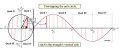
You might find this visualization useful.
Imagine a point on the circumference of a circle.
The circle rotates in a counter clockwise direction with an angular velocity ω radians per second.

The perpendicular distance of the point from the x-axis is
y = r sin θ
or
y = sin θ
where the radius r = 1.

The projection of the point describes a sine wave as shown.
The frequency of the sine wave is f cycles per second.

Every time the point rotates once around, it goes through 2π radians.
Thus the angular velocity ω = 2πf radians per second.

1778943708571.jpeg

It is easier to remember the following.
The reactance of an inductor L is ωL, i.e. reactance of L increases with frequency and inductance.
The reactance of an capacitor C is 1/ωC, i.e. reactance of C decreases with f and C.

For LC resonant circuit, resonance occurs when the two reactances are equal.
ωL = 1/ωC
Hence, the resonant frequency squared is
ω^2 = 1/(LC)
 

MrAl

Joined Jun 17, 2014
13,711
yeah, that makes sense. Thank you.. and thanks for pointing out on #25 about knowing the Zin of the next stage and the Zout of the previous stage and thanks for the equations for the 'amplitude' the next stage. I got something to work with... I'm going to have to build a two-stage amp on my breadboard, do the measurements and see if it matches up with the math.
Hi,

Oh you are welcome.

There is one more tiny detail but you probably don't have to consider it. It comes from the fact that Zin and Zout are not always the same as Rin and Rout.
Rin and Rout are strictly resistances, but Zin and Zout can be complex impedances.

For example, if Zin=10000 Ohms and Zout=1000 Ohms then they are strickly resistances and the formula works accurately in theory.
If Zin and/or Zout are complex then they might be Zin=10000+2000*j and Zout=1000-500*j or something like that.
That should only happen if there is already some capacitance and/or inductance involved in the input and/or output so you may not have to worry about it, just something to keep in mind. I think a lot of designs just go by Rin and Rout.
 

MrChips

Joined Oct 2, 2009
34,830
Note that while the units of reactance is ohms, you cannot simple add resistance and reactance.

For example, suppose C and R are in series.
The total impedance is not R + 1/ωC.

The impedance is written as
Z = R + j/ωC

The j signifies that the reactance 1/ωC is 90° out of phase.
You can use phasor analysis to calculate the amplitude and phase of the combination of R and C.

Correction:
Z = R + 1/jωC
Z = R - j/ωC
 

LvW

Joined Jun 13, 2013
2,030
The impedance is written as
Z = R + j/ωC
The j signifies that the reactance 1/ωC is 90° out of phase.
You can use phasor analysis to calculate the amplitude and phase of the combination of R and C.
Small correction: 1/jwC=-j/wC.
 
Top