Counting Timer with reset

Thread Starter

Trailer

Joined Jan 22, 2023
85
Still no schematic, so this might be wrong. A 555 astable circuit powers up with the output in the high state . . .

1. Is this a requirement for the replacement circuit? I ask because after a POR, the CD4060 powers up with all outputs in the low state.

2. How much current does the power switch have to switch?

My preliminary schematic is ready; just waiting to see what you have.

ak
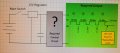
I may have badly expressed the required, hope the attach diagram explains it better.
 

Attachments

Thread Starter

Trailer

Joined Jan 22, 2023
85
Keyword- "pulse counter , CMOS " . When 4 pulses are counted, the counter halts oscillator based on 555' timer.

By the way, it's not a good idea to build an astable oscillator with such a low frequency on the 555' . Much better if oscillator works at tens of hertz, and after frequency is divided . CD4017' will do the job. And a lot of other pulse counters.

Or a microcontroller can perform all the job
I may have badly explained the requirements, hope the attached diagram explains it better. Also please take a look at my other replies
 

Attachments

ElectricSpidey

Joined Dec 2, 2017
3,334
Does the timing begin as soon as the power is applied? yes/no

Is it ok if the first on period is a few seconds longer that the rest? yes/no

Do you need the on times and the off times to be separately adjustable? yes/no

What task is being performed during the "on" time?

Also please state your preference for the reset...

Power switch
Push button reset
Both
 
Last edited:

AnalogKid

Joined Aug 1, 2013
12,128
If the 15 volt supply will stay on, then the solution is fairly simple. use a CD4017 counter IC to count the pulses, and when the count of 4 is reached then the output switches off the power mosfet.
OR, since the TS already has a power switch controlled by the 555, leave that in place. Take the 4017's 5 output (the 4017 resets into the "1" state) through a 2N7000 small MOSFET as an inverter, and connect the drain to the 555 Reset input. The same method will work with a 4-bit binary counter, using the Q2 output.

4017
R and C power for on reset
2N7000
Resistor to pull up the 555's Reset input
Cap for 4017 supply decoupling

Note: to have the 4017 change state on the 555's negative-going edge, use the 4017's Enable input as the clock input, and tie the Clock input to Vcc.

ak
 

ElectricSpidey

Joined Dec 2, 2017
3,334
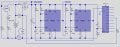
Here is a revised circuit.

Timer starts when power applied, and ends when 4 cycles complete, restarts with power cycle.
First half cycle time corrected with crutschow's mod.
Text showing how to use VR for adjustable times.
Task is still unknown.
Method shown to reset with NO Push button. (without power cycle)
Entire time must expire before Reset Button can be used including the final "off" period.
LED is connected directly to the battery thru the second NC relay contact. (with appropriate drive circuit, a resistor I would guess)

Let me know if you think this might do what you want and ask any questions.

Always be sure to breadboard any circuit before making permanent build.

555_4017_Reset_3.JPG

EDIT...I'm working on that final 15-minute issue...will get back....
 
Last edited:

MisterBill2

Joined Jan 23, 2018
27,514
The CD4017scheme will work even with an electromechanical pulser device like a gearmotor, cam, and switch. With the addition of a logic inverter it could even drive an MPSA13 transistor to control a solid state power relay. I suggest that device (MPSA13) because it is a darlington that can be driven directly from a CMOS logic output.
 
Last edited:

ElectricSpidey

Joined Dec 2, 2017
3,334
Ok, I worked out the last 15 minutes problem, but I need to know what is the minimum time that you need between resets.

There is a problem with the trick used to equalize the on times.
 

ElectricSpidey

Joined Dec 2, 2017
3,334
Solving the equalized on times issue with the single 555 in astable mode became very convoluted, so I shifted gears and changed my approach.

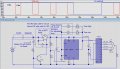
So here is my final attempt at a "simple" 555 interval timer.

AAC_Interval_Timer_Wav.JPG
AAC_Interval_Timer_Sch.JPG

The PMOS is just the first one in the list, so it is just used in the sim...choose as needed. (also the LED)

R1 & R3 are the resistors that will need to be replaced with a VR and limiting resistor for adjustable on and off times.

V1 represents the switch, regulator and battery in the OP's image.

This circuit is what it is...a 555 based long time interval timer, so the accuracy is going to be what you would expect with a 555 long time timer.

If high accuracy is needed, I would suggest using a commercially available digital interval timer module with non-volatile memory and add the external components as needed.

EDIT: Edited the schematic to include the reset button.

Please note the reset button will not restart the cycle before the time ends. To restart the cycle before the time ends use the power switch.
 
Last edited:

MisterBill2

Joined Jan 23, 2018
27,514
Unfortunately, using the "Q4" output will do the reset on the start of the fourth pulse. That is why I suggested using the clock enable input. It is an effective cheap trick to advance the counter on the falling edge of a signal.
And I am wondering, based on pst #1, if the TS had aleady had the long pulse generation part working adequately, in which case, why change it???
 

AnalogKid

Joined Aug 1, 2013
12,128
Agree. The original task is to look at the 555 trailing (negative-going) edge with a counter. On the 4th one, drive the 555 Reset input low. You can do this with either a 4017 (driving the Clock Enable input per post #47) or a 4-bit binary counter with a negative-edge clock input, plus an inverting transistor. Using a FET eliminates one resistor.

I started out proposing replacing the 555 with a CD4060 oscillator/divider, but the TS made it clear that the required output duty cycle is 67%. While decoding that is not difficult, the increased parts count is worse than the benefits of a much higher oscillator frequency, especially since the TS is happy with his current oscillator circuit's performance.

ak
 

MisterBill2

Joined Jan 23, 2018
27,514
So it can be done with a CD4017, although it seems that it will need an inverter. The slick trick is that to restart the operation resetting the 4017 will do it.
That is about as simple as it can be. The one caution I offer is that the timing with the 555 will be affected by noise on the power supply , as well as voltage variations. And temperature may have an effect as well.
So attention to those details is important.
I have seen systems that used the 555 for even longer time delays, they did use higher quality timing components though.
 

ElectricSpidey

Joined Dec 2, 2017
3,334
The main issue is getting that first "on" time to be the same as the other 3.

I solved that issue with crutschow's trick...but this resulted in different issues, after that it was like playing Whack-A-Mole.
 

AnalogKid

Joined Aug 1, 2013
12,128
One of the reasons I like the CD4060 for long delays is that even though its oscillator has the same first-half-cycle issue, it is trivial compared to the output periods of the higher stages.

ak
 

Thread Starter

Trailer

Joined Jan 22, 2023
85
Here is a revised circuit.

Timer starts when power applied, and ends when 4 cycles complete, restarts with power cycle.
First half cycle time corrected with crutschow's mod.
Text showing how to use VR for adjustable times.
Task is still unknown.
Method shown to reset with NO Push button. (without power cycle)
Entire time must expire before Reset Button can be used including the final "off" period.
LED is connected directly to the battery thru the second NC relay contact. (with appropriate drive circuit, a resistor I would guess)

Let me know if you think this might do what you want and ask any questions.

Always be sure to breadboard any circuit before making permanent build.

View attachment 296386

EDIT...I'm working on that final 15-minute issue...will get back....
Thanks and apologies for late response.. I'll test your proposal and let you know while awaiting your suggestions on that final 15 minute issue.
Any estimate of the voltage drop across the entire circuit?
 
Last edited:
Top