Coop door

Thread Starter

Wireingfire

Joined Oct 30, 2024
5
I have a 12 V ram that I want to use to push open my chicken coop door and then at night it will pull it closed. I bought a timer. I bought a relay. I bought an auto reversing relay and tried to wire it through the timer. I would prefer some type of photo I, but then I run into the problem. It feeds power to the motor. So it opens the door stops with the limit switch and then I haven’t been able to figure out how to reverse the motor one way positive negative then negative positive going the other way it’s negative and positive what am I missing? Trying to flip-flop the motor lead to make it do what I want to do. What am I missing?
 

sghioto

Joined Dec 31, 2017
8,634
OK finally a chicken coop door project. Haven't seen one posted in a while. LOL:)
Seriously though can you post a link to these relays and timer?
 
Last edited:

AnalogKid

Joined Aug 1, 2013
12,128
A problem with an electric eye signal is that it usually changes very slowly, and relays do not like slowly increasing or decreasing coil voltages - it makes the contacts chatter. Better to run the signal through one or two comparators driving two SPDT relays through a pulse circuit. What is your skill set for something like this?

ak
 

Thread Starter

Wireingfire

Joined Oct 30, 2024
5
A problem with an electric eye signal is that it usually changes very slowly, and relays do not like slowly increasing or decreasing coil voltages - it makes the contacts chatter. Better to run the signal through one or two comparators driving two SPDT relays through a pulse circuit. What is your skill set for something like this?

ak
Enough to know not to put two wires together get the shit knocked out of you lol I’ve got a DC ram that when you hook it to a battery, it moves out and then the limit which stops it and then when you flipped the polarity of the wires on the power source, then the motor goes the other direction I’ve tried using a reversing relay, but the problem being is my motor is only a positive and negative. I haven’t been able to figure out how to control that relay. I’ve tried using a double pole. Single throw relay trying to wire the motor using both sides normally open and normally closed and I got a little timer that I pulled out of my deer feeder. and I can set the time for us to come on at a certain time as many times as I want, but I just hadn’t figured out how to use that little timer to make it go into reverse with the relays. What am I missing?
 

Thread Starter

Wireingfire

Joined Oct 30, 2024
5
A problem with an electric eye signal is that it usually changes very slowly, and relays do not like slowly increasing or decreasing coil voltages - it makes the contacts chatter. Better to run the signal through one or two comparators driving two SPDT relays through a pulse circuit. What is your skill set for something like this?

ak
Enough to know not to put two wires together get the shit knocked out of you lol I’ve got a DC ram that when you hook it to a battery, it moves out and then the limit which stops it and then when you flipped the polarity of the wires on the power source, then the motor goes the other direction I’ve tried using a reversing relay, but the problem being is my motor is only a positive and negative. I haven’t been able to figure out how to control that relay. I’ve tried using a double pole. The photo I hung me up and was only able to get it to go one way and could not reverse so then I got a 12 V 24 hour time clock like what’s in a deer feeder since voltage only runs one direction. I have the issue of reversing the motor.
 

Thread Starter

Wireingfire

Joined Oct 30, 2024
5
OK finally a chicken coop door project. Haven't seen one posted in a while. LOL:)
Seriously though can you post a link to these relays and timer?
It’s a lot harder than I thought with all the time money and burn up switches and motors over the last year. I could’ve went to the chicken coop factory and just bought one and been done with it. But my kids showed interest in this so we’ve been trying to build it together.
 

sghioto

Joined Dec 31, 2017
8,634
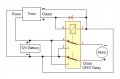
This is the setup I believe you are looking for.
The relay does the job of reversing the voltage to the motor and is shown deactivated, door closed.
The 12 volts from the timer activates the relay coil to open the door.
I still need to confirm the operation of the timer, can you post the model # or a link?
1730340920482.png
 
Last edited:

MisterBill2

Joined Jan 23, 2018
27,513
This is the setup I believe you are looking for.
The relay does the job of reversing the voltage to the motor and is shown deactivated, door closed.
The 12 volts from the timer activates the relay coil to open the door.
I still need to confirm the operation of the timer, can you post the model # or a link?
View attachment 334763
The circuit in post #8 is exactly what I was going to suggest!!! Thank You to
sghioto !! Now I don't need to draw it somehow.
 

sghioto

Joined Dec 31, 2017
8,634
The circuit in post #8 is exactly what I was going to suggest!!! Thank You to
sghioto !! Now I don't need to draw it somehow.
Appreciated that but that circuit only works if the Timer output stays at 12 volts when ON.
The TS mentioned using a Timer from a deer feeder which stays ON for a maximum of 30 seconds only. :confused:Other disadvantage is the relay coil being energized all day waste battery power.
I have an analog and a micro circuit design using that feeder timer that draws current from the battery only when activated to power the motor but probably beyond the TS interest and skill.
 
Last edited:

MisterBill2

Joined Jan 23, 2018
27,513
OK, now the secondary problem is clear. Likewise the solution becomes defined as well.

The solution is to use two relays, one to drive in each direction. THAT circuit has also been presented in this forum many times. The difference will be to add a latching contact to each relay, to keep it actuated after the initial trigger pulse has ended, and then to release the latch after the "reversible DC ram" has reached it's motion's end and been switched off by it's internal limit switch.

This can be most conveniently by means of a current sensing relay having a normally open contact that will operate when the motor is drawing current. This contact would be in series with the latching contact of the drive relay, so it will only need to carry the relay coil current. It may be simpler for the current sensing relay to have two normally open contacts, one for each direction.

The current sense relay might possibly be created by wrapping wire around a glass reed switch, although that is a scheme I have not experimented with, so my only useful advice in that direction is that the wire needs to be adequate for the expected current, and the reed relay needs to be long enough to be affected by the resulting magnetic field. Thus the smallest and cheapest reed switch will probably not be suitable for the application.
 

sghioto

Joined Dec 31, 2017
8,634
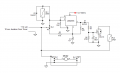
This is my analog circuit using a deer feeder Timer set for a 10 second 12 volt output once in the morning and evening.
10 seconds is just an arbitrary number assuming the motor requires 8 seconds to open or close the coop door.
It uses two relays, RL1 to reverse the motor connections and RL2 to steer the output of the Timer to the proper input.
Initially all relays and the output from the 555 are OFF
When the Timer activates in the morning it sends 12 volts directly to the motor for 10 seconds opening the door.
At the same time the 555 output goes High and is latched by R3.
C2, R4 and R5 provide a 15 second delay that prevents RL2 from activating during the 10 second output from the Timer.
After the 15 second delay Q1 is energized and C2 continues to charge to appx 3.8 volts.
In the evening when the Timer activates for another 10 seconds, RL2 is immediately activated and switches 12 volts to RL1 reversing the motor connections to close the door and to reset the 555.
RL2 remains energized as C2 now slowly discharges through R5 keeping Q1 ON for the remainder of the 10 second Timer output.
At the end of the 10 second output RL1 and RL2 drop out and the circuit is ready for the next Timer activation in the morning.
Standby current drain less then 300ua.
1730600981740.png
 

MisterBill2

Joined Jan 23, 2018
27,513
A problem with an electric eye signal is that it usually changes very slowly, and relays do not like slowly increasing or decreasing coil voltages - it makes the contacts chatter. Better to run the signal through one or two comparators driving two SPDT relays through a pulse circuit. What is your skill set for something like this?

ak
All of the last dozen "Electric Eye" sensors that I have installed have switch contacts that snap open and closed. The resistance changes slowly, the output does not.
 

crutschow

Joined Mar 14, 2008
38,504
relays do not like slowly increasing or decreasing coil voltages - it makes the contacts chatter.
Usually that's not a problem. The large hysteresis of a typical relay, coupled with the snap action of the contacts when they open or close, eliminates any contact chatter above the normally contact bounce.
 

AnalogKid

Joined Aug 1, 2013
12,128
snap action of the contacts
Not sure about that. For a simple armature action like this one, there is no mechanical hysteresis. Granted chatter is a more common issue with AC coils, but still ... Maybe for a DC coil call it an extended higher-resistance contact period.

ak


1736008083842.png
 

MisterBill2

Joined Jan 23, 2018
27,513
Certainly it will be possible to use a commonly available mains powered commercially avaiable sensor for a mains powered system.
My concern is that this system, like most of the other chicken coop systems, is battery powered and thus is a whole different set of priorities. Post #4 mentions battery power with no mention of mains availability.
So we are all guessing.
A bit of a search for the solutions provided in the other threads may offer a simple reference to a previous solution. So I suggest that approach before more guessing.
 

Alec_t

Joined Sep 17, 2013
15,118
Apart from electrical concerns there are mechanical issues to consider for coop door projects. Avoiding guillotining chickens, and overcoming friction due to chicken crap in the mechanism, are two examples.
 

MisterBill2

Joined Jan 23, 2018
27,513
Apart from electrical concerns there are mechanical issues to consider for coop door projects. Avoiding guillotining chickens, and overcoming friction due to chicken crap in the mechanism, are two examples.
The best "coop door" solution that I recall used a small motorized hoist to raise and lower a lightweight coop door.
Certainly the other issues are important considerations.
 

crutschow

Joined Mar 14, 2008
38,504
For a simple armature action like this one, there is no mechanical hysteresis.
Not sure what "mechanical hysteresis" is.
I was referring to the electrical hysteresis of the coil voltage, I.e the large difference between the contact closing voltage and the opening voltage.
That causes a snap action of the wiper movement.
The speed of that movement is not largely affected by how fast the coil voltage changes.
 
Top