Converting Pseudo-Differential Digital signals

Thread Starter

Pinski1

Joined Nov 15, 2024
7
I have ~5 meters of differential pair carrying a digital signal and the gnd/0V for that signal. There is significant noise on both the digital signal and the gnd/0V for that signal. This cable runs 'backwards' in the system and so directly connecting this signal gnd to the local gnd leads to a nasty ground loop. This signal is DISABLE and is pulled via a 1kΩ to +3V3 at the source and via 100kΩ to +3V3 at it's 6x destinations.

The pull up at both ends ensure that should a cable break, or we have a disconnection then the signal will idle high/+3V3 which signals an active DISABLE. The source of the signal has a MOSFET to pull DISABLE to gnd to signal that it is now ACTIVE. This is a safety signal and I'm very keen to maintain this functionality.

If we use an opto-isolator then a disconnected or damaged cable will result in the LED being unpowered and the system defaulting to ACTIVE.
I was hoping I could some how make a pseudo-differential receiver that would tolerate the ~1.5Vpk noise I'm seeing on the signal and it's gnd.

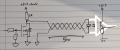
Screenshot 2024-11-18 114149.png

I want the right hand side output to be high/+3V3 for all situations (cable disconnected, individual wires broken, idling high) except when the left hand MOSFET actively pulls the DISABLE signal to the remote gnd/0V when I want the output to go to low/0V.
 

BobTPH

Joined Jun 5, 2013
11,466
If we use an opto-isolator then a disconnected or damaged cable will result in the LED being unpowered and the system defaulting to ACTIVE.
The output of an opto isolator can be wired to be either high or low when the LED is powered.
 

BobTPH

Joined Jun 5, 2013
11,466
That wouldn't work as disconnected would be the same as ACTIVE, both would have the LED unpowered.
Active is either high or low in your system. You can make it either when the LED is off. Disconnected will result in LED off.

Because of the current required to light an LED it is also very immune to noise. It is unlikely your wiring will pick up enough noise to light LED.
 

ericgibbs

Joined Jan 29, 2010
21,395
Hi Pin,
Is the noise a differential noise on the twisted pair, or is it referenced to 0v?

Usual practice is not to connect the cable shielding to 0V/Gnd at both ends.
E
 

Thread Starter

Pinski1

Joined Nov 15, 2024
7
>Active is either high or low in your system.
Sorry if I've been unclear, ACTIVE is when the MOSFET is on, shorting the two wires together. There is no way to have an LED light when the wires are shorted and still have isolation.

>Is the noise a differential noise on the twisted pair, or is it referenced to 0v?
Referenced to the local 0V I'm getting ±1.5V noise swings on the DISABLE wire and the remote 0V wire. Currently the 0V wire is directly connected to the local 0V, which is then causing ±3.0V swings in the DISABLE wire as it goes into an SN74LVC1G17 buffer.
I can disconnect the 0V wire, but I would still get ±1.5V swings which would be enough to trip the Schmitt trigger buffer rising and falling. The cable does not have shielding, this 0V wire was intended as a ground reference.
 

BobTPH

Joined Jun 5, 2013
11,466
Active is either high or low in your system.
Sorry if I've been unclear, ACTIVE is when the MOSFET is on, shorting the two wires together. There is no way to have an LED light when the wires are shorted and still have isolation.
You clearly have no clue what I am talking about.

Show me your circuit with an opto and I will explain to you how to rewire it to be not active when the LED in the opto is disconnected.
 

Thread Starter

Pinski1

Joined Nov 15, 2024
7
No I don't. I think it'd be better if you drew the circuit, but here's my attempt.Screenshot 2024-11-18 114149 2.png

I know I can swap the photo-transistor and resistor to make the output active high or low.
Additionally, I'll have 6 of these LEDs in parallel as there are 6 boards in a chain.
This means that if I use the PC817C each LED would only get ~0.3mA each.
 

crutschow

Joined Mar 14, 2008
38,325
ACTIVE is when the MOSFET is on, shorting the two wires together.
The best fail-safe solution is for ACTIVE to be when the MOSFET is off and the signal high.
That way when the MOSFET ON, power is lost at the driver end, or the wire is open, all will indicate a DISABLE.
 

Thread Starter

Pinski1

Joined Nov 15, 2024
7
> The best fail-safe solution is for ACTIVE to be when the MOSFET is off and the signal high.
Unfortunately I'm not in a position where I can change the source PCBA so can only change the right hand side of my circuits.
 

Thread Starter

Pinski1

Joined Nov 15, 2024
7
> You clearly have no clue what I am talking about.
> I give up. Maybe someone else can explain it better.
I find pen & paper sketches plus a mobile phone work well for communicating schematic ideas, maybe that would help you explain it better?

I went a different route and was looking at differential receivers for RS422 as these would get me away from treating the remote 0V like local 0V while also subtracting the voltage. Unfortunately the one I'm already using on the PCB (MAX3280 or ISL3283) treats shorted together a fault like disconnects and will falsely show ACTIVE.
I also looked at op-amps/comparators but was having little success there. I'd love if anyone had any suggestions.
 

crutschow

Joined Mar 14, 2008
38,325
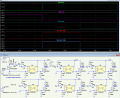
Okay, here's my take on using an opto for isolation for the six receivers (LTspice sim below):
I added a MOSFET buffer on the opto output to minimize the input current required from the M1 source.
Note that the source common and the opto output common are isolated.

All the ACT outputs (Act1 and Act6 outputs shown) are high when M1 is Active on (m1-d output low).

The ACT outputs are low when the M1 output is high or the inputs are open [S1 open when V(close) is low].

Will that do what you want?

1731955325613.png
 
Last edited:

MisterBill2

Joined Jan 23, 2018
27,187
OK, the problem that I see is that the sending part of the system is not differential.
There are actual differential line driver IC devices available, as well as differential line receiver devices.
What sort of signal is sent over the twisted pair??
I am familiar with what is done for thermocouple temperature controls, which is added bias , either upscale or down scale. so that when a thermocouple fails open the bias forces the signal in which ever direction causes a safe shutdown.

For a digital signal, if it is constantly changing between one and zero, then a very short cycle timer that is always reset by the signal changes would rapidly time out if the signal line failed. That could be very simple and quite reliable, and not depend on any DC level.
 

crutschow

Joined Mar 14, 2008
38,325
the problem that I see is that the sending part of the system is not differential.
Why is that a problem in this application where only a slow DISABLE/ACTIVE signal is being sent.
And certainly an opto isolator receiver doesn't care whether it is truly differential.
 

MisterBill2

Joined Jan 23, 2018
27,187
OK, I went back to the circuit in post #1, and what I see is that an option will be to remove the pull up from the origination end and have it only at the opto-isolator end of the twisted pair. Then any break in the circuit will deliver the active disable signal, if it is present, or if the signal lead is broken. This will also require a bit of resistance to common at the lower end of the opto, to the local common circuit.
 

MisterBill2

Joined Jan 23, 2018
27,187
I looked at the circuits in both #1and #8. I was thinking about the opto-isolated scheme. Adding another pull up of the LED side of the opto-isolator , and then also a resistor to the supply common side of that LED will provide redundancy as well as asserting a disable command in the event of a connection failure. And it requires no changes to the originating circuit nor to the interconnect wiring.
 
Top