Converting NC SPST to NO SPST

Thread Starter

atummoilwily

Joined Apr 15, 2025
4
I have a specific microswitch I want to use for a project that is no longer made. I was able to find a NC SPST version, but need it to be NO SPST. Is there any way that I can adjust it internally where it becomes NO SPST?
 

MrChips

Joined Oct 2, 2009
34,628
I have a specific microswitch I want to use for a project that is no longer made. I was able to find a NC SPST version, but need it to be NO SPST. Is there any way that I can adjust it internally where it becomes NO SPST?
No.
Show us the circuit diagram of the application for the switch and maybe we can provide an external solution.
 

LowQCab

Joined Nov 6, 2012
5,101
If it is actually a "Micro-Switch" style of Switch, it is most definitely still manufactured.

Please include a picture, and/or part-number/manufacturer, of your existing Switch.
.
.
.
 

Thread Starter

atummoilwily

Joined Apr 15, 2025
4
I should have provided more preface to what I'm doing. I am working on an arcade cabinet and trying to put it together. None of what I'm doing has been part of my skillset, but I am fascinated with all the things I am learning. I am working on the lever/joystick at the moment, and it led me to a deep rabbit hole trying to find micro switches that were discontinued since June 2014.

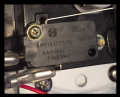
The lever uses Panasonic AM51610C69N, however, this naming convention doesn't properly represent the switch I'm looking for. The proper parts number is AM516130C69N (SPDT), but I can also use AM51633C69N (SPST NO) since it would be used as NO.

I'm not so keen on circuit designs, but perhaps I can describe it all the best I can. The lever is set up with a microswitch for each cardinal directions (Up, Down, Left, Right), and each micro switch leads back to the raspberry pi that runs everything.

@MrChips I spent some time trying to figure out how to accurately draw you a circuit design, but I think it needs a little work--this is all new to me. I'll post one as soon as it's ready.

@LowQCab: I am looking for Panasonic AM51613C69N or AM51633C69N. I have tried searching low and high for them. I did however run to a SPST NC version. I thought I could move the NC terminal down and flip the activating mechanism around to work with NO. I thought this could be a great opportunity to convert them to the specific micro switch I need, rather than buying a completely different system.

I have read about relays and Forn B, which make sense. But I guess when I go about everything, I'm entering blind and not drawing any strong connections (no pun intended).

I hope this information is helpful
 

MrChips

Joined Oct 2, 2009
34,628
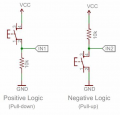
Switches are very often utilized to send digital information to a controller. The microswitch is either pressed or not pressed.

1) A voltage is transmitted to the input of a controller in the form of a TRUE or FALSE input.
The corresponding voltage can be almost anything you want. Hence the switch contacts can be NO or NC. It is a simple matter to choose the required voltage for either case. This is often done with a resistor in series with the switch wired across power and ground. Interchange the resistor and the switch and you will invert the logic.

1744772316689.png


2) If the input is to be read by a microcontroller such as a raspberryPi, you can invert the logic in the code.
 

LowQCab

Joined Nov 6, 2012
5,101
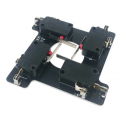
I also have the option of purchasing a PCB or designing my own PCB that I'll solder fuse clips, which will connect to the terminal and com of the microswitch. I have attached an image of the PCB for reference.
.
Those are totally "standard" Micro-Switches,
made by several major manufacturers,
with the exception that they appear to be extra cheap Chinese-knock-offs,
and, they appear to be "glued", or "molded" to a common plastic mounting-plate
instead of using Screws and Nuts to mount them.
Most of the replacement Micro-Switches You will find are Double-Throw,
so they will work no matter what configuration You need.
.
.
.
 

boostbuck

Joined Oct 5, 2017
1,034
If you can change to the PCB illustrated in your post #5, surely any microswitch of similar size and form is going to work?

Why do you need to use that particular Panasonic microswitch?
 

MisterBill2

Joined Jan 23, 2018
27,186
If you have the measurements of the switch that you need to replace, and can salvage the operating lever, you will be able to find a FUNCTIONAL replacement. a specific arrangement with a particular terminal style may no longer be available, but an identical switch with different terminals may be available.
The one challenge may be if you are doing a "Competition Class" restoration to the "exactly original details". So I suggest looking ata larger supplier, such as "Digikey".
 

Tonyr1084

Joined Sep 24, 2015
9,744
This video shows how a microswitch is made and how it works. It demonstrates why you can not change its function from NC to NO or vice versa. It also demonstrates how you can use a SPDT µS (MicroSwitch) in place of one that is JUST NO or just NC. I've salvaged plenty of them in all three configurations NO Only, NC Only and NO/NC or SPDT configurations.

In my salvaging I've taken many from discarded microwave ovens. Some of the µS's have 1/4" lugs whereas others have had smaller. MY ice maker / water dispenser had a failed µS. Fortunately I had the right size switch to replace the defective one. And they are not discontinued. Perhaps the whole assembly you're looking for may be discontinued but the switches themselves are still available. In the video you can see that they can be opened. In your case you'll need the lever salvaged from a defective switch to install into a replacement switch.

Here's another video:

Your ship is not sunk, just needs a small patch to keep it afloat.
 
Last edited:

Tonyr1084

Joined Sep 24, 2015
9,744
Before now I've never paid attention to disassembly of the switches in my stockpile. Having now examined mine closer, some have a single rivet holding the assembly together while others have two rivets. Still more have no rivets at all and I've been able to open one without having to drill out a rivet. The ones with rivets also have lever arms, suggesting there's a need for extra support for the lever. In your picture there are no rivets suggesting it would be easy to disassemble one and take the lever arm and move it to a replacement.

Here is where you can find replacement µS's. Just don't buy one with a rivet. In fact, this one looks like the very switch you need:
https://www.amazon.com/2Pack-KW3A-M...CHDBWB/ref=sxin_16_pa_sp_search_thematic_sspa
Should be easy to open and install the lever from one of the failed µS's. If you want to replace them all - a good idea, µS's don't have an infinite number of times they can be cycled - - - . Food for thought. Just pay attention to which slot the lever is installed in. Repurpose each switch ONE AT A TIME! That way if you get confused it's easy to see how they should be reassembled.
 

LesJones

Joined Jan 8, 2017
4,511
The microswitches in your picture in post #5 look like normal V3 microswtches but with only the NO contact fitted. There is nothing in your picture to give a sense of size so the may look like V3 microswitches but be a different size. Post the dimensions of your switches. The versions with changover conntacts are more common so I don't see why you cant use those.
Here is a link to one source of V3 microswitches with only the NO contact fitted.
https://www.ebay.co.uk/itm/256425874549

Les.
 

MisterBill2

Joined Jan 23, 2018
27,186
One thing that I have seen is that some two terminal micro-switches internally have the other contact,, but it does not extend out of the housing. So in those cases it maybe possible to solder to that stub that is visible.
 

panic mode

Joined Oct 10, 2011
4,866
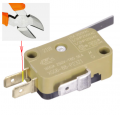
that seem to be switch assembly from an arcade joystick. what you are looking for are very common microswitches with lever actuator like this one. the other contact may interfere with PCB components. you can simply use wire cutter or rotary tool to make it shorter (or gently bend it away) so that there is no interference. they are cheap so buy one or two more in case your modifications destroy the switch.
1744825286751.png
 
Last edited:

Thread Starter

atummoilwily

Joined Apr 15, 2025
4
I appreciate all the feedback and education on microswitches. Post #5 aren't the switches I will be using; I was just trying to refer to the way I may attach the switches rather than using a wiring and disconnects. Apologies for any confusion it may have caused.

The micro switches I am trying to use are noted to have the best tactile feel and actuation to other switches, it just boils down to preference in the end. I have attached the micro switch I seek, but it's SPDT, when I have found the equivalent NC SPST version. I have other options of microswitches, I just wanted to see what possibilities were available. I didn't find a clear answer searching the internet and was happy to have stumbled upon this forum.

@MisterBill2 I have noticed a small stubbed terminals in some switches. I can test that out. And don't worry, there will be no cutting of terminals.

Right now, the path of least resistance (no pun intended) is to follow @MrChips suggestion and attempt to invert the logic through the code. I am using an arcade specific pcb and have reached out to them and will see where that goes.

And as someone who likes to tinker, I will also try @Tonyr1084 idea of salvaging switches. From my understanding, what makes the Panasonic switch special is the sharpanal/spring mechanism. I may take that part and place it in another Panasonic switch that is NO SPST or SPDT.
 

Attachments

Tonyr1084

Joined Sep 24, 2015
9,744
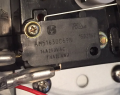
I have attached the micro switch I seek, but it's SPDT, when I have found the equivalent NC SPST version.
No, the switch you show:
Screenshot 2025-04-17 at 7.24.21 AM.png
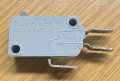
is SPST NO. It's not SPDT. And there is very little concern using an SPDT switch. You just ignore the unwanted pin. Of the 3 contact points, the bottom middle one is the common. I think you already know that but just to be sure you understand. The bottom pin on the left (not the top pin which is not shown in your picture) is the NO contact. Above that is the NC contact. Since the one you show is not riveted closed you can easily open it up and remove the contact you don't want. Or as has been suggested - cut it off. As to @MisterBill2's objection to cutting off an unwanted pin - I'm sure he has his reasons. Me? If it really needed to be cut off I'd do just that.

Opening the one I have, the SPDT switch, removing the unwanted NC contact does not result in fragmentation of the switch. It still works. There is a difference in the way the switch feels, it takes more of a throw to make it switch (or close the NO contact).

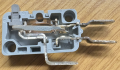
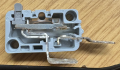
Screenshot 2025-04-17 at 7.33.36 AM.png Screenshot 2025-04-17 at 7.34.05 AM.png Screenshot 2025-04-17 at 7.34.13 AM.png

Also, the one shown above the contacts of the NO and the NC can both be removed and reinstalled in any of the two positions. They are interchangeable. With further investigation I'm sure it can be determined just how much of a fragmentation threat it is. But there doesn't seem to be a threat from merely opening it up. The picture on the right (if I were to close it) would be exactly the same as the one you show in your latest picture.
I just wanted to see what possibilities were available.
If a google search is all you want just say so. Yes, I'm a bit incensed that you asked for our help and we've offered solutions but you're merely curios.
Right now, the path of least resistance • • • is to follow @MrChips suggestion and attempt to invert the logic through the code.
Good idea.

Unwatched.
 
Last edited:
Top