Looking at the datasheet for a relay. The contacts are rated at 8A @ 250VAC. Does that convert to 16A @ 125VAC? The relay I'm looking at is fan relay #90-380.
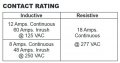
Would it be a White Rogers #90-380 as seen in this data sheet? The contact ratings are given for that relay for inductive and resistive loads at 125 and 250 VAC 50/60 Hz.
Would it be a White Rogers #90-380 as seen in this data sheet? The contact ratings are given for that relay for inductive and resistive loads at 125 and 250 VAC 50/60 Hz.
Yes, thanks i got that from the other responder. For some reason the datasheet I had only showed 250V.
I'm going to have 10A @ 120V through the contact. So, 12A at 125V appears sufficient. The problem I have now is if the device I'm using to provide signal to the relay coils can put out a 1A signal at 24VAC since I'll need 8 relays. It's a sprinkler timer being used to control lights. Per the specs, each relay coil consumes .125A. At times, there will be 8 relays running simultaneously (.125A x 8 = 1.0A). I just discovered solid state relays. They seem to require much less current to run. I'll need to study those datasheets.
Using a SSR (Solid State Relay) is always an option. Just make sure the SSR you choose uses a 24 VAC control voltage. SSRs have a load voltage & current and the control voltage which is like a mechanical relay coil voltage.
I'm looking at contactors, trying to determine the load of the contactor's coil to see if my timer can handle it. My timer can put out 800mA @ 24VAC. Datasheets for contactors state "In-rush VA = 55" and "Sealed VA = 13". What does in-rush and sealed mean? What is a VA (does 13VA mean 0.54A @ 24VAC)?
The coil of an AC relay or contactor is an inductor with only moderate resistance. The resistance is constant but the inductance changes.
When the contacts and armature are in the open position, the core of the inductive coil is an open magnetic circuit - the centre piece that the coil is formed around and one or two outer arms that essentially form a U or W sort of arrangement with the centre piece. In this state, the inductance is quite low so reactance to the AC voltage applied is low and the current is high. This is the "inrush" current. When the armature has been pulled in - "sealed" - the magnetic path is closed by the armature. This greatly increases the inductance so the current drops substantially. I have no idea how "sealed" became the term used.
Because the coil is inductive and AC is applied, the voltage and current are not in phase, There is a reasonably large resistive component. The true power consumed must consider these things. Because the true power often is of less concern than the amount of current required at the operating voltage, the VA - volt-ampere product - is usually what is specified. As you thought, to determine the current you just divide the VA value by the applied voltage. The true power, which would be expressed in watts, will be considerably lower.
Relays and contactors with DC coils will almost always require much less current at the nominal voltage than the "same" devices with AC coils.

 Facebook
 Google
 GitHub
 Linkedin