@Ian0 may I know how exactly it works?Or a boost coverter.
I recently did a 7kW emergency lighting system with 216V DC (18 x 12V 100AH batteries) using LED lamps with electronic ballasts. It switches from 230V AC to 216V DC when the mains fails.
@Ian0 may I know how exactly it works?Or a boost coverter.
I recently did a 7kW emergency lighting system with 216V DC (18 x 12V 100AH batteries) using LED lamps with electronic ballasts. It switches from 230V AC to 216V DC when the mains fails.
Afraid not - commercially sensitive information.@Ian0 may I know how exactly it works?
A 12W LED fixture comprises a number of LED that typically require 3 - 4v at 120mA. If your AC block is 350mA then you will have 3 strings of 8 LEDs, needing typically 36v.Thank you @Irving - however, the wattage of the entire light fixture is 12W, and I thought there will be a 12V input to the LED, so the current drawn will be 1A. For 8 hours of usage, I will require one 8Ah battery. Am I correct? And from the batteries, is it possible to connect two wires to a small dc-ac converter, at the other end of which I feed my LED wires? Kindly advise.
This. Don't mess with higher voltage batteries, buck drivers etc, you want a single stage of energy conversion, from 12V to the LEDs' required voltage and current. Best bet for that is a Meanwell LDH-45A-350W boost driver, 9-18V input, 12 to 86VDC @350mA output at up to 95% efficiency. Readily available from many suppliers including Mouser for under US$20.Forget about producing the AC input. That would be going through two conversations each with losses.
Measure the DC voltage going to the LEDs when powered by the constant current driver, then buy a 12V powered 350mA LED driver that includes that voltage in it’s range.
12W at 350 mA suggests that voltage is 34V, but I would measure it to be sure.
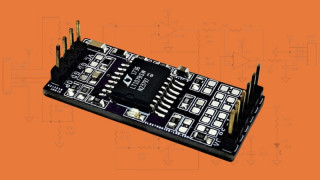
Won't work for his application, he has 12W of 350mA LEDs, so around 12 in series, so needs a driver capable of 36V. The driver you linked to is a buck driver, so batt voltage would have to be higher than 40V (the driver has a 4V overhead requirement). The Meanwell driver I mentioned is the simplest, most effective solution for running a string of 1W LEDs on a 12V supply.Here is an example of a driver that would run your LEDs from a 12V battery at 350 mA constant current. This would replace the AC power supply.
LED driver
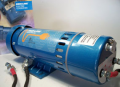
The old rotary inverters were interesting, but not overly efficient, and certainly not what the OP is looking for. They are a novel device though, used to have one many, many (many) years ago.
Ya I just wanted to see if anyone knew what it was.The old rotary inverters were interesting, but not overly efficient, and certainly not what the OP is looking for. They are a novel device though, used to have one many, many (many) years ago.
Yep, I missed that fact.Won't work for his application, he has 12W of 350mA LEDs, so around 12 in series, so needs a driver capable of 36V. The driver you linked to is a buck driver, so batt voltage would have to be higher than 40V (the driver has a 4V overhead requirement). The Meanwell driver I mentioned is the simplest, most effective solution for running a string of 1W LEDs on a 12V supply.
Probably starting to show my age now...Ya I just wanted to see if anyone knew what it was.
I'm impressed.
Yeah he can use a hand crank with gearing or some mice in running wheels to drive that thing ha ha
@Ian0 - thank you, you mean it works like a UPSAfraid not - commercially sensitive information.
In principle - when the mains voltage is below a certain threshold a double pole contactor changes state and connects the lamps to the battery instead of the mains.
@Boggart thank you for the suggestion - I would like it to be powered from the ac supply also, at times, and from the battery, when the supply is not available. If we connect such a driver to the leads, I won't be able to run it on ac later, will I ?This. Don't mess with higher voltage batteries, buck drivers etc, you want a single stage of energy conversion, from 12V to the LEDs' required voltage and current. Best bet for that is a Meanwell LDH-45A-350W boost driver, 9-18V input, 12 to 86VDC @350mA output at up to 95% efficiency. Readily available from many suppliers including Mouser for under US$20.
Thank you @Irving for your explanation.A 12W LED fixture comprises a number of LED that typically require 3 - 4v at 120mA. If your AC block is 350mA then you will have 3 strings of 8 LEDs, needing typically 36v.
To power these from DC for 8h you will need 0.35 x 8 = 2.8Ah @ 36v so realistically 4Ah or more depending on battery chemistry eg 3 x 12v lead-acid (SLA) will be 42v fully charged but only 33v at 20% charge so you wont get more than 70% discharge before the voltage drops too low.
This is why a boost converter running of a nominal 12v (9 - 15v) supply is a better solution than multiple batteries, but since your input voltage is 1/3 your current will be 3x and as the boost converter is only 85% efficient across the voltage range you need a little more Ah, about 20% more, so 12v 10 -12Ah again depending on chemistry.
Not without some additional circuitry, which could easily be incorporated into the charging arrangement. Basically something to sense when the AC is lost and switch to batteries. There are many options for this.@Boggart thank you for the suggestion - I would like it to be powered from the ac supply also, at times, and from the battery, when the supply is not available. If we connect such a driver to the leads, I won't be able to run it on ac later, will I ?
The simplest being a DPDT relay with a 230V AC coil.Not without some additional circuitry, which could easily be incorporated into the charging arrangement. Basically something to sense when the AC is lost and switch to batteries. There are many options for this.
That'll do it... plus a couple of schottky diodes.The simplest being a DPDT relay with a 230V AC coil.
If I were doing it, to keep all voltages safe, then I would run it from the battery and use a 12V, 1A (or greater) power supply to trip a 12V relay, which would feed 12V to the meanwell driver. When the power went out, the relay would drop out and change power sources to the battery.@Boggart thank you for the suggestion - I would like it to be powered from the ac supply also, at times, and from the battery, when the supply is not available. If we connect such a driver to the leads, I won't be able to run it on ac later, will I ?