Converting 12v to 5v for reading alarm state

Thread Starter

shachar85

Joined Aug 31, 2017
7
Hi

I'm trying to read the "lock" signal of the alarm. The one which locks the doors when pressing the lock button of the remote control of the car.
The car is 2008 Honda Civic.
I'm using arduino for the project, so I need to convert it to 5v.

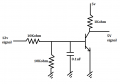
I built a circuit as in the picture attached.

First I tried reading the ACC of the car and it worked great. With Switch on , I got 0v in the output signal and with switch off, I got 5v in the output signal.

Then I tried to do the same with the "lock" signal.
I connected to the right wire. I measured about 12v fixed voltage from that wire. I assume that when locking the car, there's a pulse of 0v in that wire.
I couldn't measure it, but when connecting that wire to the car's ground I hear a relay closes and the doors indeed lock.

When I connected the input of my circuit to that wire, weird thing happened. The voltage on that wire, which was 12v fixed, became 6.4v fixed.
That was without touching anything. Just connecting.
So now I'm not sure what happened. So far I couldn't find the car's original wiring diagram of that circuit. Still looking for it.
I thought maybe someone here have experience with that matter and can give some advice.
 

Attachments

ericgibbs

Joined Jan 29, 2010
21,460
hi 85,
The 10Ks will limit the transistor bias current to a very low value, a door lock could draw a few amps.
Which type of transistor is shown in that circuit.?
E
 

AlbertHall

Joined Jun 4, 2014
12,629
hi 85,
The 10Ks will limit the transistor bias current to a very low value, a door lock could draw a few amps.
Which type of transistor is shown in that circuit.?
E
I think the circuit is intended to monitor the lock signal and reduce it to 5V for the Arduino input.

From the voltage readings, it looks as if that wire is an input to the door locking system not an output. It may be that locking the door pulls that line low, perhaps only briefly. If you set up the Arduino to look for a transition to low level, do you see a pulse?
 

MrChips

Joined Oct 2, 2009
34,866
Did the auto come with remote keyless entry or is this after market installation?

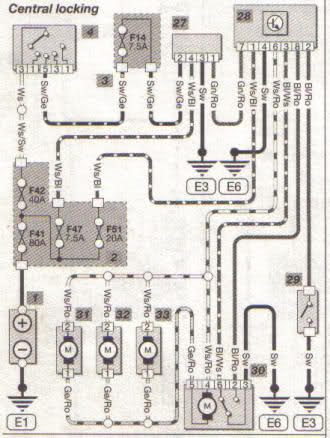
Does your wiring look like this?


3:interior fusebox
28:central locking unit
30: drivers side door lock
31 passenger door lock
32 (4 door rear lock)
33 (4 door rear lock)
 

MrChips

Joined Oct 2, 2009
34,866
Your circuit has an input resistance of about 10kΩ.
We don't know what wire of the locking control you connected your circuit.
If the signal dropped from 12V to 6V, then it would appear that the signal you connected to has a resistance of about 10kΩ also.
 

Thread Starter

shachar85

Joined Aug 31, 2017
7
Hi all

Thanks for the replies and sorry I didn't get to read them until now.

From what I got so far, I think it might be risky to do it that way, because I'll change the voltage of a system of the car.

Maybe I can do it another way - What about a relay?
Let's say I connect to the "Lock" wire a small resistor with a relay.
Well...I still change the system's voltage cause I create once again a voltage divider, but what if I use a small resistor? Then I only take a small amount of voltage. Can something like that work?
 

ian field

Joined Oct 27, 2012
6,536
Hi

I'm trying to read the "lock" signal of the alarm. The one which locks the doors when pressing the lock button of the remote control of the car.
The car is 2008 Honda Civic.
I'm using arduino for the project, so I need to convert it to 5v.

I built a circuit as in the picture attached.

First I tried reading the ACC of the car and it worked great. With Switch on , I got 0v in the output signal and with switch off, I got 5v in the output signal.

Then I tried to do the same with the "lock" signal.
I connected to the right wire. I measured about 12v fixed voltage from that wire. I assume that when locking the car, there's a pulse of 0v in that wire.
I couldn't measure it, but when connecting that wire to the car's ground I hear a relay closes and the doors indeed lock.

When I connected the input of my circuit to that wire, weird thing happened. The voltage on that wire, which was 12v fixed, became 6.4v fixed.
That was without touching anything. Just connecting.
So now I'm not sure what happened. So far I couldn't find the car's original wiring diagram of that circuit. Still looking for it.
I thought maybe someone here have experience with that matter and can give some advice.
There may be some justification for protecting the logic level stuff with an opto coupler. The 12V side is simply a matter of adding a series resistor to limit the current through the IRLED. The type with transistor output would overlay part of your schematic, but there are opto couplers with ready to go logic level outputs.
 

Picbuster

Joined Dec 2, 2013
1,059
Hi

I'm trying to read the "lock" signal of the alarm. The one which locks the doors when pressing the lock button of the remote control of the car.
The car is 2008 Honda Civic.
I'm using arduino for the project, so I need to convert it to 5v.

I built a circuit as in the picture attached.

First I tried reading the ACC of the car and it worked great. With Switch on , I got 0v in the output signal and with switch off, I got 5v in the output signal.

Then I tried to do the same with the "lock" signal.
I connected to the right wire. I measured about 12v fixed voltage from that wire. I assume that when locking the car, there's a pulse of 0v in that wire.
I couldn't measure it, but when connecting that wire to the car's ground I hear a relay closes and the doors indeed lock.

When I connected the input of my circuit to that wire, weird thing happened. The voltage on that wire, which was 12v fixed, became 6.4v fixed.
That was without touching anything. Just connecting.
So now I'm not sure what happened. So far I couldn't find the car's original wiring diagram of that circuit. Still looking for it.
I thought maybe someone here have experience with that matter and can give some advice.
The most save solution is an opto coupler Led part running with a 10K resistor in series and at the other site pull-up to 5V 10K.

PICbuster
 

ian field

Joined Oct 27, 2012
6,536
The most save solution is an opto coupler Led part running with a 10K resistor in series and at the other site pull-up to 5V 10K.

PICbuster
Probably worth taking a look at the data sheet before generalising - opto coupler IRLEDs usually take more current than visible types. your figure would be a little high even for a high efficiency visible LED.
 
Top