Facebook
 Google
 GitHub
 Linkedin
I trying to determine if a piece of equipment is on or off using its power LED and an opt isolator.
When I look at the output of the OI on an Ohm meter I get a nice stable “—“when the unit is off and, a stable 120K when it is turned on. I then connected the OI to a micro controller and set the pin to read resistance. What I am seeing is 12,0,12,0,12…
I assume that LED is using PWM to control its brightness and the meter is just not fast enough to detect the fluctuation.
I could probably deal with this in software but would rather provide the micro controller with a clean signal.
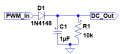
Is there a few component way to stabilize the wave output and “slow it down” so it reads “0” when off, or “12’ when on?
I tried a 104 cap across the output of the OI but that just made the “12” reading drop and still picked up the “0”
I don’t have a scope or freq counter to examine the output more closely.
When I look at the output of the OI on an Ohm meter I get a nice stable “—“when the unit is off and, a stable 120K when it is turned on. I then connected the OI to a micro controller and set the pin to read resistance. What I am seeing is 12,0,12,0,12…
I assume that LED is using PWM to control its brightness and the meter is just not fast enough to detect the fluctuation.
I could probably deal with this in software but would rather provide the micro controller with a clean signal.
Is there a few component way to stabilize the wave output and “slow it down” so it reads “0” when off, or “12’ when on?
I tried a 104 cap across the output of the OI but that just made the “12” reading drop and still picked up the “0”
I don’t have a scope or freq counter to examine the output more closely.