Controlling two Transistors with one source

Thread Starter

Jeffery Vahrenkamp

Joined Jun 16, 2016
53
I am testing out a circuit I am planning to incorporate into a PCB and running into some behavior that isn't' making sense to me.

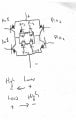
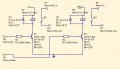
I have a single LED with two transistors on either side of it. The goal is to drive both of these transistors with a single pin on from a micro controller. I have it set up in three different situations (see image below). In one I am supplying 3v to the transistor (data sheet ->here <- for those who want it) and the LED does not light up. When I use two separate pins from the micro controller to supply 3v to the two transistors, I get light. If I short out these two control pins the light shuts off. My guess is that there is less resistance for all the current to flow through the base of transistor 2 (closes to the ground) to the ground, but I am pretty sure that isn't how transistors work... Insight would be appreciated, a solution to drive two transistors with a single pin would be even better :).
 

crutschow

Joined Mar 14, 2008
38,504
Why do you have two transistors driving one LED? :confused:
Just remove the top transistor and replace it with a resistor to control the LED current.

That circuit won't work with one signal source unless you put resistors in series with each transistor base (try 5kΩ).
BJTs need resistors in series with their base to control the base-emitter current.
 

Thread Starter

Jeffery Vahrenkamp

Joined Jun 16, 2016
53
Why do you have two transistors driving one LED? :confused:
Just remove the top transistor and replace it with a resistor to control the LED current.

That circuit won't work with one signal source unless you put resistors in series with each transistor base (try 5kΩ).
BJTs need resistors in series with their base to control the base-emitter current.

I'm building an hbridge. This was a test circuit to troubleshoot why it wasn't working. Using two resistors worked, though I'm trying to figure out why having too much current going to the base would inhibit current flow between the collector and emitter. Shouldn't it saturate both the bases allowing the maximum amount of current to flow through both transistors?
 

dl324

Joined Mar 30, 2015
18,326
I don't see any transistors in your photo; unless that's what the 'T' things on either side of the LED are. You need to draw them properly for us to be able to analyze the circuit; and we need to know how the bases are being driven.

An H-bridge requires 4 transistors.
 

WBahn

Joined Mar 31, 2012
32,824
So both of your transistors are NPN transistors? Look in the data sheet for the correct symbol you should use in your schematics. Different transistors need different things to work and a well-drawn schematic let's the reader know the important things at a glance.

If so, you definitely need base resistors. When you use two separate signals, the right-hand transistor is going into hard saturation and sucking up all the current that the pin can provide and pulling it to a relatively low voltage -- lower than is needed to turn on the other transistor since the base of it has to be the sum of the transistor Vbe, the LED forward voltage drop, and the Vcesat voltage of the right hand transistor. That's going to come out to something pushing the 3 V you have to work with.

With the bases tied together, measure the pin voltage when they should be on.

An H-Bridge normally has complementary transistors on the top and bottom. With an NPN on top, it will be difficult to get it into saturation because what you basically have is an emitter-follower configuration.
 

crutschow

Joined Mar 14, 2008
38,504
Shouldn't it saturate both the bases allowing the maximum amount of current to flow through both transistors?
A BJT base-emitter junction looks like a forward biased diode so, if there's no resistor, the bottom transistor hogs all the current and the base voltage stays at about 0.7v.

If you are building a H-bridge I suggest to you google some H-bridge circuits, as there are many examples that show exactly how to build such a bridge, since you apparently do not seem very familiar with how transistors work. ;)

Note that using an NPN transistor for the top of the bridge means that transistor will not saturate, giving a minimum ON voltage drop of about 0.7V across the collector-emitter.
 

Thread Starter

Jeffery Vahrenkamp

Joined Jun 16, 2016
53
A BJT base-emitter junction looks like a forward biased diode so, if there's no resistor, the bottom transistor hogs all the current and the base voltage stays at about 0.7v.

If you are building a H-bridge I suggest to you google some H-bridge circuits, as there are many examples that show exactly how to build such a bridge, since you apparently do not seem very familiar with how transistors work. ;)

Note that using an NPN transistor for the top of the bridge means that transistor will not saturate, giving a minimum ON voltage drop of about 0.7V across the collector-emitter.

Okay, let me see if I have this right. My intuition that I was essentially shorting out my left base and sending all my current to my right base was correct, and the series resistors ensures that the current is more evenly distributed between the two bases (prevents too much voltage drop from the right transistor).

now for some best practices: Let me know where I am wrong please

When I have a transistor upstream of a load and I want current and voltage amplification, I want to use a PNP transistor, for example the positive sides of my H bridge. These are activated by grounding (lower than the collector).
When I have a transistor downstream of a load and I want current and voltage amplification, I want to use an NPN transistor, for example on the negative side of my H bridge. These are activated with positive current.

Now, the problem is, I want to use a single pin on my H bridge to drive each direction, but from what I understand, you pull a PNP transistors base low to make it conduct. However, since I need to drive both a PNP and an NPN transistor at the same time, that means two pins per direction or 4 pins total to control my H bridge.

However with a little reading up on transistors and some experimenting I found that my setup works okay. My relay I am switching is a 3v relay with a nominal voltage of 2.25 V for the coil to operate. I was hoping to switch at 5V to off set any voltage drop, but if my understanding of what I read today is right, a common emitter setup means you only get out the voltage that goes into the base, so even though my collector has 5V coming in, since my base is supplying 3.3V, the max I could get out is 3.3V - 0.6V. This is what I am measuring across my terminals (2.75V). However, what I read also said that you still get current amplification with the common transmitter setup, which was my limiting factor. I've tested it out and it works for my relays. Now I have to put transistors after my relays to control them individually, and diodes... (see diagram below). Pins will of course be connected to high value resistors. I'll have to play around with the circuit... would be easier if the relay pins would fit in my bread board :(.


Thread Starter

Jeffery Vahrenkamp

Joined Jun 16, 2016
53
I just had an epiphany when Thinking about transistors that I am sure one of you will have after reading my above post.

If I do an PNP transistors at the top of the H bridge and NPN at the bottom of the H bridge, I can control each side with a single pin and since they need opposite current I will be able to use two pins to control it, as well as making a short circuit impossible. I then control the middle NPN's with their own switches and diodes to bipass the opposite direction so that my NPN is downstream of the load.

( Of course I drew the direction of my flow backwards below, but apart from that I think ti makes sense).

Is there anything I need to know about matching transistors?
0011_171125031344_001 (505x800).jpg
 

WBahn

Joined Mar 31, 2012
32,824
Perhaps I've missed it somewhere, but I still am unclear exactly what it is you are trying to achieve.

Apparently you have two relays and you want to control the direction of current in the coils independently? Does that cover it, or is there more?

HOW you do something depends very heavily on WHAT it is you want to do.
 

Thread Starter

Jeffery Vahrenkamp

Joined Jun 16, 2016
53
Perhaps I've missed it somewhere, but I still am unclear exactly what it is you are trying to achieve.

Apparently you have two relays and you want to control the direction of current in the coils independently? Does that cover it, or is there more?

HOW you do something depends very heavily on WHAT it is you want to do.

I have two single coil, latching, signal relays that are switching AC signals for a thermostat. The H-bridge is to change the direction of the current so I can switch the relays on and off. The transistors next to the relays are to allow me to switch the relays individually (don't want the AC and Heater running at the same time!).
 

be80be

Joined Jul 5, 2008
2,395
You want to make sure the ac is no on with the heat you don't need to do a h bridge.
You also dont what go for AC to Heat or Heat to AC without a delay like 5 minutes.

All thermostats that are the newer one do this very simple you have in most 4 small
relays with 4 npn transistors and 4 diodes across the coil of the relay.

You then just set the output low this keeps all relays off .
You then set witch output hi you need heat you set that pin high.
Same for AC you set all low then set the AC high.
Screenshot from 2017-11-24 21-54-28.png
 
Last edited:

Thread Starter

Jeffery Vahrenkamp

Joined Jun 16, 2016
53
The AC circuit isn't an issue. I have a working version that I've had running in my house for 1.5 years. I'm just trying to free up two pins so I can run an LCD screen for people I am building it for, so they don't have to use their phone for the settings/temp.
 
Top