Considering if I need a snubber network for my application

Thread Starter

Xavier Pacheco Paulino

Joined Oct 21, 2015
728
Hello,

I extracted this fragment from the textbook Switching Power Supply Design, Abraham I. Pressman:

With MOSFETs, turnoff switching losses are considerably less than those with bipolar transistors. Current fall time with a MOSFET is so rapid that current in it will have fallen almost to zero by the time the voltage across it has risen significantly. Thus, although turnoff snubbers are used with MOSFETs, their prime function is not to reduce overlap dissipation, which is already low. Rather, the function of the MOSFET turnoff snubber is to reduce the amplitude of the leakage inductance voltage spike. Since leakage inductance voltage spikes are proportional to dI/dt in the transistor, a MOSFET with much faster current turnoff time than a bipolar will have a larger voltage leakage spike.

I would like to add that some new MOSFETs claim to have improvements on their dv/dt and di/dt capability.
As stated in one of my previous posts, I'm going to use this one: IRF250P224.for a PMDC Brushed motor control application.

Do you think that a snubber is strictly necessary in my application? I know that it could bring somo improvements somehow, maybe not noticeable. It will of course reduce overall efficiency in the MOSFET.
 

-live wire-

Joined Dec 22, 2017
959
Yes. If you are switching an inductive load at high currents, you will definitely want a snubber of some sort. Espescially if it has a large inductance. Otherwise there will be huge voltage spikes, damaging components greatly.
 

MrAl

Joined Jun 17, 2014
13,667
Hello,

I extracted this fragment from the textbook Switching Power Supply Design, Abraham I. Pressman:

With MOSFETs, turnoff switching losses are considerably less than those with bipolar transistors. Current fall time with a MOSFET is so rapid that current in it will have fallen almost to zero by the time the voltage across it has risen significantly. Thus, although turnoff snubbers are used with MOSFETs, their prime function is not to reduce overlap dissipation, which is already low. Rather, the function of the MOSFET turnoff snubber is to reduce the amplitude of the leakage inductance voltage spike. Since leakage inductance voltage spikes are proportional to dI/dt in the transistor, a MOSFET with much faster current turnoff time than a bipolar will have a larger voltage leakage spike.

I would like to add that some new MOSFETs claim to have improvements on their dv/dt and di/dt capability.
As stated in one of my previous posts, I'm going to use this one: IRF250P224.for a PMDC Brushed motor control application.

Do you think that a snubber is strictly necessary in my application? I know that it could bring somo improvements somehow, maybe not noticeable. It will of course reduce overall efficiency in the MOSFET.
Hi,

It's all about power heating dissipation and where you intend to dissipate the energy from the spike.

If you use a snubber then it is also important to have it wired in as close to the MOSFET ir protects especially if the dv/dt is high. It is typical to see these snubber boards mounted right to the same heatsink that the mosfet itself is mounted on so the wiring can be super short. Even a little wire inductance can affect the speed of response of the snubber. The power dissipation comes out to be partly in the snubber resistor and sometimes partly in the transistor when it turns back on.

You can also experiment with lowering the dv/dt on purpose. That means using an asymmetrical drive such that the turn off is somewhat slow. In this case the transistor dissipates all of the spike energy and so the efficiency still goes down, but if it is done right it should not be any more than using a snubber. The timing has to be nearly perfect though so that you dont dissipate any more energy than you need too. Even with a ramp (as that would be what it would be then) though the snubber is still a oood idea but it wont have to dissipate as much energy then so it can be smaller. This technique would be called a highly controlled turn off. The inductive energy has to be dissipated some how, and that's just another way to get it done.
 

MrAl

Joined Jun 17, 2014
13,667
Hello again,

It looks like you are driving a motor, and you have a catch diode there too?
That helps to lower the spike energy because the diode shunts energy. Depending on how fast that picks it up you may not need a snubber.

The theory is based on the inductive kickback and the snubber circuit you choose to use, and this really requires knowing the value of the inductance in the circuit. Since we dont usually know what that is for sure, we approximate and then make sure we are prepared to change snubber values once we run the circuit up and check for the maximum spike voltage.

I guess we can go through the rigor of analyzing the entire circuit and that would give some insight, or do a few simulations. In any case we might end up changing some values once the actual real life circuit is ruin up for the first time because we will probably be guessing at the equivalent inductance in the circuit.

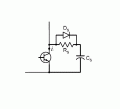
Many snubbers are just a diode, cap, and resistor. The cap absorbs energy through the diode, then the cap discharges through the resistor when the transistor turns 'on'.

Snubber_20180620-1.gif

In this diagram the wire that goes 'up' connects to the inductance, and when the transistor turns off that means we have a resistor and cap in series with the inductor when without the snubber we have nothing. Thus the circuit topology is different with the snubber and so the cap helps to dampen out the spike. When the transistor turns back on, it dissipates that stored energy through the resistor. Enough energy has to be dissipated so that the cap is ready for the next cycle.
This means we have two different topologies to consider, one when the transistor just turns off (conduction through the diode and cap) and another when the transistor turns on (conduction back though the resistor can cap). There is also some cap ESR to consider for both topologies.
 
Last edited:

ebp

Joined Feb 8, 2018
2,332
In a motor driver, a snubber would normally be used primarily to suppress high frequency ringing that can occur between the capacitance of the FET and the small inductances of the connections. This is for purposes of controlling EMI/RFI. It would not be expected to cope with any significant energy stored in the inductance of the motor - you want that energy to "recirculated" through and be beneficially used by the motor, and that is what the diode across the motor is for.

There is no "leakage inductance" spike in a motor driver that corresponds to that to which Pressman refers. (To me, the term "leakage inductance" makes much more sense if you think of it a inductance due to magnetic flux leakage - energy from the input source is stored in a magnetic field that does not couple to where it is supposed to couple - it has "leaked out".) In an isolated flyback converter, energy from the input supply is stored as a magnetic field using one winding on the inductor during the switch ON time and then delivered to the output (load) during the switch OFF time using another winding on the inductor. Ideally, all of the energy stored by the input winding can be delivered to the output winding, but the coupling of the magnetic fields is never perfect - there is leakage inductance. Leakage inductance arises in part because there is a conflict between designing the windings to minimize it and safety requirements. The amount of energy stored in the leakage inductance is sufficient that if you switch the FET off very fast a voltage spike of great magnitude can be produced. You can't use a simple diode across the primary like you use for the motor because it would make a path for all of the stored energy, not just that in the leakage inductance. So you use a snubber to dissipate the energy in the leakage inductance while miniimizing waste of the energy you want to go to the output circuit.

In the motor circuit, there will be some energy stored in the inductances of the connections in the circuit, but the amount will be small. Still, with fast switching rise and fall times that energy can be enough to cause ringing as it resonates with the capacitance of the FET. A simple RC snubber may be beneficial in dissipating the energy to suppress the ringing and reduce problems with EMI and RFI.
 
Top