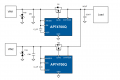
Connecting two batteries in parallel

Thread Starter

hoyyoth

Joined Mar 21, 2020
528
I am building a POC with two COM-15208 buck-boost boards (5V/3.3V from 3.7V LiPo). Daily draw: ~1825 mAh (~76 mA avg).

I have two 10000 mAh batteries available with me and I want to parallel two identical protected 10,000 mAh packs. I need my system work for seven days without changing the battery.

I'm worried about initial voltage mismatch causing high inrush current, uneven discharge, or damaging the built-in protection circuits.Batteries aren't perfect voltage sources; their open-circuit voltage (OCV) varies with state of charge (SoC):

May I know any tips for safe connection?
 

Futurist

Joined Apr 8, 2025
737
I am building a POC with two COM-15208 buck-boost boards (5V/3.3V from 3.7V LiPo). Daily draw: ~1825 mAh (~76 mA avg).

I have two 10000 mAh batteries available with me and I want to parallel two identical protected 10,000 mAh packs. I need my system work for seven days without changing the battery.

I'm worried about initial voltage mismatch causing high inrush current, uneven discharge, or damaging the built-in protection circuits.Batteries aren't perfect voltage sources; their open-circuit voltage (OCV) varies with state of charge (SoC):

May I know any tips for safe connection?
What about a power diode on each battery +ve?
 

KeithWalker

Joined Jul 10, 2017
3,604
Connect the negatives together and connect a 10 Ohm 1/2 Watt resistor between the two positives. Measure the voltage across the resistor. When it drops to zero, it is safe to connect the cells parallel.
 

Reloadron

Joined Jan 15, 2015
7,882
The following is from our friends at Battery University:

Parallel Connection
If higher currents are needed and larger cells are not available or do not fit the design constraint, one or more cells can be connected in parallel. Most battery chemistries allow parallel configurations with little side effect. Figure 4 illustrates four cells connected in parallel in a P4 arrangement. The nominal voltage of the illustrated pack remains at 3.60V, but the capacity (Ah) and runtime are increased fourfold.

Parallel connection of four cells (4p)
Figure 4: Parallel connection of four cells (4p)[1]

With parallel cells, capacity in Ah and runtime increases while the voltage stays the same.
A cell that develops high resistance or opens is less critical in a parallel circuit than in a series configuration, but a failing cell will reduce the total load capability. It’s like an engine only firing on three cylinders instead of on all four. An electrical short, on the other hand, is more serious as the faulty cell drains energy from the other cells, causing a fire hazard. Most so-called electrical shorts are mild and manifest themselves as elevated self-discharge.

A total short can occur through reverse polarization or dendrite growth. Large packs often include a fuse that disconnects the failing cell from the parallel circuit if it were to short. Figure 5 illustrates a parallel configuration with one faulty cell.

Parallel/connection with one faulty cell
Figure 5: Parallel/connection with one faulty cell[1]

A weak cell will not affect the voltage but provide a low runtime due to reduced capacity. A shorted cell could cause excessive heat and become a fire hazard. On larger packs a fuse prevents high current by isolating the cell.
As long as your two (or more) batteries are the same you should not have any imbalance. I also like KeithWalker's suggestion above as to the use of a 10 Ohm resistor.

Ron
 

MisterBill2

Joined Jan 23, 2018
27,415
For putting rechargeable batteries in parallel, they should be in similar conditions and ages, and at close to the same state of charge.
CAUTION: A series diode will isolate but also waste power in the 0.7+ voltage drop. (700 milliwatts at one amp.)
 

sparky 1

Joined Nov 3, 2018
1,218
Using 3 batteries in series with a high efficiency DC DC step down converter
you will have a better chance of a longer run, workload determines current draw.
When powering a supply circuit that is transient sensitive, a ramp known as soft start
can increase current slower at power-up. This becomes more important as the power
requirement increases. It is a recommendation on some applications and is strongly
recommended on others. We need to have done due diligence to understand the needs
of an application, what is acceptable regarding transient surge as everything that can go wrong...
 
Last edited:

WBahn

Joined Mar 31, 2012
32,784
I am building a POC with two COM-15208 buck-boost boards (5V/3.3V from 3.7V LiPo). Daily draw: ~1825 mAh (~76 mA avg).

I have two 10000 mAh batteries available with me and I want to parallel two identical protected 10,000 mAh packs. I need my system work for seven days without changing the battery.

I'm worried about initial voltage mismatch causing high inrush current, uneven discharge, or damaging the built-in protection circuits.Batteries aren't perfect voltage sources; their open-circuit voltage (OCV) varies with state of charge (SoC):

May I know any tips for safe connection?
As noted by others, put a resistor across them until they equalize sufficiently. If I'm thinking about in my head correctly, the size of the resistor will only determine how long it will take to equalize, but should have no effect (in theory) on the amount of energy lost to heat. A lower resistor results in more power dissipated, but for a shorter period of time, while a larger resistor results in less power, but for a longer period of time. I think the total energy dissipated as heat will be something like 1/2 of the energy difference between the two starting states (assuming identical batteries).

So I could see an argument for using the largest resistor that will equalize them in the time you can devote to the process. That should put the least stress on the batteries and probably result in the most efficient transfer, since most batteries are more efficient at lower currents (don't know about LiPo though).

For the most efficient and shorted equalization, charge them individually first, so that their states of charge are nearly identical. At that point, you should actually be able to strap them together immediately, but if you use a resistor to balance them, you can use a smaller resistor for the same initial current, which will result in a faster equalization.
 

Irving

Joined Jan 30, 2016
5,096
As long as the batteries are within, say, a 100mV of each other when you start, paralleling them isn't an issue - you might get a small spark with the 15A or so balancing current but that's only going to last a few milliseconds as they adjust to the mean voltage. Using a low value resistor, 1 - 10ohms, isn't a bad idea if they're more than 500mV or so apart, just to balance them before permanently paralleling them up, but it isn't essential. My 1900Wh 8S5P pack uses 5 x 15Ah in parallel in each bank, they've been running nearly 10y now with no issues and no significant loss of capacity either.
 

MisterBill2

Joined Jan 23, 2018
27,415
Probably adding "OR" function electronics will not deliver any benefit. Splitting the power delivery between two batteries may even put the discharge in a more favorable part of the discharge curve. (Only a GUESS) Certainly any added device may burn a bit of power nut fed to the load.

Possibly, if the TS would describe the load, there might be a suggestion able to reduce the energy consumption a bit.
 

Thread Starter

hoyyoth

Joined Mar 21, 2020
528
My load is a Microcontroller and 8 nos of PID gas sensors like this. 7 zero bias electrchemical gas sensors and one radiation gas sensor.Each PID gas sensor will take 18mA(For POC I will be using only one PID).Electrochemical and Radiation sensor will take very less current
 
Top