Complementary Emitter Follower Loading Down My Buffer Op Amp Output - Can I Fix It?

Thread Starter

brockrwood

Joined Oct 23, 2016
89
I have been working on hobby electronics project, off and on now, for about a month. I am an avid electronics hobbyist with a B.A. in Philosophy. I am not an electronics engineer.

The circuit is a BJT transistor astable multivibrator. The output of the astable multivibrator is fed to a TL071 op amp configured as a unity gain buffer. The output of the op amp is fed to a complementary emitter follower pair of transistors (2N3904 and 2N3906).

The output of the complementary emitter follower pair is finally fed to an 8 ohm speaker. A 100 ohms variable resistor in placed in series with the speaker as a volume control.

Here is a hand-drawn schematic of the circuit:
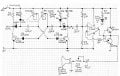
astable_bjt_diagram_with_output_transistors_diode_position_corrected_1900_wide_sharpened.jpg

Here is my problem. When I adjust he variable resistor (a linear pot configured as a variable resistor), R12, so that the resistance starts to go below about 50 ohms, the wave form output from my op amp starts to distort. It seems like the op amp is being stressed and is putting out too much current.

This suprises me. The whole point of adding the emitter follower complementary pair of transistors to the output of the op amp was to be able to send more current to the speaker (make the volume louder) without loading down the op amp.

Can anyone suggest a change to my circuit that would solve this problem?

Thank you in advance!
 

crutschow

Joined Mar 14, 2008
38,435
At that point the voltage should be no more than about 4V, giving a peak current of 80mA
For this the op amp only has to supply about 0.8mA, which should not be a problem.

But that op amp is not a rail-rail type, so it's output is rather limited for a 9V total supply voltage (±4.5V).
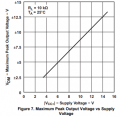
As can be seen from the data sheet graph below, the maximum peak output at a ±4.5V supply voltage is only about 3V.
That may be your problem.

upload_2019-3-19_13-37-15.png

Since the signal is a square-wave, what's the purpose of the op amp?
Just drive Q3 and Q4 directly from Q2's collector.
 

Thread Starter

brockrwood

Joined Oct 23, 2016
89
At that point the voltage should be no more than about 4V, giving a peak current of 80mA
For this the op amp only has to supply about 0.8mA, which should not be a problem.

But that op amp is not a rail-rail type, so it's output is rather limited for a 9V total supply voltage (±4.5V).
As can be seen from the data sheet graph below, the maximum peak output at a ±4.5V supply voltage is only about 3V.
That may be your problem.

View attachment 172782

Since the signal is a square-wave, what's the purpose of the op amp?

Just drive Q3 and Q4 directly from Q2's collector.
Thanks for the helpful reply! Well, the reason for the op amp is that I wanted to buffer the output of the astable multivibrator from the speaker so that the speaker did not affect the square wave from the astable multivibrator. Then, when I did that, it worked, but I could not get much volume to the speaker from the output of the op amp. So, on the suggestion of another commenter in another website's forum, I added the complementary pair emitter follower to the output of the op amp. It never occurred to me to just omit the op amp entirely! Duh! I will try that! I need some sort of current limit resistor on the tied together bases of the emitter follower "push-pull" pair, correct?
 

crutschow

Joined Mar 14, 2008
38,435
I need some sort of current limit resistor on the tied together bases of the emitter follower "push-pull" pair, correct?
Nope.
In that configuration only one emitter-follower is on at a time, and an emitter-follower only takes the base current it needs to drive the load, so no need for a base current limiter.
 
Last edited:

Thread Starter

brockrwood

Joined Oct 23, 2016
89
Nope.
In that configuration only one emitter-follower is on at a time, and an emitter-follower only takes the base current it needs to drive the load, so no need for a base current limiter.
Thank you so much for explaining that! I can't wait to modify the circuit and see how it works!
 

Audioguru

Joined Dec 20, 2007
11,248
The squarewave output makes a buzzing sound. The output is about 4.2V peak-to-peak which is a power output of only 0.28W for the main low frequency and about 0.28W for all the buzzing harmonics. A cheap clock radio is louder and sounds much clearer.

When the volume control is maximum then the low value of the 47uF output capacitor cuts all frequencies below 425Hz so loudness of low frequencies will be reduced.

The circuit is missing a very important supply bypass capacitor across the battery connections of the circuit. Use 470uF. This capacitor will hold up the battery voltage when the volume control is nearing maximum output power.
 

Thread Starter

brockrwood

Joined Oct 23, 2016
89
The squarewave output makes a buzzing sound. The output is about 4.2V peak-to-peak which is a power output of only 0.28W for the main low frequency and about 0.28W for all the buzzing harmonics. A cheap clock radio is louder and sounds much clearer.

When the volume control is maximum then the low value of the 47uF output capacitor cuts all frequencies below 425Hz so loudness of low frequencies will be reduced.

The circuit is missing a very important supply bypass capacitor across the battery connections of the circuit. Use 470uF. This capacitor will hold up the battery voltage when the volume control is nearing maximum output power.
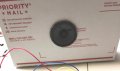
Should I use a bigger coupling capacitor? I am using a 2" inch round speaker, full range, rated for 2 watts. I never got an specs on it (ebay item purchased directly from seller in Asia). If I use a 470uF cap as the coupling capacitor, that should do it, right? That would not cut off any low frequencies this little speaker could possibly handle? Just for the record, here is a picture of the speaker:

2inch_speaker.jpg

Classy, huh? ;-)

I am particularly proud of the speaker "enclosure". ;-)

- Brock
 

Audioguru

Joined Dec 20, 2007
11,248
Isn't that 4.2V peak?
Typically, the output of the TL071 with a brand new 9V battery has a swing of about 7.4V p-p and the little overloaded output transistors reduce the speaker output to about 5.8V p-p.
But since "typical' transistors cannot be bought the ones with minimum spec's will produce 4.2V p-p if the battery is still brand new.
 

Thread Starter

brockrwood

Joined Oct 23, 2016
89
Typically, the output of the TL071 with a brand new 9V battery has a swing of about 7.4V p-p and the little overloaded output transistors reduce the speaker output to about 5.8V p-p.
But since "typical' transistors cannot be bought the ones with minimum spec's will produce 4.2V p-p if the battery is still brand new.
Just to clarify: I am using my homemade work bench power supply to supply a regulated 9V to the circuit, if that matters for the analysis.
 

Audioguru

Joined Dec 20, 2007
11,248
A cheap little 2" speaker (squeaker) produces no low frequencies. The cardboard box enclosure vibrates and cancels any low frequencies anyway.
A simple calculation of the reactance of a capacitor shows that 470uF cuts frequencies below 43Hz into an 8 ohms speaker.

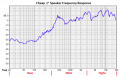
A good speaker produces frequencies from 20Hz to 20kHz at almost the same level. Your little speaker varies its levels all over the place like this:
 

Attachments

Thread Starter

brockrwood

Joined Oct 23, 2016
89
A cheap little 2" speaker (squeaker) produces no low frequencies. The cardboard box enclosure vibrates and cancels any low frequencies anyway.
A simple calculation of the reactance of a capacitor shows that 470uF cuts frequencies below 43Hz into an 8 ohms speaker.

A good speaker produces frequencies from 20Hz to 20kHz at almost the same level. Your little speaker varies its levels all over the place like this:
Man, that frequency response is terrible. I knew it was low-fi. I didn’t know it was “no-fi”.
 

Audioguru

Joined Dec 20, 2007
11,248
Man, that frequency response is terrible. I knew it was low-fi. I didn’t know it was “no-fi”.
Yeah, it sounds boomy at 450Hz like a little bongo drum and it shrieks up high. Bong, bong, beep, beep.
A much better sounding tiny 2" speaker costs $8.70US at Parts Express and a 3" $20.00US speaker sounds great.
 

Thread Starter

brockrwood

Joined Oct 23, 2016
89
Why would anybody want to change the frequency of a buzzer?
The original circuit, the transistor, astable multivibrator, is being developed for a Level II workshop on hobby electronics I am trying to develop. This is not an engineering class but simply a "let's have fun with a breadboard and a dollar's worth of transistors and other parts" weekend workshop. I wanted to show the students how the they could get different tones out of the oscillator by varying the resistor part of the two RC networks. Of course, to make the oscillator worthwhile, then I had to feed the output to a speaker. Then I realized that I needed a buffer of some sort to connect between the oscillator and the speaker because the current draw of the speaker, at anything approaching a reasonable volume, altered the frequency and the output square wave (and its amplitude). Then I added the op amp to buffer the output of the astable multivibrator. Then I wanted more current for the speaker... Yadda yadda yadda. The circuit kind of evolved on me. :)
 

Thread Starter

brockrwood

Joined Oct 23, 2016
89
A cheap little 2" speaker (squeaker) produces no low frequencies. The cardboard box enclosure vibrates and cancels any low frequencies anyway.
A simple calculation of the reactance of a capacitor shows that 470uF cuts frequencies below 43Hz into an 8 ohms speaker.

A good speaker produces frequencies from 20Hz to 20kHz at almost the same level. Your little speaker varies its levels all over the place like this:
You were so right. When adjusting the frequency of the oscillator, the cheap, 2" speaker was pleasantly loud but not very loud at 1,000 Hz. At 650 Hz, it was ear-splittingly loud. Wow. Talk about a not-very-flat frequency response! I thought I needed more amplification for the speaker output. The amplification part of the circuit is quite capable of driving the speaker to a loud volume level. The speaker, however, is quite finnicky about which frequencies it chooses to reproduce loudly and which it chooses to reproduce quietly!!
 
Top