Compatible

Thread Starter

Paul Bober

Joined May 11, 2024
86
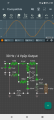
In the real world, when a TL081 is operated from a single supply of 9 volts, the output can swing up to 8.1 volts, and down to 1.8 volts. The ideal bias voltage, when operated from 9 volts is
( 8.1 + 1.8 ) / 2 = 4.95 volts. My circuit is biased at 4.91 volts. In case anyone is wondering, the
150K resistor in the negative feedback is used to minimize d.c. offset. The voltage gain of this circuit = 1 + ( 16,500 / 5,454) = 4. The 10K and
12K resistors in the voltage divider, are in
parallel. This equals 5,454 ohms.
 

Attachments

sghioto

Joined Dec 31, 2017
8,633
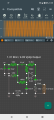
The 4.91 volt bias does make a difference.
Extends the negative half of the signal for a symmectrical output.
At 4.5 volt bias the negative half of the signal clips before the positive side.
 

MisterBill2

Joined Jan 23, 2018
27,159
In the real world, production tolerances and the battle between cost and perfection mean that most of the time we do not go to the absolute maximum that could be achieved. Te exception to that is funny cars and top fuel dragsters. But they occasionally explode.
In real world circuits that use 5% tolerance resistors, generally there is a bit of range left to allow using all of the parts.
 

MisterBill2

Joined Jan 23, 2018
27,159
If you are willing to use variable resistors then it would be possible to set the bias and the gain for every assembly. BUT you would have three adjustments, or maybe just two, for every one of them. That adds to production costs and usually brings on drift problems caused by aging and temperature rise.
 

Thread Starter

Paul Bober

Joined May 11, 2024
86
I understand your point, however, symmetrical clipping is more pleasing to the human ear, than asymmetrical clipping.
 

Thread Starter

Paul Bober

Joined May 11, 2024
86
Overdrive / distortion pedals rely on clipping. I can assure you that symmetrical clipping is more pleasing to the human ear.
 

MrChips

Joined Oct 2, 2009
34,627
Overdrive / distortion pedals rely on clipping. I can assure you that symmetrical clipping is more pleasing to the human ear.
If you want pleasant clipping, that’s what a compression or log circuit is for, or use a tube amp.

I know a member here on AAC who builds pedals using tube amps.
 

Ian0

Joined Aug 7, 2020
13,097
I understand your point, however, symmetrical clipping is more pleasing to the human ear, than asymmetrical clipping.
Actually, the opposite is true, which is why most guitar distortion pedals use a single diode to clip one side only. This produces even harmonics of which the first three are at an octave, an octave and a half and two octaves above the fundamental.
Symmetrical clipping produces anharmonic frequencies at 3, 5 and 7 times the fundamental.
That is one reason why single-ended valve amplifiers are popular, the distortion is almost entirely second harmonic (asymmetrical) which adds a tone an octave above the fundamental.
 

Thread Starter

Paul Bober

Joined May 11, 2024
86
I've heard this argument before. I tried to tell my college professor that a tube amplifier produces a warmer tone quality, in comparison to a transistorized amplifier. He told me that the only thing warmer about a tube amplifier, is the temperature at which it operates at. There is power that is used up in the heater filaments, and then to make matters worse, there is only a 50% transfer of power from the output transformer, to the speaker.
 

Ian0

Joined Aug 7, 2020
13,097
I've heard this argument before. I tried to tell my college professor that a tube amplifier produces a warmer tone quality, in comparison to a transistorized amplifier. He told me that the only thing warmer about a tube amplifier, is the temperature at which it operates at. There is power that is used up in the heater filaments, and then to make matters worse, there is only a 50% transfer of power from the output transformer, to the speaker.
It is possible to build valve amplifiers with very low distortion (Theo Williamson achieved 0.1% THD back in 1947), but I presume that we are talking about the "single ended triode" type amplifiers: the sort with a 300B that sell for £10000 apiece. Yes, the distortion is dreadful, but it's all second harmonic, and it doesn't really have enough gain to clip abruptly, so even when overloaded it sounds OK, but it looks pretty.
It's not the transformer where the losses occur, because it is a class-A amplifier the output valve runs at a standing current equal to the output current, so the losses are in the output valve; but if you made a Class-A transistor amplifier (with no output transformer) it would be only 25% efficient, but you could get the distortion down to parts-per-million. So perhaps the transistor amplifier would be warmer? Maybe - we haven't taken into account the power dissipated in the heaters.
 
Top