Common Source Stage with Constant Current Source Load

Thread Starter

Kenny Lu

Joined Mar 2, 2018
11
Hi everyone,

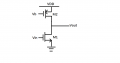
I have trouble determining the Vds of the PMOS of the circuit shown below. When the common source stage is configured with a resistive load, I know how to work out Vds of NMOS. It is simply Vds = VDD - Id*R. How about when a PMOS is incorporated to serve as a constant current source load to the topology? Would you please give me a hand? :)
CS.png

Thank you very much :)
Kenny
 

Jony130

Joined Feb 17, 2009
5,593
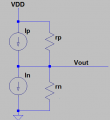
Haven't we already discussed it? To be able to solve for Vds you need to include the MOS secondary effect the channel length modulation effect ( λ lambda or rout). And to be able to "set" the output voltage at desire value requires a negative feedback loop.

Try solve for Vo in this simple circuit:

12.png

where rp and rn represent channel length modulation effect. As you can see now we can quite easily solve for Vo.


Also try read this
http://www.ittc.ku.edu/~jstiles/412...mmon Source Amp with Active Loads lecture.pdf (page 19)

And the output characteristic
http://aries.ucsd.edu/NAJMABADI/CLASS/ECE102/12-F/NOTES/ECE102_F12-LecSet-5.pdf (page 20)
 

Thread Starter

Kenny Lu

Joined Mar 2, 2018
11
Haven't we already discussed it? To be able to solve for Vds you need to include the MOS secondary effect the channel length modulation effect ( λ lambda or rout). And to be able to "set" the output voltage at desire value requires a negative feedback loop.

Try solve for Vo in this simple circuit:

View attachment 149270

where rp and rn represent channel length modulation effect. As you can see now we can quite easily solve for Vo.


Also try read this
http://www.ittc.ku.edu/~jstiles/412/handouts/6.5 The Common Source Amp with Active loads/section 6_5 The Common Source Amp with Active Loads lecture.pdf (page 19)

And the output characteristic
http://aries.ucsd.edu/NAJMABADI/CLASS/ECE102/12-F/NOTES/ECE102_F12-LecSet-5.pdf (page 20)

Hi Jony130,
Thank you very much for your help. For your question above, I know the gain of the circuit is given by Av = gm1 * (rn//rp). What I don't understand is that if we can still use rp and rn to work the the DC level of Vout (Vo in this case). This question arose when I was simulating the circuit using hspice. I was able to bias the two MOSFETs fine, but I didn't know how to set the DC level of the output to the value I desired. I wanted to ensure that the stage exhibited reasonable voltage headrooms. Would you please explain the concept to me? :)
Thank you very much
Kenny
 

Jony130

Joined Feb 17, 2009
5,593
Like how to work out the DC level of output voltage.
Are you able to solve for Vo in a circuit that I have shown in post 2? Because this simple circuit is the key to understand how to solve for Vo. Especially with the case where Ip = In.


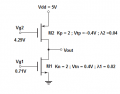
Try solve this circuit:

12u.png
In saturation this equation is true

\(I_D = \frac{K_P}{2} (V_{GS} - Vt)^2 (1+\lambda V_{DS})\)

Can you solve it for Vout? Notice that without any external load resistance Id1 = Id2 is always true.
 
Last edited:

MrAl

Joined Jun 17, 2014
13,667
Are you able to solve for Vo in a circuit that I have shown in post 2? Because this simple circuit is the key to understand how to solve for Vo. Especially with the case where Ip = In.


Try solve this circuit:

View attachment 149353
In saturation this equation is true

\(I_D = K_P (V_{GS} - Vt)^2 (1+\lambda V_{DS})\)

Can you solve it for Vout? Notice that without any external load resistance Id1 = Id2 is always true.
Hello there Jony,

Did you try to solve it using that equation alone?
And if so, did you get a voltage between 0 and 5v?
 

Thread Starter

Kenny Lu

Joined Mar 2, 2018
11
Are you able to solve for Vo in a circuit that I have shown in post 2? Because this simple circuit is the key to understand how to solve for Vo. Especially with the case where Ip = In.


Try solve this circuit:

View attachment 149353
In saturation this equation is true

\(I_D = K_P (V_{GS} - Vt)^2 (1+\lambda V_{DS})\)

Can you solve it for Vout? Notice that without any external load resistance Id1 = Id2 is always true.

Hi Jony,

I have given it a go and this is what I found.
Firstly, I wrote out the equations and plugged in the values, obtaining the following result:
In = 2 * (0.71 - 0.4)^2 * ( 1 + λVo)
Ip = 2 * (0.71 - 0.4)^2 * ( 1 + λVo)

Secondly, we know that the output port is left open and that the two MOSFETs are in series, requiring that In = Ip.
After equating them and solving for Vo, I have Vo = 0, which I don't think is correct.

Would you please show me how you would work it out?

Thank you very much
Kenny
 

Jony130

Joined Feb 17, 2009
5,593
Did you try to solve it using that equation alone?
And if so, did you get a voltage between 0 and 5v?
Yes, I manage to solve it, and yes I get the answer between 0 and 5V.

Would you use a different approach to this type of problem?
 
Last edited:

Thread Starter

Kenny Lu

Joined Mar 2, 2018
11
Vo is not the Vds voltage for PMOS.

Also I made a error in the equation

Id = Kp/2 * (Vgs - Vt)^2 (1 + λVds)

Sorry for that.
Oops My mistake.

So I got Vo = 3.33V. Is that what you have got? Is it correct to say that in order to determine the DC level of Vout, channel length modulation effect of the MOSFETs must be taken into account? :)

Thank you
Kenny
 

Jony130

Joined Feb 17, 2009
5,593
So I got Vo = 3.33V. Is that what you have got?
Yep, exactly the same result.

Is it correct to say that in order to determine the DC level of Vout, channel length modulation effect of the MOSFETs must be taken into account?
Yep we need to include channel length modulation effect in our equation.

But notice something interesting

If we solve for Id2 = 2/2(0.71 -0.4)^2 = 96.1mA
and from ther we find ro2 = 1/(λ *Id) = 1/(0.04*0.0961) ≈ 260Ω and we use the same curtrent for M1 --->ro1 = 1/(0.02*0.0961)≈ 520Ω

We can solve for Vo also.
Because Id1 = Id2 the Vo is equal to:

Vo = Vdd* ro1/(ro1 + ro2) = 5V * 520Ω/(520Ω + 260Ω) = 3.33V
(simple voltage divider)
 

Thread Starter

Kenny Lu

Joined Mar 2, 2018
11
Yep, exactly the same result.


Yep we need to include channel length modulation effect in our equation.

But notice something interesting

If we solve for Id2 = 2/2(0.71 -0.4)^2 = 96.1mA
and from ther we find ro2 = 1/(λ *Id) = 1/(0.04*0.0961) ≈ 260Ω and we use the same curtrent for M1 --->ro1 = 1/(0.02*0.0961)≈ 520Ω

We can solve for Vo also.
Because Id1 = Id2 the Vo is equal to:

Vo = Vdd* ro1/(ro1 + ro2) = 5V * 520Ω/(520Ω + 260Ω) = 3.33V
(simple voltage divider)
Thank you very much for your help. I got it now

Kenny
 

MrAl

Joined Jun 17, 2014
13,667
Yes, I manage to solve it, and yes I get the answer between 0 and 5V.

Would you use a different approach to this type of problem?
Hi again,

Funny thing, the first time i did this i got something like -40 volts :)

But i went over it and now i get:
Vds1=(Vdd*L2)/(L2+L1)
Vds2=(Vdd*L1)/(L2+L1)

where "L" is lambda.

This agrees with your calculations. It also makes sense since the width of a conductor vs the resistance for a homogeneous material is linear, and we see that come to life in the symbolic solutions. Notable though is my calculation for current is a little bit lower than 96.1ma (more like 90ma or close to that).

So is this a linear approximation? Linear that is in Vds not lambda ?

I ask because when i look at the curves, i dont get anything like that with the formulas here. I have to use an exponential of some type to reproduce the curves we see on the web and a spice curve fit.
It's been a long time since i did this but it seems like the formulas being used should come at least somewhere near the published curves, or at least a little close to the spice curves trace.
What i get with the formulas here is a completely linear curve.
Note this may be off topic a little, but interesting i think. I could be doing something wrong too or just interpreting the problem wrong :)
If a purely linear solution is allowed or it comes close to a more general solution then we have no problem anyway though.
 
Last edited:

Jony130

Joined Feb 17, 2009
5,593
So is this a linear approximation? Linear that is in Vds not lambda ?
And frankly speaking I don't know also. But this may be the case because in hand calculation we are using this simplified quadratic model and lambda is also a linear approximation similar to the Early voltage VA = 1/Lambda.
 
Top