Yes - and the questioner should know that this expresson (RC/RE) can be used for an amplifier without bypass only in case RE>>1/gm (gm: transconductance).
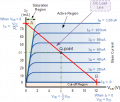
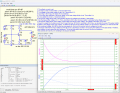
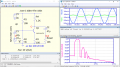
Here is an example of a common emitter amplifier I-V curve with load line.
If you wish, you can design for the transistor operating at the Q-point (quiescent point) when there is no input signal applied. I am not designing for the Q-point. I am designing for base bias resistor R1 when the maximum base current is required.
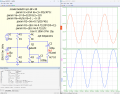
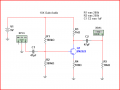
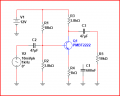
Here are my calculations to guide you. (I have rounded the numbers.)
Vcc = 9 V, selected
R3 = 1k Ω, selected
Av = 10, selected
R4 = R3 / Av = 100 Ω
Ic = Vcc / (R3 + R4 ) = 8.2 mA
β = 100
IB = Ic / β = 0.08 mA
Vc =Vcc - Ic x R3 = 0.8 V
VE = Ic x R4 = 0.8 V
VB = 0.65V + VE = 1.45 V
R1 = (Vcc - VB) / IB = 100k Ω
R2 = R1 x VB / (Vcc - VB) =19k Ω
Because I did not include the current to be drawn from the voltage divider, after simulating the circuit, R2 needed to be increased to 25k Ω.
If R1 is calculated using the Q-point, R1 becomes 200k Ω and R2 is adjusted to 250k Ω to obtain results similar to the first example. Clearly, the transistor is starved from insufficient base current since the value of R1 is too high.
To demonstrate how the choice of R1 is not critical, you can make R1 as low as 10k Ω and R2 adjusted to 1.5k Ω. What changes is the input impedance.
Question:
What is the purpose of your design values (calculation) Ic=8.2mA and VC=VE=0.8 volts ?
Instead, the circuit diagram shows Vc=4.55 V and VE=0.45 V (and the current is Ic=4.55 mA)
Question:
What is the purpose of your design values (calculation) Ic=8.2mA and VC=VE=0.8 volts ?
Instead, the circuit diagram shows Vc=4.55 V and VE=0.45 V (and the current is Ic=4.55 mA)
I would follow the classical method for designing such a simple stage (Based on some of your example values):
* Given Vcc=9V and Av=-10
* Select Rc and Ic
* Why not Ic=4mA and Rc=1k (Ic*Rc gives about 40...50% of Vcc, rule of thumb)
* Av=10, therefore Re=0.1k (1/gm=25m/4m=6,25 ohms can be neglected against RE=100 ohms in the first step)
* VE=4m*0.1k=0.4 V and VB=0.4+0.7=1.1V
* Not knowing about B we can assume Ib=Ic/100
* Classical rule of thumb: Current through divider Id=10*Ib
* Selection: R1=(Vcc-Vb)/11*Ib
* R2=Vb/10*Ib
* Comment:
Uncertainties of B (and Vbe=0.7 V) are not very important due to a voltage divider which is less sensitiv to Ib.
More than that, negative feedback caused by Re makes insensitive to Vbe=0.7 V
The situation improves for divider current k*Ib with k=15 or 20.
I would follow the classical method for designing such a simple stage (Based on some of your example values):
* Given Vcc=9V and Av=-10
* Select Rc and Ic
* Why not Ic=4mA and Rc=1k (Ic*Rc gives about 40...50% of Vcc, rule of thumb)
* Av=10, therefore Re=0.1k (1/gm=25m/4m=6,25 ohms can be neglected against RE=100 ohms in the first step)
* VE=4m*0.1k=0.4 V and VB=0.4+0.7=1.1V
* Not knowing about B we can assume Ib=Ic/100
* Classical rule of thumb: Current through divider Id=10*Ib
* Selection: R1=(Vcc-Vb)/11*Ib
* R2=Vb/10*Ib
* Comment:
Uncertainties of B (and Vbe=0.7 V) are not very important due to a voltage divider which is less sensitiv to Ib.
More than that, negative feedback caused by Re makes insensitive to Vbe=0.7 V
The situation improves for divider current k*Ib with k=15 or 20.
Your method chooses divider current ID = 10 x IB where as my method chooses ID = 2 x IB.
Your method gives R1 = 18k Ω and R2 = 2.75k Ω.
Your "rule of thumb" of ID = 10 x IB clearly gives more acceptable results. You win.
I will revise my "rule of thumb" to ID = 5 x IB using my value of Ic = Vcc / (Rc + RE),
or ID = 10 x IB using Ic = (Vcc / 2)/ (Rc + RE). Same difference.
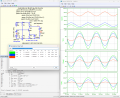
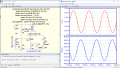
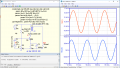
I decided to show how the impedance of the signal source affects. In this case, I assumed that an electret microphone with an output impedance of 2K was used. I set three collector current values. And despite the fact that with a higher current, the steepness of the transistor is greater, the output signal turned out to be the smallest at the maximum current!
Perhaps the questioner is interested to know if there is any practical upper limit for voltage gain - and how to find such a limit.
Here is my rough calculation:
When there is a (large) capacitor Ce in parallel to the emitter resistor Re the voltage gain is Av=-gm*Rc.
The transconductance gm (slope of the Ic=f(Vbe) characteristic) can be easily found: gm=Ic/Vt.
The temperature voltage Vt can be assesed to be Vt=25mV.
Allowing app. 40% of the supply voltage Vcc for the product Rc*Ic (for nearly symmetric operation around the bias point), we have app. 60% of Vcc for Vce (50%) and Ve=IeRe (10%). For these assumptions, the max. possible voltage gain is
Av,max=-0.4*Vcc/0.025=-16*Vcc.
For Vcc=9V the maximum possible gain is app Av, max=-144.
This upper limit for the voltage gain Av can be, of course, increased (by a factor of app 1.5...2) if we allow a smaller output amplitude range (because of unsymmetric clipping of the pos. or neg. amplitude). In this case, either Rc or Ic (and with it gm) should be somewhat increased.
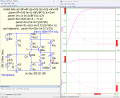
Here is a circuit in which the first transistor amplifies ~ 1700 times, and the second transistor repeats the signal, i.e. its amplification is ~ 1 time.
Here is a circuit in which the first transistor amplifies ~ 1700 times, and the second transistor repeats the signal, i.e. its amplification is ~ 1 time.
Yes - this is an interesting combination.
* However, this effect needs the second transistor for coupling back the output signal.
The principle of this transistor combination can be described as dynamic increase of the collector resistance R5 - similar to the well-known "bootstrap effect" which enlarges the input resistance of a transistor stage.
* Another example for exploiting the dynamic resistance of a device is the differential amplifier with a transistor-based current source in the common emitter path and a current mirror in the collector path. In both cases, the ohmic resistors R are replaced by dynamic/differential resistances r_ce.
Mr.Chips, Your circuit was very good at THD 0.10% The 2N2222 model in my simulator likes the ratio for R1 and R2 to be 2:1
I tested it with simulator, wanted to optimize it. It likes a base bias current of 50uA.
R3 dissipates 31.3 mW and Q1 dissipates 15.9 mW average power. It performs well on spectrum analyzer.
It is a nice single NPN audio amplifier circuit and it is one of the better ones. Thanks for sharing!
...................................
I tested it with simulator, wanted to optimize it. It likes a base bias current of 50uA.
.................................
Sparky 1 - the problem with your circuit are the resistors (voltage division) at the base node.
The problem becomes obvious when you compare the current through the divider with the curent into the base.
It should be our aim to make the base potential as less sensitive as possible to the base current which has huge tolerances.
That means: The voltage at the base node should be as "stiff" as possible (as far as allowed from the viepoints power consumption and input resstance).
More than that, the DC stabilization (negative feedback) caused by he emitter resistor works best only in case of a stiff base voltage.
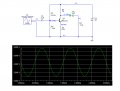
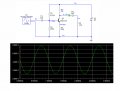
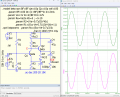
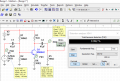
Many Multisim users are illiterate. In addition, the inferiority of Multisim also contributes to its contribution - the bad model of the 2N2222 transistor has VAF= 10.If you look at the input and output probes in the picture below, you can calculate a gain of 3.34/0.4=8.35, i.e. not 10 at all. Additionally, the greatly underestimated VAF=10 value reduced the gain. It's funny, because this transistor is used by many Multisim users in their educational electronic circuits.
NPX PMBT2222 model and more base current. Bypass connected also works.
It went smoothly after increasing the voltage source.
Like open source Linux operating system and applications that had large support.
I think the incentive for semiconductor companies and sales to maintain models to insure clients are happy.
Simulation teachers may spend less time explaining bugs and have better user interface.
This simulation output should include an audio spectrum analyzer with sufficient resolution.

 Facebook
 Google
 GitHub
 Linkedin