Common Diodes

Thread Starter

jethro99

Joined Oct 31, 2020
66
Given enough exotic sensitive test equipment, if positive voltage were to be applied to the cathode side of standard common diode would it be possible to measure some positive voltage on the anode side? In other words, diode is connected backwards. Assume the voltage applied to be ~ 15 volts.

I am not seeing any voltage across the diode when using a typical digital volt meter.
 

Ian0

Joined Aug 7, 2020
13,131
Yes. The leakage current of a 1N4148 is 25nA. If you connect a 10MΩ resistor from the anode to ground, and connect the cathode positive, you should be able to measure a voltage across it, which should be a maximum of 250mV
 

dl324

Joined Mar 30, 2015
18,326
Given enough exotic sensitive test equipment, if positive voltage were to be applied to the cathode side of standard common diode would it be possible to measure some positive voltage on the anode side? In other words, diode is connected backwards. Assume the voltage applied to be ~ 15 volts.

I am not seeing any voltage across the diode when using a typical digital volt meter.
Show how things are connected and specify the input impedance of your meter.
 

Papabravo

Joined Feb 24, 2006
22,082
All diodes have a reverse breakdown characteristic. In a Zener diode it is more controlled and predictable, but in ordinary diodes, not so much.
 

panic mode

Joined Oct 10, 2011
4,974
there is always leakage current - even in insulators ... or vacuum. and there is a device called insulation tester or high pot tester just for such purpose - determining breakdown limits of insulation (voltage and current).
modern components are far cry compared to components from the past, which is the reason you don't the old Selenium rectifiers any more.

why don't you tell what your multimeter specs are, what diode you tested it with and how.
most of common DMMs are 10MOhm when measuring voltage and most are still 3.5 digits meaning that even on lowest setting (200mV) you only can see down to 0.1mV. to see anything in such scenario, leakage current would need to be at least
0.1V/10Meg = 0.00000001A = 0.01uA

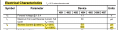
datasheet for something like 1N400x tells that max leakage current is 5uA at rated voltage. that is worst one should ever expect to see - normally that current is much smaller. easily 100x smaller. they just needed to spec the value that would never be crossed.

next - your test was done with 15VDC. for diode such as 1N4004, rated DC blocking voltage is 400V. for 1N4007 it is 1000V.
reality is that nobody is retooling or changing process to make each of the kind of 1N400x diodes, they just make the best one 1N4007 and depending on market needs labels some batches as lower grade products like 1N4001 or 1N4002 etc

so to really see such low leakage current you would just need a better meter and do the test with higher voltage - or you need to blast it with a heat gun. actually that is a good thing to try on other components too. for example carbon resistors, trimmers and potentiometer. you would be surprised how much they drift. this is why metal film parts are much better.
 

MisterBill2

Joined Jan 23, 2018
27,506
Measuring a reverse voltage with a diode reverse biased is not likely to produce results. Measuring reverse CURRENT will provide you with some useful information. The reverse current will depend on the reverse voltage applied, it will be a rather small amount below the specified breakdown voltage of the diode.
 
A typical digital multimeter (DMM) likely wouldn't show any significant voltage on the anode side of a standard diode connected backwards (with positive voltage to the cathode) at 15 volts.
This is because:
1: Leakage current
2: DMM Limitations
3: Reverse Biasing of Diode

With very sensitive equipment, you might be able to observe:
1: Voltage drop
2: leakaage current

if you want to verify the diode's functionality without exotic equipment, you can try:
1: forward bias test
2: Diode tester function
 
Given enough exotic sensitive test equipment, if positive voltage were to be applied to the cathode side of standard common diode would it be possible to measure some positive voltage on the anode side? In other words, diode is connected backwards. Assume the voltage applied to be ~ 15 volts.

I am not seeing any voltage across the diode when using a typical digital volt meter.
When you apply a positive voltage to the cathode side of a diode (connecting it backward), the diode is in reverse bias. In this configuration, the diode is not conducting current in the usual sense, so you should not see a significant voltage drop across it using a typical digital voltmeter.

In reverse bias, a small leakage current can flow through the diode due to minority carriers, but this current is usually very low, typically in the range of microamps (or even less for standard silicon diodes). As a result, the voltage drop across the diode is minimal and may not be detectable with a typical digital voltmeter, especially if it has a high input impedance.

However, if you use specialized test equipment such as a sensitive high-impedance voltmeter or an oscilloscope with high input impedance, you might be able to detect a small reverse voltage across the diode. Additionally, if the voltage applied is significantly higher than the reverse breakdown voltage of the diode, you might observe breakdown effects such as avalanche breakdown, where the reverse voltage suddenly drops as the diode conducts in reverse breakdown. However, this is typically not desired or recommended for standard diodes, as it can damage the diode.

In summary, while it's technically possible to measure some reverse voltage across a diode under certain conditions and with specialized equipment, it's not something you would typically observe with a standard digital voltmeter in normal operation.
 

MisterBill2

Joined Jan 23, 2018
27,506
There would be a SMALL REVERSE CURRENT that might result in a small measured reverse voltage.
As the reverse voltage is increased this may increase. Above the specified maximum reverse voltage the current can be expected to increase a lot faster. THAT is why the reverse voltage specification is so important.
 

crutschow

Joined Mar 14, 2008
38,503
You should be able to see a small voltage with a multimeter if it has a 10 megohm input impedance.
Try warming the diode (such as with a hair dryer) as that will increase the reverse current.
 

MrChips

Joined Oct 2, 2009
34,807
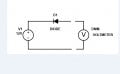
Let us examine the theory.
Diode reverse voltage.jpg
In theory, there is no voltage differential between the anode and cathode of the diode. Hence there should be 12V measured across the voltmeter.

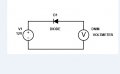
What happens in practice?
Diode reverse bias.jpg

In practice, the voltmeter leaks away any charge on the anode because the voltmeter has internal resistance.
Let us assume that the internal resistance of the DMM is 10MΩ which is a common case.

If the leakage current is 1nA, the voltage registered on the meter is:

V = I x R
V = 1nA x 10MΩ = 10mV = 0.01V

If the leakage current is 1μA, the voltage registered on the meter is:
V = 1μA x 10MΩ = 10V

Thus, for a diode with very low leakage current, the voltage measured will be very low.
Try this experiment with a 1N5817 Schottky rectifier which has much higher leakage current.

In summary, the voltage measured will depend on the reversed bias leakage current of the diode and the internal resistance of the voltmeter.
 
Top