Facebook
 Google
 GitHub
 Linkedin

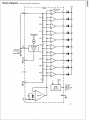
The 391x series takes a different approach to envelope detection - it lets you brain do it. The input stage is designed to clip off the negative half-cycles of the incoming audio, acting as a precision half-wave rectifier. But after that there is no integrating capacitor. The signal goes straight to the comparators, so the LEDs blink one every cycle of every note with a brightness that is proportional to that half-cycle only. Your retina and brain smooth this out to what appears to be a light that follows the energy of the note. Because of this, you might not need the two diodes and shunt capacitor after the BPF, just the series cap and shunt R to shift the DC down to the 3914 input range.
If by first amp you mean the one after the input pot, a gain of 1000 is too high. At 10 kHz that is a gain-bandwidth of 10 million; that's a lot. What is your highest frequency of interest for the color organ, and what is the input signal level?
ak
If by first amp you mean the one after the input pot, a gain of 1000 is too high. At 10 kHz that is a gain-bandwidth of 10 million; that's a lot. What is your highest frequency of interest for the color organ, and what is the input signal level?
ak