Facebook
 Google
 GitHub
 Linkedin
Hello all first time poster.
I'd appreciate some advice concerning a little project I've been working on.
My university class has been assigned the task of designing a coil-winding machine.
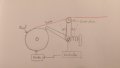
As a part of my team I've been assigned the task of designing the tension control subsystem, which resembles this (Top down view):

For the bobbin to be properly wound up the tension in the wire must remain constant, so I've come up with the above lever-arm design. As the tension in the wire increases/decreases above/below it's optimal tension, the lever arm moves away from it's null position, and thus sends a signal to the controller. Depending upon the arm's position, the controller sends a signal to the brake, causing it to increase/decrease the reel's friction until it returns to the null position.
I'd like some advice concerning the position sensor portion of the controller. My first thought was to use a potentiometer as a voltage divider, to manage the voltage supplied to the brake (Which will be either an electromagnetic brake or a disc brake). I've also considered using a rotational encoder instead, so I could perhaps hook up a microcontroller to the system, as I've read they can send out digital outputs.
Are there any other considerations I need to account for in designing this circuit (Power dissipation etc) that I may have missed? I've never designed a circuit from scratch before, so I'm not sure where exactly to start, aside from some resistors to limit the amount of current the brake receives.
Any assistance would be appreciated.
I'd appreciate some advice concerning a little project I've been working on.
My university class has been assigned the task of designing a coil-winding machine.
As a part of my team I've been assigned the task of designing the tension control subsystem, which resembles this (Top down view):
For the bobbin to be properly wound up the tension in the wire must remain constant, so I've come up with the above lever-arm design. As the tension in the wire increases/decreases above/below it's optimal tension, the lever arm moves away from it's null position, and thus sends a signal to the controller. Depending upon the arm's position, the controller sends a signal to the brake, causing it to increase/decrease the reel's friction until it returns to the null position.
I'd like some advice concerning the position sensor portion of the controller. My first thought was to use a potentiometer as a voltage divider, to manage the voltage supplied to the brake (Which will be either an electromagnetic brake or a disc brake). I've also considered using a rotational encoder instead, so I could perhaps hook up a microcontroller to the system, as I've read they can send out digital outputs.
Are there any other considerations I need to account for in designing this circuit (Power dissipation etc) that I may have missed? I've never designed a circuit from scratch before, so I'm not sure where exactly to start, aside from some resistors to limit the amount of current the brake receives.
Any assistance would be appreciated.

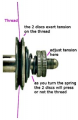
 See my first thought< attached.