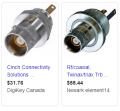
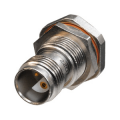
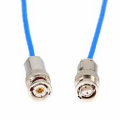
They used to be a common item for 75Ω twinax to the cable terminal on the back of TV sets. Probably have some hidden away in a junk box, BUT they are 75Ω as is twinax. Just what are you trying to connect at what impedance? Seems that now there is another kind of twinax than what I used to deal with as a HAM.
They used to be a common item for 75Ω twinax to the cable terminal on the back of TV sets. Probably have some hidden away in a junk box, BUT they are 75Ω as is twinax. Just what are you trying to connect at what impedance? Seems that now there is another kind of twinax than what I used to deal with as a HAM.
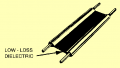
@eetech00 I haven't seen that stuff in years but yes, it was basically a 300Ω to 75Ω (RG-59?) transformer. What we called twinax (plastic flat 2-wire antenna "cable") is not what they are now calling twinax for data transmission networks. That old stuff had no ground shield like a true coax. Just a cheap form of the very old Ladder-Wire for antennas.
@eetech00 I haven't seen that stuff in years but yes, it was basically a 300Ω to 75Ω (RG-59?) transformer. What we called twinax (plastic flat 2-wire antenna "cable") is not what they are now calling twinax for data transmission networks. That old stuff had no ground shield like a true coax. Just a cheap form of the very old Ladder-Wire for antennas.
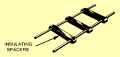
Only a few antenna systems (fixed frequency VHF emergency radio systems) were still using ladder-lead feed systems when I was in, almost everything was HELIAX pressurized coax cables to antennas like this.
I just noticed that here on the video, they have what we called, the 'Coke Machine', it was TS/SCI rated secure voice switcher.
The RED equipment cabinet in the receiver technical control space.
@eetech00 I haven't seen that stuff in years but yes, it was basically a 300Ω to 75Ω (RG-59?) transformer. What we called twinax (plastic flat 2-wire antenna "cable") is not what they are now calling twinax for data transmission networks. That old stuff had no ground shield like a true coax. Just a cheap form of the very old Ladder-Wire for antennas.
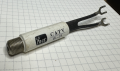
The coupler I remember had a coax connector with a barrel type body containing a transformer. The twin-lead stuck out the other end with each wire terminated with spade terminal.
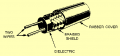
The Twinax cables that I am familiar with were for linking computers MANY LONG YEARS AGO. That stuff had a differential pair inside a single coaxial shield.We had hundreds of pounds of it and never found a decent use for it because of te strange connectors.
The Twinax cables that I am familiar with were for linking computers MANY LONG YEARS AGO. That stuff had a differential pair inside a single coaxial shield.We had hundreds of pounds of it and never found a decent use for it because of te strange connectors.
I found this after a few minutes of rooting through the junk tubs. It's the opposite of what I was looking for. This is one used for TVs with screw terminals instead of a coax port to bring cable TV to screwed connections. Yeah, we also called it twin lead but around here ~45 years ago it was also being called twinax albeit probably improperly so. I looked around and found already terminated twinax cables but not the terminals alone.
Yes, "twin lead" is 300Ω unshielded parallel transmission line. It was conveniently matched to folded dipoles. Twinax is the parallel conductor version of coax—hence the name. It's basically balanced line shielded pair.
The "Twinaxial" cable was never ever used for Television applications. It was a computer interface .
Twin LEAD is an entirely different animal still used for some varieties of antennas and connections. Totally different in every aspect.
The "Twinaxial" cable was never ever used for Television applications. It was a computer interface .
Twin LEAD is an entirely different animal still used for some varieties of antennas and connections. Totally different in every aspect.
Just a nitpick: Twinax has properties that makes it very useful for some applications that have nothing to do with computer networking. Any place high frequency differential signaling is needed twinax (shielded twisted pair) is a candidate. It is also used in connection of sensors, and interconnection of test gear in noisy environments.
Just a nitpick: Twinax has properties that makes it very useful for some applications that have nothing to do with computer networking. Any place high frequency differential signaling is needed twinax (shielded twisted pair) is a candidate. It is also used in connection of sensors, and interconnection of test gear in noisy environments.

 Facebook
 Google
 GitHub
 Linkedin