Closed loop system

MrAl

Joined Jun 17, 2014
13,720
Hi,

Yes. This is a good starter for this procedure however keep in mind there are somewhat more modern ways of doing it now, namely, by repeatedly stepping the variable in question and solving for the roots and simply plotting them as points, and when you get enough points plotted you see the entire root locus. The way they do it in the link is the old way but it has been used for a long time and so it is still informative and educational for sure.
After you check out some of those examples the idea is to apply it to this problem, if that is possible. If not we will have to plot the response in a simulator and decide what to do. The stability depends on both the gain and the time constant, but i dont know waht you are allowed to change in this problem you'll have to tell me that. You can most likely change the gain, but can you change the time constant too.

This seems to be very well written too i was lucky to find it...
https://lpsa.swarthmore.edu/Root_Locus/RLocusExamples.html

The most important part is to be able to form the proper equation for doing the procedure with because that's really the key to it, and there are different ways to find the roots so that's secondary really.
Take a look and see what you can get from it.

BTW you never told me what simulator you use or if you even use any simulator yet.
 

MrAl

Joined Jun 17, 2014
13,720
Hello again,

I hope you made some progress with the procedure outlined in that link.
In the mean time, i have found a couple ways to solve for the root locus or at least for when the real part crosses the jw axis for the plant in this problem without the controller yet and i think the results are informative. I think it is interesting to find this information about the plant itself without anything else.

However, it also seems that in this kind of problem we would not have much control over the gain and the time constant of the plant itself in real life, so we would concentrate more on the controller. The controller in the form of a PI controller may be simpler to solve for. I will be looking for ways to do that next.

Investigating the plant itself we can find the point where it becomes an oscillator, and then know we have to stay far away from that because the response become more and more oscillatory as the real part approaches the jw axis even though it may not reach that point.

Looking at the closed loop transfer function without an extra controller, we might notice that in the numerator we see a 'delay' but in the denominator we see two terms that amount to the minimum terms that would be needed for periodicity, and that turns the 'delay' into a pulse. The denominator also has an extra 's' term however, and that combined with the constant term '1' acts like a low pass filter. So in effect we end up with a repeating pulse that is filtered by a low pass filter. The 'K" constant in the denominator however complicates that a little more, by perhaps turning that pulse into an impulse for higher values of K. In the end we end up with a response that looks like an integrated pulse train.
When we add the controller though this will change and we should be able to get a good response for any plant gain and time constant.

I also found that LT Spice, at least the version i am using, does not represent transfer functions like this one very well when the response becomes unstable. It can handle the response when it is stable, but cant do every well when it has a gain factor that causes the real response to become unstable. Instead of showing an increasing oscillatory response it shows a response that looks stable!
Now this could be because of the version of LT Spice that i am using so i might ask other members to try to reproduce the problem i am seeing with it.
 

MisterBill2

Joined Jan 23, 2018
27,652
Hello again,

I hope you made some progress with the procedure outlined in that link.
In the mean time, i have found a couple ways to solve for the root locus or at least for when the real part crosses the jw axis for the plant in this problem without the controller yet and i think the results are informative. I think it is interesting to find this information about the plant itself without anything else.

However, it also seems that in this kind of problem we would not have much control over the gain and the time constant of the plant itself in real life, so we would concentrate more on the controller. The controller in the form of a PI controller may be simpler to solve for. I will be looking for ways to do that next.

Investigating the plant itself we can find the point where it becomes an oscillator, and then know we have to stay far away from that because the response become more and more oscillatory as the real part approaches the jw axis even though it may not reach that point.

Looking at the closed loop transfer function without an extra controller, we might notice that in the numerator we see a 'delay' but in the denominator we see two terms that amount to the minimum terms that would be needed for periodicity, and that turns the 'delay' into a pulse. The denominator also has an extra 's' term however, and that combined with the constant term '1' acts like a low pass filter. So in effect we end up with a repeating pulse that is filtered by a low pass filter. The 'K" constant in the denominator however complicates that a little more, by perhaps turning that pulse into an impulse for higher values of K. In the end we end up with a response that looks like an integrated pulse train.
When we add the controller though this will change and we should be able to get a good response for any plant gain and time constant.

I also found that LT Spice, at least the version i am using, does not represent transfer functions like this one very well when the response becomes unstable. It can handle the response when it is stable, but cant do every well when it has a gain factor that causes the real response to become unstable. Instead of showing an increasing oscillatory response it shows a response that looks stable!
Now this could be because of the version of LT Spice that i am using so i might ask other members to try to reproduce the problem i am seeing with it.
Really, the controller needs to have a derivative term available, since overshoot and instability are far more likely to be caused by insufficient derivative compensation. The most useful function of the integral compensation is reducing the error after the new point is reached.
 

MrAl

Joined Jun 17, 2014
13,720
Really, the controller needs to have a derivative term available, since overshoot and instability are far more likely to be caused by insufficient derivative compensation. The most useful function of the integral compensation is reducing the error after the new point is reached.
Hi,

Well a lot of systems become very stable after adding an integrator in the forward path. But i'll wait until i go farther with this to see what happens.
You might be interested to know that the system is already stable with low enough value of K. It acts like a low pass filter because that periodicity part in the denominator becomes less effective while the low pass part takes over. So we see a little tiny overshoot then settling to a constant DC value. I could show some result graphs i guess.
It's kind of interesting how that delay complicates the problem.

As a side issue, have you used LT Spice to plot a Laplace Transform directly and if so did you run into any problems with LT Spice.
 

MisterBill2

Joined Jan 23, 2018
27,652
Hi,

Well a lot of systems become very stable after adding an integrator in the forward path. But i'll wait until i go farther with this to see what happens.
You might be interested to know that the system is already stable with low enough value of K. It acts like a low pass filter because that periodicity part in the denominator becomes less effective while the low pass part takes over. So we see a little tiny overshoot then settling to a constant DC value. I could show some result graphs i guess.
It's kind of interesting how that delay complicates the problem.

As a side issue, have you used LT Spice to plot a Laplace Transform directly and if so did you run into any problems with LT Spice.
I have not used spice to model a servo or feedback system. Our general procedure would be to start the system with no derivative or integral feedback, and increase the gain until there was a small amount of overshoot. Then we would add some derivative feedback to stablize it and boost the gain some more. 2 or three iterations would usually get us very close. After that it was working toward getting the fastest response without any bad overshoot. It was done that way because we did not have adequate math models of the hardware.
 

MrAl

Joined Jun 17, 2014
13,720
I have not used spice to model a servo or feedback system. Our general procedure would be to start the system with no derivative or integral feedback, and increase the gain until there was a small amount of overshoot. Then we would add some derivative feedback to stablize it and boost the gain some more. 2 or three iterations would usually get us very close. After that it was working toward getting the fastest response without any bad overshoot. It was done that way because we did not have adequate math models of the hardware.
Hello again,

Well thanks for that info. I hope to be looking into this soon.

I think perhaps our interpretations of 'stabilize' might be a little different.
When i say stabilize, i mean that the solution is either completely oscillatory or too oscillatory for the application. In this context i dont think i have ever heard anyone associate added derivative control with stabilization. Derivative control usually quickens the response time. However, in the design of a controller derivative control may be added in the process of trying to 'compensate' the system response and so as a whole it may be confused with stabilization which i take as a separate concept.

Also, since there is a delay in this system i think it is even more of a concern when using derivative control because the response gets more oscillatory as the time constant gets smaller,

Another possibility is derivative feedback. Derivative control in the feedback is like an integration in the forward path. I could easily see this as helping to stabilize the system.

But as i said before, i'll look at it closer soon and see what i can find out. I'll get back here with some results.
 

MisterBill2

Joined Jan 23, 2018
27,652
Hello again,

Well thanks for that info. I hope to be looking into this soon.

I think perhaps our interpretations of 'stabilize' might be a little different.
When i say stabilize, i mean that the solution is either completely oscillatory or too oscillatory for the application. In this context i dont think i have ever heard anyone associate added derivative control with stabilization. Derivative control usually quickens the response time. However, in the design of a controller derivative control may be added in the process of trying to 'compensate' the system response and so as a whole it may be confused with stabilization which i take as a separate concept.

Also, since there is a delay in this system i think it is even more of a concern when using derivative control because the response gets more oscillatory as the time constant gets smaller,

Another possibility is derivative feedback. Derivative control in the feedback is like an integration in the forward path. I could easily see this as helping to stabilize the system.

But as i said before, i'll look at it closer soon and see what i can find out. I'll get back here with some results.
I ALWAYS use derivative control, first to allow a reasonable speed without excess overshoot, which is also the way to prevent oscillation. Overshoot is, after all, oscillation without enough gain to keep it going. So unless a large amount of error is OK, derivative feedback must be provided to keep the system stable. The math shows us that this is true, experience backs it up 100%.
 

MrAl

Joined Jun 17, 2014
13,720
Hello again,

I have a feeling we are saying the same thing just in a different way.

Derivative control in the forward path causes a faster response, which means it rises faster.

But on the other hand you seem to be saying that derivative control somehow makes the response more stable. If that is true, then maybe you can show me one system that works that way because i can show you one system that does not work that way although it can be used to get a better response time. If you do, please try to keep it simple as i will also.
 

MisterBill2

Joined Jan 23, 2018
27,652
Hello again,

I have a feeling we are saying the same thing just in a different way.

Derivative control in the forward path causes a faster response, which means it rises faster.

But on the other hand you seem to be saying that derivative control somehow makes the response more stable. If that is true, then maybe you can show me one system that works that way because i can show you one system that does not work that way although it can be used to get a better response time. If you do, please try to keep it simple as i will also.
Derivative control in the feedback path, where the speed of change is reduced as the error term becomes less. Closely related to proportional control, but not quite the same. One of the systems was used to set the pressure in an air tank to an exact value, which was used to drive a crash sled. The tank needed to pressurize rapidly, but any overshoot was wasting both time and energy. So as the difference was reduced the rate of change of the difference had to be reduced.. But due to only having an on/off fill control, and with the elastic nature of air, a derivative plus time function was used. It worked quite well, in reality. That was a sort of complex derivative control.
 

MrAl

Joined Jun 17, 2014
13,720
Hello again,

Oh yes that sounds interesting.
But now that we are talking about derivative in the feedback path i agree completely because derivative control in the feedback path is sort of like integration in the forward path (where a PID control often exists).

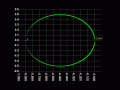
Here is a quick root locus plot of a system that is stable with Kd=0 (the small white dot labeled "0" but becomes more oscillatory as Kd increases up to 1000 in that plot. But that is when it is in the forward path.

Thanks for the example it's always interesting to hear about what other folks are doing out there.

System-0001.gif
 

Thread Starter

hero22222222222

Joined Dec 22, 2019
78
Hello again,

I hope you made some progress with the procedure outlined in that link.
In the mean time, i have found a couple ways to solve for the root locus or at least for when the real part crosses the jw axis for the plant in this problem without the controller yet and i think the results are informative. I think it is interesting to find this information about the plant itself without anything else.

However, it also seems that in this kind of problem we would not have much control over the gain and the time constant of the plant itself in real life, so we would concentrate more on the controller. The controller in the form of a PI controller may be simpler to solve for. I will be looking for ways to do that next.

Investigating the plant itself we can find the point where it becomes an oscillator, and then know we have to stay far away from that because the response become more and more oscillatory as the real part approaches the jw axis even though it may not reach that point.

Looking at the closed loop transfer function without an extra controller, we might notice that in the numerator we see a 'delay' but in the denominator we see two terms that amount to the minimum terms that would be needed for periodicity, and that turns the 'delay' into a pulse. The denominator also has an extra 's' term however, and that combined with the constant term '1' acts like a low pass filter. So in effect we end up with a repeating pulse that is filtered by a low pass filter. The 'K" constant in the denominator however complicates that a little more, by perhaps turning that pulse into an impulse for higher values of K. In the end we end up with a response that looks like an integrated pulse train.
When we add the controller though this will change and we should be able to get a good response for any plant gain and time constant.

I also found that LT Spice, at least the version i am using, does not represent transfer functions like this one very well when the response becomes unstable. It can handle the response when it is stable, but cant do every well when it has a gain factor that causes the real response to become unstable. Instead of showing an increasing oscillatory response it shows a response that looks stable!
Now this could be because of the version of LT Spice that i am using so i might ask other members to try to reproduce the problem i am seeing with it.
Hi thank you for asking about my progress.

The link you gave me really helped. I realised the question i asked was a bit to difficult for my level of understanding so i have decided to learn everything from the very basics.

Once i learn the basics ill come back to this question :)

thanks again for all the help you have given me
 

MrAl

Joined Jun 17, 2014
13,720
Hi thank you for asking about my progress.

The link you gave me really helped. I realised the question i asked was a bit to difficult for my level of understanding so i have decided to learn everything from the very basics.

Once i learn the basics ill come back to this question :)

thanks again for all the help you have given me

Hi,

Oh i was afraid of that happening. Really the root locus basic idea is very simple let me state it in words.
You are right though in that you should work with some of the non delayed systems first just to get the hang of the root locus procedure and the ideas behind that. But keep in mind the basic idea is very simple: form a particular equation knowing the gains in the system and then solve it.

With a feedback of just '1' (negative feedback system) and a forward gain of G, the equation to be formed is just:
1+G=0

Now since G has a numerator N and denominator D, we have;
1+N/D=0

This is really just an algebraic equation nothing more, although it does involve complex numbers. So you do need to know the algebra of complex numbers but that's not hard to learn.

To get that equation in a more workable form, multiply through by D and get:
D+N=0

Now either N or D or both are a function of the variable you want to explore the behavior of, so really we have:
D(k)+N(k)=0

Let's look at a simpler example and look for the key point to all this.

We have a system with forward gain K/(s+1) and we want to see what happens when we vary K.
First we set up the equation:
1+K/(s+1)=0

now multiply through by (s+1) and get:
s+1+K=0

Now for the full solution we would set s=a+b*j so we get:
a+b*j+1+K=0

but let's say we just want to find out where the system becomes a complete oscillator, and that is when a=0, so set a=0 and get:
b*j+1+K=0

The imaginary part is:
b*j=0
and the real part is:
1+K=0

The solution for b must be zero, and the solution for K must be -1.
The solution for b may not be that interesting, but the solution for K tells us that the system becomes an oscillator at K=-1 so we want to avoid that at all costs unless of course we are designing an oscillator.

Now if we wanted to find out other points on the complex plane, we could just step K and see what we get when 'a' is not zero.
The imaginary part is the same as before but the real part is then:
a+1+K=0

So solving this for 'a' we get:
a=-K-1

This is interesting because if we keep K positive, 'a' always comes out negative and that means it is stable for all K>-1. The only caution is that this is a strict view of stability and often we have to consider the settling time. The settling time is related to 'a' which is always negative for positive K so the more negative 'a' is the faster it settles. This is a secondary point however.

Just for reference, the original delayed system of this thread (post #16) becomes an oscillator when Kp=1.2497 when Tc=0.3 and Td=1, and k=1 (Tc is the time constant tau and Td is the time delay, and Kp is the controller gain with proportional control only for now).
That is again when 'a' reaches the jw axis.
That value is a little harder to find because it involves a little more algebraic work, but it's the same idea. You can also use a a simulator though if you test the simulator to make sure it handles these kinds of problems properly, or digitize the system and use a program to find the solution(s). The program i used comes up with the same number.
BTW one of the key points to the delayed systems is to convert the complex powers of 'e' (like e^-s) into their trigonometric forms first so they become more manageable. Still not particularly easy to solve sometimes but at least doable.
For example, the trig form for e^(-s*Td) with s=a+j*b is:
e^(-a*Td)*(cos(b*Td)-j*sin(b*Td))
As you can guess this doesnt make it super easy to solve the root locus expression but it does work.
 
Last edited:
Top