Circuits with diodes - II

Thread Starter

PsySc0rpi0n

Joined Mar 4, 2014
1,786
Morning... I'm back with some problems...

I'm trying to draw Vout for the attached circuit.

I was trying to use the nodal analysis but I don't know how to write the current for the middle vertical branch.
I should consider the ideal model for the diode (short circuit).

If I say that 3 currents exits the Vout node, I can write:

I1 + I2 + I3 = 0

(Vout-V(t))/R1 + ???? + Vout/100 = 0

I just don't know what to place on the ??? of the above equation!

PS: Ignore the 400 ohm of R3 resistor. It's 100 ohm.
 

Attachments

ericgibbs

Joined Jan 29, 2010
21,439
hi Psy,
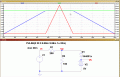
You know the Rate of rise/fall of the Triangular tooth source voltage.
Calculate the Rate/s at the junction of R1 and R3, you are give Vb =5V and its an ideal diode.
So determine the conduction period thru the diode and calc the RMS or Average current over that conduction period.
E
The 1N4007x diode model I have used, has been set for Vfwd very close to 0V.
 

Attachments

Last edited:

Thread Starter

PsySc0rpi0n

Joined Mar 4, 2014
1,786
hi Psy,
You know the Rate of rise/fall of the Triangular tooth source voltage.
Calculate the Rate/s at the junction of R1 and R3, you are give Vb =5V and its an ideal diode.
So determine the conduction period thru the diode and calc the RMS or Average current over that conduction period.
E
The 1N4007x diode model I have used, has been set for Vfwd very close to 0V.

Is that all needed to find the output equation in function of Vin?
 

WBahn

Joined Mar 31, 2012
32,829
Is that all needed to find the output equation in function of Vin?
It shouldn't be.

All you need to do if determine the voltage transfer characteristic for the circuit, i.e., a plot of Vout vs. Vin, which should be very simple since you've just done the same thing for a more complex multi-diode circuit. Then it's a simple matter applying that characteristic to the Vin signal.
 

ericgibbs

Joined Jan 29, 2010
21,439
Is that all needed to find the output equation in function of Vin?
Hi Psy.
Look at the V(vd) plot on the image I posted, that is the voltage transfer function of that circuit, so post the equation which produces that plot.
 

Thread Starter

PsySc0rpi0n

Joined Mar 4, 2014
1,786
Ok, I would say that D1 is ON for Vout >= 5.7V and D1 is OFF for Vout < 5.7V.

So,

\(
\displaystyle {V_{out} = \left\{\begin{matrix}
\frac{1}{3}\cdot V_{in}\,, V_{in} < 5.7V\\
5.7V\,, V_{in} \geq 5.7V
\end{matrix}\right.}
\)

Mr. EricGibbs, I'm assuming that diode is a 0.7V battery!
So when D1 is OFF we have a voltage divider between R1 and R2 for V_in value.
 
Last edited:

Thread Starter

PsySc0rpi0n

Joined Mar 4, 2014
1,786
Ok, nevermind. It's all the same but instead of Vin < 5.7V should be Vin < 5V and instead of Vin >= 5.7V should be Vin >= 5V, right???

Is the rest correct?
 

ericgibbs

Joined Jan 29, 2010
21,439
hi Psy,
Consider your transfer function post #56.
Is it possible for you to plot the transfer function, [as per the image in post #52], using pencil and paper, for that particular circuit, using your function.???

What is missing.?

E
 

Thread Starter

PsySc0rpi0n

Joined Mar 4, 2014
1,786
hi Psy,
Consider your transfer function post #56.
Is it possible for you to plot the transfer function, [as per the image in post #52], using pencil and paper, for that particular circuit, using your function.???

What is missing.?

E
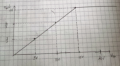
Well, I've done it again but I can't find the first condition in function of Vin!
 

Attachments

Last edited:

WBahn

Joined Mar 31, 2012
32,829
Ok, nevermind. It's all the same but instead of Vin < 5.7V should be Vin < 5V and instead of Vin >= 5.7V should be Vin >= 5V, right???

Is the rest correct?
Think about your limits here.

To find the critical value of Vin (the value where the diode just changes from being ON to OFF (or vise versa), pick the operating point for the diode that has it at that critical point where it is both ON and OFF at the same time. Namely, it has 0V across it but ALSO 0A through it. With that constraint, what is the corresponding value of Vin and Vout?
 

Thread Starter

PsySc0rpi0n

Joined Mar 4, 2014
1,786
Think about your limits here.

To find the critical value of Vin (the value where the diode just changes from being ON to OFF (or vise versa), pick the operating point for the diode that has it at that critical point where it is both ON and OFF at the same time. Namely, it has 0V across it but ALSO 0A through it. With that constraint, what is the corresponding value of Vin and Vout?

Have you seen what I posted just before your post? I have done it all again in paper. And considering the ideal diode as I have stated at the beginning to try to be consistent.

Then Mr. EricGibbs asked what was missing, and I think he's referring to the fact that is missing a third equation for the descending side of the input sawtooth wave form. But I don't know how to find it because the condition that turns the diode OFF is already stated for the rising part of the input waveform!

Anyway, answering to you, WBhan, that critical point should be Vin = 5V but I think I could also say that it is Vout = 5V.
 

WBahn

Joined Mar 31, 2012
32,829
Have you seen what I posted just before your post? I have done it all again in paper. And considering the ideal diode as I have stated at the beginning to try to be consistent.

Then Mr. EricGibbs asked what was missing, and I think he's referring to the fact that is missing a third equation for the descending side of the input sawtooth wave form. But I don't know how to find it because the condition that turns the diode OFF is already stated for the rising part of the input waveform!

Anyway, answering to you, WBhan, that critical point should be Vin = 5V but I think I could also say that it is Vout = 5V.
Yes, I saw what you posted just before my post, where you attached the diagram with the following transfer characteristic at the bottom:

upload_2015-6-29_20-45-26.png

This shows the critical point being at Vin=15V and Vout=5V
 

Thread Starter

PsySc0rpi0n

Joined Mar 4, 2014
1,786
Ok, so, what's missing there that Mr. EricGibbs was talking about? Was what I was saying about the descending part of the waveform?
And what about the condition I said that I couldn't find? I marked it red on my handmade work!
 

ericgibbs

Joined Jan 29, 2010
21,439
hi Psy,
We have said that you should always check your answer by using result in some way to verify the answer.
The manual plot of post #10 shows its OK.

Vd=5V when Vi/3 => 5V [diode On, conducting]
else
Vd = Vi/3 [diode Off, not conducting]
 

Thread Starter

PsySc0rpi0n

Joined Mar 4, 2014
1,786
I think you have selected 2 zeners instead of one zener and one diode.

And yes, I have downloaded the whole list of standard.xxx available at LTSpice wiki page, so I have plenty diodes, zeners, etc in my library!
 

ericgibbs

Joined Jan 29, 2010
21,439
Woops!
I posted the same file twice!.:( I will correct that and repost tomorrow.
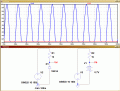
You could change one asc sim from zener to diode and re-run it yourself.
E

EDIT:
Corrected image for your diode.
My advice would be not to use batteries as an equivalent circuit for diode or zener.
 

Attachments

Last edited:

Thread Starter

PsySc0rpi0n

Joined Mar 4, 2014
1,786
Sure no problem... I'll change the .asc file.

You say I should not use batteries to replace the diode/zener. Why and what should I use? Regular voltage sources?
 

ericgibbs

Joined Jan 29, 2010
21,439
OK, I did post an edit.
The reason why not, is because a battery or voltage source will not give the correct response/result in your remodelled circuit.

Why would you want to use a battery or voltage source to replace a zener diode model.?
 
Last edited:
Top