Chokes and inductors preference

Thread Starter

Shaista_12

Joined Jun 10, 2023
1
Hi all,

I am trying to understand the preference between a choke and inductor in a DC to DC converter and a DC to AC inverter. Is a choke always used on the input side and an inductor/reactor on the output of the DC to AC converter if it is grid tied.

Thanks!
 

crutschow

Joined Mar 14, 2008
38,415
A choke is just a type of inductor.
It usually has a high inductance with a specific a function, which is often to significantly attenuate high frequencies, hence its name.

In general, an inductor has a specific inductance to perform other functions such as filtering certain frequencies or temporary energy storage in power converters.
 

nsaspook

Joined Aug 27, 2009
16,273
That's not an exact analogy, as all condensers are capacitors, but not all inductors are chokes (expect in a very loose sense of the term).

A better analogy might be automobile and vehicle.
+1
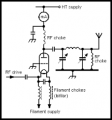
You often see chokes and inductors working together in a typical RF amplifier. The choke separates the generated RF from the DC/AC supply bus and the inductor tunes the RF output.

1686445811977.png

https://www.ctrengineeringinc.com/rf-chokes-and-inductors/
 

Ian0

Joined Aug 7, 2020
13,113
All the references I have checked seem to be struggling to identify a difference. For instance, if
The choke separates the generated RF from the DC/AC supply bus and the inductor tunes the RF output.
why is there DC on the antenna? That final choke connected to the antenna looks much more as though it is part of a tuned circuit, which would fit your definition of an inductor.

Wikipedia gets itself into a complete muddle
The name comes from blocking—"choking"—high frequencies while passing low frequencies. It is a functional name; the name "choke" is used if an inductor is used for blocking or decoupling higher frequencies, but the component is simply called an "inductor" if used in electronic filters or tuned circuits. Inductors designed for use as chokes are usually distinguished by not having low-loss construction (high Q factor) required in inductors used in tuned circuits and filtering applications.
so it's a choke if it blocks high frequencies and passes low frequencies (i.e. a filter) but an inductor if used in "filtering applications"?

OED gives "choke" as an abbreviation of "choking coil"
2. choking coil n. a coil of high inductance inserted in an alternating-current circuit to impede and cut down the current or to change its phase. Called also impedance or reactance coil.
1893 R. M. Walmsley Wormell's Electr. in Service of Man 644 An extremely pretty device known as a ‘choking’ coil.
1902 W. G. Rhodes Alternating Currents 83 Impedance coils, or choking coils, as they are often called, are simply coils having low ohmic resistance and high self-induction.
1962 S. Handel Dict. Electronics 52 Choke (Choking coil), an inductor designed to present a relatively high impedance to alternating current.
and inductor:
d. A device (commonly a coil) possessing inductance or used on account of its inductance.
1928 G. E. Sterling & R. S. Kruse Radio Man. i. 20 Iron Core Inductance.—This form of inductor is made by winding many turns of wire on an iron core.
1950 K. Henney Radio Engin. Handbk. (ed. 4) iii. 124 Straight wires are used as inductors in h-f applications where the inductance must be very low.
1963 G. E. Williams & B. J. Prigmore Electr. Engin. v. 129 A standard mutual inductor..can be made by winding coil No. 1 on a long straight core and winding No. 2 round the mid-portion of No. 1.
Perhaps the best definition is that a choke is for power and an inductor is for signals. In which case, in the context of the original question, they are all chokes.
 

crutschow

Joined Mar 14, 2008
38,415
Perhaps the best definition is that a choke is for power and an inductor is for signals. In which case, in the context of the original question, they are all chokes.
That's also an inaccurate distinction.
Inductors are often used for power purposes, such as switching power supplies.

A choke is usually used in RF applications to essentially block the RF signal, but it's not a tuned circuit, i.e. a specific inductor value with a specific capacitor value.
RF inductors are usually used in a tuned circuit.
 

nsaspook

Joined Aug 27, 2009
16,273
All the references I have checked seem to be struggling to identify a difference. For instance, if

why is there DC on the antenna? That final choke connected to the antenna looks much more as though it is part of a tuned circuit, which would fit your definition of an inductor.
Why is there DC on a antenna? Because big HF antennas are outside with the wind, dust and weather can produce large triboelectric effect static charges. Touching a ungrounded antenna can be a shocking experience. :eek: The choke is there is bleed that static to ground and is a safety factor in the rare case of HV tube coupling capacitor failure.
https://palomar-engineers.com/antenna-products/antenna-static-bleeders/
https://www.edn.com/rf-power-amplifier-safety/
 

MisterBill2

Joined Jan 23, 2018
27,316
That's not an exact analogy, as all condensers are capacitors, but not all inductors are chokes (expect in a very loose sense of the term).

A better analogy might be automobile and vehicle.
NONE of the condensers on my refrigeration systems are capacitors. "Choke" is an application description for an inductance used to resist the flow of alternating current, usually in a DC circuit..
 

Ian0

Joined Aug 7, 2020
13,113
But what is in the set of “inductors that are not chokes”?
The only thing I have found consistently to be named “inductor” but never “choke” are inductors in tuned circuits of radio equipment.
Resonant power supplies use both terms interchangeably for the “resonant” inductor.
Buck regulators use both terms for the output inductor.
Radio Frequency Chokes are used on both AC and DC signals.
 

Ian0

Joined Aug 7, 2020
13,113
Top