Choke = Inductor?

Thread Starter

ihayles

Joined Sep 24, 2010
3
I don't get chokes. I see them in EMI filters, typically, but if I analyze the differential equation for the choke, I basically get the same thing I'd expect for an inductor, but with L=L1+L2±M.

So why the special treatment? It's just a coupled inductor, right? The only thing that makes a bit of sense is that:

1) Greater inductance per material by coupling two inductors
2) "Tunable" inductance based on winding and coupling technique, easier manufacturability per a given inductance value

Any input on what's special about a choke vs. an inductor? Why do I always see them in EMI filters...I must be missing something. Inductors in EMI filters are few and far between.
 

Ghar

Joined Mar 8, 2010
655
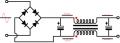
Are you talking about a configuration like this?
common-mode_choke.png
That's a common-mode choke.
For differential signals, like your signals or power, the common-mode choke ideally has no effect. That is, if you go around the loop you get:

Vsrc - Vchoke - Vload + Vchoke = 0
Vsrc = Vload

The 1:1 coupling makes the voltage across the choke cancel out for differential situations. Similarly differential signals don't saturate the core material because of this effect. This means you can have a small and very high permeability core material even with large DC currents.

For common mode current the choke appears as simply an inductor.
Common mode is a fairly abnormal situation you don't often think about and it's key in EMI, hence the use of common mode chokes in EMI filters.
Common mode is when both wires are carrying current in the same direction, the loop being closed by parasitic capacitance or an unintended conductive path somewhere else in the circuit.
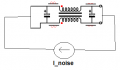
This would be what the choke is doing for common mode signals:
common-mode_choke2.png

That schematic there could be showing a ground loop for example. The choke would reduce the ground loop current.
 

Wendy

Joined Mar 24, 2008
23,862
Choke is indeed another name for inductor, they are meant to use for power supply circuits. I have several in my parts box. They use resistor color codes to mark the values.

In general the chokes that are the same sizes as resistors are pretty high resistance, the wires inside are smaller diameter.
 

sceadwian

Joined Jun 1, 2009
499
For a real world example why are there cars trucks and vans? They all have four wheels.. Application changes the appropriate word.
 

Thread Starter

ihayles

Joined Sep 24, 2010
3
Are you talking about a configuration like this?
View attachment 23108
That's a common-mode choke.
For differential signals, like your signals or power, the common-mode choke ideally has no effect. That is, if you go around the loop you get:

Vsrc - Vchoke - Vload + Vchoke = 0
Vsrc = Vload

The 1:1 coupling makes the voltage across the choke cancel out for differential situations. Similarly differential signals don't saturate the core material because of this effect. This means you can have a small and very high permeability core material even with large DC currents.

For common mode current the choke appears as simply an inductor.
Common mode is a fairly abnormal situation you don't often think about and it's key in EMI, hence the use of common mode chokes in EMI filters.
Common mode is when both wires are carrying current in the same direction, the loop being closed by parasitic capacitance or an unintended conductive path somewhere else in the circuit.
This would be what the choke is doing for common mode signals:
View attachment 23107

That schematic there could be showing a ground loop for example. The choke would reduce the ground loop current.
Thanks; this helps.

For the common mode signal case, I did KVL on the top and bottom branches...

The equations are...

I had resistors in there to ground, but it's even easier to see that if you let Rp=Rn=0, then In and Ip are as if the choke is just an inductor. Let M = 0 and the equations have the same form.

The the differential mode case, I did KVL around the loop...

The equation and analysis for perfect coupling with Lp=Ln shows what you mention...

So, really, chokes should be perfectly coupled with Lp=Ln. In this case, they're different than simple inductors in that the stop common-mode signals, but let differential ones pass, as Ghar mentioned.

Thanks for pointing me in the right direction!
 

Thread Starter

ihayles

Joined Sep 24, 2010
3
For a real world example why are there cars trucks and vans? They all have four wheels.. Application changes the appropriate word.
Indeed, inductors also are great for the city and commuting, saving you fuel, while chokes are great for hauling your kids and boat around while on vacation!
 

Ghar

Joined Mar 8, 2010
655
You're welcome, glad you worked it out.
It depends on the situation but you often don't want perfect coupling in a common mode choke so that you also get some amount of differential filtering.
EMI filters generally need to take care of both differential and common mode noise.
 
Top