ChatGPT

joeyd999

Joined Jun 6, 2011
6,456
Aside from the uncomfortable pauses and the characters' overall lack of emotion, this is pretty damn good and entertaining.

And it answers a question I've had for a very long time.


Bonus: I can't tell the difference between 'real' Data and AI Data. It seems that AI is excellent at simulating androids. Go figure.
 

ElectricSpidey

Joined Dec 2, 2017
3,358
Are you kidding, 30 seconds into the battle the Enterprise's reactor would start spewing steam, Data would malfunction, feelie lady would start to have a nervous breakdown, and the blue chick would go into heat and start trying to seduce the crew.
 

WBahn

Joined Mar 31, 2012
33,137
As people increasingly just accept the "Search Assist" results that many browsers are producing, they are increasingly likely to just take flat wrong information at face value.

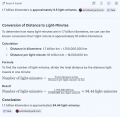
Example that I just encountered when replying to another thread to tell me how many light-minutes equals 1.7 billion km:

1788738217283.png


I didn't have any reason to question that result, but recognized that it was a bit more than one astronomical unit (the nominal distance from the Sun to the Earth). So I asked it how many kilometers is it from the Sun to the Earth:

1788738328540.png

That raised a huge red flag, so I went back to the first one and clicked the "More" button and got:


1788738135783.png

So, regardless of whether the number is the "Conclusion" is correct or not, it presented as the answer a value that was an order of magnitude different from its own conclusion!
 

nsaspook

Joined Aug 27, 2009
16,473
https://www.scientificamerican.com/...oughs-commit-research-misconduct-experts-say/
Like a number of recent AI breakthroughs, it pasted together ideas from the mathematical literature to build a new theorem. Once again, the LLM’s trick is its superhuman patience for assembling puzzle pieces, not the ability to make some profound intellectual leap.

In particular, Astra’s key mathematical step combined ideas first found in two papers from 2016 and 2019. Andreas Thom, a mathematician at the Dresden University of Technology, who co-authored the 2019 paper, summarized the result on MathOverflow.com, calling it “creative and at the same time elementary.”


OpenAI’s initial press release seemed to ignore—or be completely unaware of—these crucial, recent developments. Fournier-Facio argues that the two preceding papers show humans had not hit a stalemate with the soficity problem. OpenAI’s mathematicians did their best to attribute these ideas correctly in their paper, he says. But, in spite of their good intentions, “there is the big PR machine that wants to sound as impressive as possible and does not care about being 100 percent accurate,” he says.
 
Top