charging via bluetooth ..#2

MisterBill2

Joined Jan 23, 2018
27,523
Consider the amplitude of the loopstick antenna signal: It is microvolts, at best. So while theory predicts that it is sensing the magnetic field, the magnitude of such a magnetic field at a distance of a few hundred miles argues otherwise..
BUT no matter what, there is not a useful amount of power able to do useful battery charging.
My additional comments are with-held
 

nsaspook

Joined Aug 27, 2009
16,325
Are you missing my point, or just trying to argue? You originally said wirelessly charging was not RF because it is coupled by the magnetic field. I pointed out two other devices that are certainly considered RF and are coupled by the magnetic field. The you changed your argument to say that is not RF energy unless it a a propagated wave.

The distinction you are making, as I hinted at in my last post, is between the near-field and far-field EM interaction.

If you say that near-field wireless charging is not charging through propagated EM waves, I would completely agree with you.

As I have said twice, it is debatable which ones involve “RF energy.”

Think of a loop-stick on ferrite rod, the classic potable AM radio antenna. It couples to the magnetic field. The electric field has nothing to do with its reception.
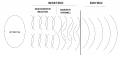
It interesting to see the actual RF data on the 2.4GHz charging devices for deeper implants. We see the characteristics of Fresnel Region interactions between source, receiver and the transmission media. True far-field EM interactions are not source position sensitive to mm distance changes causing large antenna path loss and pattern changes we see in the RF data on these devices.

1766780490238.png
 

BobTPH

Joined Jun 5, 2013
11,516
Consider the amplitude of the loopstick antenna signal: It is microvolts, at best. So while theory predicts that it is sensing the magnetic field, the magnitude of such a magnetic field at a distance of a few hundred miles argues otherwise..
Here is the AI summary:
A loopstick AM antenna's output is a weak, low-voltage electrical signal (induced voltage) representing the magnetic component of the AM radio waves, which is then fed into a tuned circuit (LC tank with a variable capacitor) to resonate at desired frequencies, amplifying the signal and sending it to the radio's receiver for demodulation into audible sound, effectively converting the magnetic field energy into a usable radio signal.
Which agrees with multiple explanations I looked up.
How are you proposing the signal is received, by magic?
BUT no matter what, there is not a useful amount of power able to do useful battery charging.
My additional comments are with-held
My first post in this thread pointed out that you cannot practically do wireless charging at a distance. I have never implied that you could.
 

MisterBill2

Joined Jan 23, 2018
27,523
ONE ADDITIONAL COMMENT: Do not believe that if one wanted something to be possible, the engineering team could make it so.
Our team WAS VERY GOOD, but reality is often brutal and unforgiving.
The laws of physics and thermodynamics are not actually broken even by a GREAT TEAM like ours was..
(Reply edited to remove one person's initials)
 
Last edited:

Ya’akov

Joined Jan 27, 2019
10,235
Are you missing my point, or just trying to argue? You originally said wirelessly charging was not RF because it is coupled by the magnetic field. I pointed out two other devices that are certainly considered RF and are coupled by the magnetic field. The you changed your argument to say that is not RF energy unless it a a propagated wave.

The distinction you are making, as I hinted at in my last post, is between the near-field and far-field EM interaction.

If you say that near-field wireless charging is not charging through propagated EM waves, I would completely agree with you.

As I have said twice, it is debatable which ones involve “RF energy.”

Think of a loop-stick on ferrite rod, the classic potable AM radio antenna. It couples to the magnetic field. The electric field has nothing to do with its reception.
I missed this, sorry.

I was talking to a person and wanted to communicate. As it the ordinary practice in discussing topics like this I used a combination of technical and vernacular usage. Their is not technical definition of "RF Energy", it is a vague, useful catchall for things that involve combined E and B field phenomena, at frequencies generally understood as above some intuited but undefined threshold. As a rule of thumb, one would expect "radio frequencies" to be above any frequency a human can sense directly.

But, how do I distinguish between magentically coupled signals and far field radiation effects without writing even more text to wade through? By looking at the title of this post and the reference to Bluetooth and contrasting that with the practical "long range" wireless charging. An air core transformer—a reasonable rhetorical reduction of wireless charging—even if operated at a frequency used by practical "radio" devices, would not be generally called and "RF device" when Bluetooth is part of the discussion.

So, no—I didn't want to argue, but I also didn't want to erase semantic distinctions into a cloud of qualifications. It's akin to someone saying "that's chemistry" and someone responding "you mean it's physics" when the point if calling it chemistry was to distinguish it from a mechanical phenomenon.

Sorry if I seemed argumentative, Your point is reasonable from your point of view and my objection wasn't based on something absolute or with technical precision.
 

MisterBill2

Joined Jan 23, 2018
27,523
One more thought about wireless charging in general, relative to"Bluetooth" signals that are intended for SAFE wireless connections at some distances: The power levels are very different!! The power levels needed (and used) for safe local are communications are not great enough for most useful charging applications. CLOSE magnetic field inductive charging is used for recharging a variety of medical devices, both implanted and worn. Those systems have FDA approval as far as safety. In those applications efficiency is not the foremost consideration. And they are certainly not wide field charging systems.

LONG RANGE FIELD charging, either magnetic or electrical field, will not meet safety requirements. So we will probably never be able to have a microwave hand warmer available.
 
Top