Charging 2s 18650 Using Solar

Thread Starter

ZChromium

Joined Dec 1, 2025
9
I have a project where i use the pic18f microcontroller and a couple of sensors to collect various data. Now the minimum voltage required to the board is 5v so i have to use a 2s1p 18650 configuration. Now the device that i am making will be outdoors. So i was thinking about using a solar module to charge the batteries. How would i go about doing that? I want the device to have a 24/7 uptime but i also read that the 18650 cannot charge via solar and discharge at the same time to keep my project running. Either i can charge my battery via solar or keep my project running. I don't know if i understand the concept clearly and require some help understanding the concept of charging via solar.
 

ericgibbs

Joined Jan 29, 2010
21,390
but i also read that the 18650 cannot charge via solar and discharge at the same time to keep my project running.
Hi ZC,
Welcome to AAC.
Please post a diagram of the project, also where did you read the text of the above Quote?

E
 

Thread Starter

ZChromium

Joined Dec 1, 2025
9
Hi ZC,
Welcome to AAC.
Please post a diagram of the project, also where did you read the text of the above Quote?

E
I have not yet implemented the charging via solar. I am just using a 2s1p 18650 configuration and have just connected the +ve and -ve wires to my device and nothing else.
I actually talked to technical support of a website via which i ordered my batteries. He said the above quote.

Thank you for your quick reply eric.
 

ericgibbs

Joined Jan 29, 2010
21,390
hi ZC,
What method are you using to drop the 7.4V down to 5V for the PIC.
Also, what is the Solar charger specification?

E
 

Thread Starter

ZChromium

Joined Dec 1, 2025
9
hi ZC,
What method are you using to drop the 7.4V down to 5V for the PIC.
Also, what is the Solar charger specification?

E
Hello Eric,
I am new to the world of embedded systems and pcbs. So forgive me but i don't have strong basics.
Currently, I am using the AMS1117 5v To Drop 12v To 5v. I want to optimise this setup and Use 2s1p instead of 3s1p.
I dont have a solar charger right now. As i do not understand the concept or the output voltage, output current required to charge this battery, i have yet to select a BMS for the battery and a solar module.

Thank you for your quick reply Eric.
 

Thread Starter

ZChromium

Joined Dec 1, 2025
9
hi ZC,
Look through this link for 18650 power converting modules, outputting 5v.
E
https://www.amazon.co.uk/s?k=18650+charger+pcb+module&crid=3LSXEPYOJ4YQH&sprefix=,aps,120&ref=nb_sb_ss_recent_1_0_recent


I use this type:
Hello Eric,
Thank you for your help.
Dropping down 7.4v to 5v is not an issue. I will figure that out later. Maybe use a buck converter to gain more efficiency. I dont know how to make my device so that it can last for 2 to 3 years. And for that i think that solar is the way to go. And unfortunately i am weak in concept of BMS and solar charging. Would you be kind enough help me in this regard?

Thank you
 

ericgibbs

Joined Jan 29, 2010
21,390
hi ZC,
Dropping from 7.4V down to 5V using linear regulators is inefficient.

In order to advise on powering your project, especially over a 2 to 3-year period, we need to know the power requirements of the project, also the best information regarding expected 'sunshine' levels for the panel location.

This will determine the Solar panel specification and the battery capacity.

E
 

Externet

Joined Nov 29, 2005
2,624
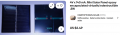
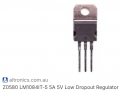
I would use two mini solar panels of 4 Volts each, each connected in parallel to each 18650 cell and no complications. The current capability of the panels under the recommended charging rate of the cells. Will power your circuit and recharge at the same time at daylight. Plus a low dropout linear regulator to supply the 5V circuit from the 8V battery. Something like :


1764599086931.png

1764600344195.png
 
Last edited:

jaclement

Joined Apr 15, 2009
60
I fi your project does not use too mach current ,you might be able to both charge 1
lithiom ion cell and simultaniously power you 5 volt circuit with these modlues.

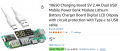
8Pcs 2A USB 18650 Lithium Li-ion Battery Charger Module Adjustable Boost Module DC-DC 3.7V to 5V 9V 12V Step Up Boost Module TP4056 DIY Kit Parts
 

Thread Starter

ZChromium

Joined Dec 1, 2025
9
hi ZC,
Dropping from 7.4V down to 5V using linear regulators is inefficient.

In order to advise on powering your project, especially over a 2 to 3-year period, we need to know the power requirements of the project, also the best information regarding expected 'sunshine' levels for the panel location.

This will determine the Solar panel specification and the battery capacity.

E
Hello Eric,
1) I know that droping down using LDO is inefficient. I will try to upgrade this in my later version. Right now i have already made a PCB with the AMS1117 5v.

2) Also after measuring via a multimeter, the peak consumption of my entire device is 53 mA. The multimeter shows a range between 45 mA to 53 mA. So I suppose the power requirement is 0.265 W/h => 6.3 W/day?

3) Honestly, there is no 'expected sunshine' time where i live. Somedays its 4 hours, Somedays its 10 Hours. It varies significantly based on the construction work going around where i live.

4) Also i would like to mention an important detail that i missed before. I am currently not using any BMS and am using 2s1p at 2000 mAh capacity to power my project.
 

Thread Starter

ZChromium

Joined Dec 1, 2025
9
I would use two mini solar panels of 4 Volts each, each connected in parallel to each 18650 cell and no complications. The current capability of the panels under the recommended charging rate of the cells. Will power your circuit and recharge at the same time at daylight. Plus a low dropout linear regulator to supply the 5V circuit from the 8V battery. Something like :


View attachment 359790

View attachment 359795
Hello Externet,
Thank you for your reply.

I actually want the solar module to be of 70 x 70 cm (if possible) so this panel is exactly what i want. i just want to confirm about the output current of this panel. It says 4v at 140 mA. the 18650s can Take upto 2A as charging current right? Like you say if i " use two mini solar panels of 4 Volts each, each connected in parallel to each 18650 cell" then won't the batteries eat up all the 140 mA of current leaving my device with minimal or zero current?
 

Thread Starter

ZChromium

Joined Dec 1, 2025
9
I fi your project does not use too mach current ,you might be able to both charge 1
lithiom ion cell and simultaniously power you 5 volt circuit with these modlues.

8Pcs 2A USB 18650 Lithium Li-ion Battery Charger Module Adjustable Boost Module DC-DC 3.7V to 5V 9V 12V Step Up Boost Module TP4056 DIY Kit Parts
Hello jaclement
Thank you for your reply
My current requirement is not actually that much. All in all even if i add some other modules in the future, it wont exceed beyond 300 mA at most. I dont know about the peak consumption but its average will be well below 300 mA.
I looked into the module that you provided. It lacks a protection circuit to protech from overdischarge.
Also i am concerned related to its heating. The Tp4056 heats well over 80 degree celsius even when charging a single 18650. So is it a nice idea to use this module to charge my device which will be in direct sunlight?
 

jaclement

Joined Apr 15, 2009
60
Its a cheap device ,certantly won't survive 80 degrees C IO use them for low current projects becuase I can easily get a fixed voltage output in a cheap way, with just one cell .It supplies 12 volts to a receiver and relay that gives me a remote swich in a small plastic box that I use when I am fixing my irrigation leaks in the yard . That way I can turn the water on and off as I find and fix the leak rather than going back to the controller.

DieseRC 433Mhz Universal Wireless Remote Control Switch DC 12V 1CH RF Relay Receiver Module with 1 Transmitter, EV1527 Learning Code Remote Switch
Sold by: Wenqia Electronic
 

Externet

Joined Nov 29, 2005
2,624
then won't the batteries eat up all the 140 mA of current leaving my device with minimal or zero current?
The 140mA at full sun provided by each solar cell is consumed by both charging and operating your circuit. The current for the circuit comes from the 5V voltage regulator fed by 8V of the 2 series. As long as the regulator input does not starve, everything will work. For extra peace of mind, you can instead use larger capability solar cell or several 4V 140mA in parallel to make the thing work for the number of hours the 2 series cells can provide power in the dark.
The 18650s will 'eat' current until the 18650 reaches the solar cell voltage. Then, at balanced condition, it will not increase charging; the panels just feeding the circuit and at dark it will then use the energy stored in the 18650s. The panels summing 8V; allows the regulator to provide 5V for the circuit if fully charged. At night, the 2x18650 also provide 8V for night time operation.
 

Thread Starter

ZChromium

Joined Dec 1, 2025
9
Its a cheap device ,certantly won't survive 80 degrees C IO use them for low current projects becuase I can easily get a fixed voltage output in a cheap way, with just one cell .It supplies 12 volts to a receiver and relay that gives me a remote swich in a small plastic box that I use when I am fixing my irrigation leaks in the yard . That way I can turn the water on and off as I find and fix the leak rather than going back to the controller.

DieseRC 433Mhz Universal Wireless Remote Control Switch DC 12V 1CH RF Relay Receiver Module with 1 Transmitter, EV1527 Learning Code Remote Switch
Sold by: Wenqia Electronic
Hello jaclement,
Will the module that you suggested work well with solar input? Because i cant seem to find any data relevant to this and i also found a youtube video which suggest that directly connecting solar panel input to a charging module like tp4056 is not a great idea and it may lead to overcharging of the battery so one should use a load sharing circuit.

This is the video in question: "
"

I couldnt understand this circuit as well as to how the "load sharing" actually occurs.

Do you think that i should also implement a similiar load sharing circuit?

Thank you for your help
 

Thread Starter

ZChromium

Joined Dec 1, 2025
9
The 140mA at full sun provided by each solar cell is consumed by both charging and operating your circuit. The current for the circuit comes from the 5V voltage regulator fed by 8V of the 2 series. As long as the regulator input does not starve, everything will work. For extra peace of mind, you can instead use larger capability solar cell or several 4V 140mA in parallel to make the thing work for the number of hours the 2 series cells can provide power in the dark.
The 18650s will 'eat' current until the 18650 reaches the solar cell voltage. Then, at balanced condition, it will not increase charging; the panels just feeding the circuit and at dark it will then use the energy stored in the 18650s. The panels summing 8V; allows the regulator to provide 5V for the circuit if fully charged. At night, the 2x18650 also provide 8V for night time operation.
Hello Externet,

I am mostly wrong in saying this but don't the batteries have lower internal resistance than my device? won't current flow towards path of least resistance and mostly all current from solar go to charge the batteries?

I want a 24/7 uptime so say that at night the batteries are at 2.9v (assuming that this is the cut off voltage) then my device may get powered off right? then at the morning until my batteries charge via solar, my device wont turn on. Am i going in the correct direction with this scenario?

Also you mentioned that "The current for the circuit comes from the 5V voltage regulator fed by 8V of the 2 series. As long as the regulator input does not starve, everything will work." Do you mean that the AMS1117-5v converts voltage to current as it steps the voltage down to 5v from 8v? I know that step up chargers like this 3s 4A usb c charger module Consume current coming from the usb adapter to step up the voltage from 5v to 12v. But i dont about the voltage regulator. I read that its a linear regulator and that it dissipates energy as heat. So if i step down 8.4v to 5v at 100mA, i waste about 0.34w as heat. Doesnt this mean that the current is also lost?

Thank you for your help
 
Last edited:

Externet

Joined Nov 29, 2005
2,624
Hi.
If the batteries are already charged, they will not 'suck' more current from the solar panels. solar current will then be for the use of your circuit. At a cloudy moment when the solar production cannot supply your circuit; the circuit uses the 8V battery of 18650s after the 5V voltage regulator. On longer than expected periods of dark/clouds the 18650s can be depleted under the minimum needed by the 5V regulator to work. That is what you have to avoid for '24/7'
The solar must be capable of charging the 18650s to a level that ensures healthy supply. That is the 'put more solar in parallel'; or more 18650s capability or both.
Cover the worst case to achieve your reliability. Afraid of low battery ? Increase its capability. Afraid if dark time ? Increase solar capability while sunny. Paranoia ? Increase both. More paranoia ? Triple all energy sourcing. Or make it a 12V system (or more) Your goal is '24/7'; not 'avoid waste'

About "waste"; the sun has been shining for a million years and that is the waste as you did not do anything with it. Now you want to avoid half a watt waste ? What is to care about half a watt waste ? Just increase solar collection and forget if half a watt goes to heat. The added parts cost will be near nothing.

Would you install a 40"x80" panel and a automotive battery for your 24/7 tiny device ? Noooo, would be too much. Right. Size your needs; leave provisions to add capability in parallel if unsure.

1764770647653.png
See the sunny background on the picture above ? That is Terawatts waste; not your half a watt.
 
Last edited:
Top