Ceramic Capacitor - Frequency dependance of capacitance

Thread Starter

jannerfish

Joined Jan 21, 2016
22
Curious about how you can find the frequency dependance of ceramic capacitors. I was looking at ceramic capacitor datasheets and found these charts of capacitance frequency dependance,
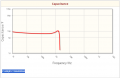
C1608JB1C106M080AB_CapFreq.png
https://product.tdk.com/en/search/capacitor/ceramic/mlcc/info?amp=&part_no=C1608JB1C106M080AB
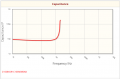
C1608X5R1C106M080AB_CapFreq.png
https://product.tdk.com/en/search/capacitor/ceramic/mlcc/info?part_no=C1608X5R1C106M080AB

Both of these are from TDK manufacturer.

Clearly, the depedance deviates strongly a bit over 1MHz which could make a cap totally unsuitable for an application.

I hadn't seen these charts before and couldn't find any equivalent charts or specs in datasheets from other manufacturers. This data seems important, Should I be able to calculate this deviation from other datasheet specs?
Can I predict is capacitance will rise or fall (as seen in charts above)?
Is this just common knowledge about ceramic caps?

I read that X7R doesn't deivate until higher frequencies. However, the X7R caps at TDK show just the same behaviour as X5R (I didn't look at all X7R parts).

Only noticed this as I was looking for a suitable replacement for a ceramic capacitor with obscure dialectric type, JB. Decided X5R is fine and looked at some specs. I'm only using the cap at a lower frequency so this deviation doesn't matter for me, but would like to know more about this.
 
Last edited:

nsaspook

Joined Aug 27, 2009
16,275
Curious about how you can find the frequency dependance of ceramic capacitors. I was looking at ceramic capacitor datasheets and found these charts of capacitance frequency dependance,

View attachment 347618
https://product.tdk.com/en/search/capacitor/ceramic/mlcc/info?amp=&part_no=C1608JB1C106M080AB

View attachment 347619
https://product.tdk.com/en/search/capacitor/ceramic/mlcc/info?part_no=C1608X5R1C106M080AB

Both of these are from TDK manufacturer.

Clearly, the depedance deviates strongly a bit over 1MHz which could make a cap totally unsuitable for an application.

I hadn't seen these charts before and couldn't find any equivalent charts or specs in datasheets from other manufacturers. This data seems important, Should I be able to calculate this deviation from other datasheet specs?
Can I predict is capacitance will rise or fall (as seen in charts above)?
Is this just common knowledge about ceramic caps?

I read that X7R doesn't deivate until higher frequencies. However, the X7R caps at TDK show just the same behaviour as X5R (I didn't look at all X7R parts).

Only noticed this as I was looking for a suitable replacement for a ceramic capacitor with obscure dialectric type, JB. Decided X5R is fine and looked at some specs. I'm only using the cap at a lower frequency so this deviation doesn't matter for me, but would like to know more about this.
That's perfectly normal for those types of devices. That's why you use more than one ceramic capacitor for bypass and decoupling applications. Select the needed capacitance (a 10 uf for energy storage and a 0.1 uf for high frequency chip bypass/decoupling) for the application (these capacitors serve different uses, so they might be physically separated on the board design), check the chart, if you need higher frequency specs, at a particular spot, select another to parallel the first so their charts overlap. This is very old stuff we learned in the tube era. You kids don't learn this in Maker school today? Even if the capacitors are perfect, there is still trace inductance and other factors that will require correct placement of each capacitor on the board.

https://www.ti.com/lit/an/scba007a/scba007a.pdf
 
Last edited:

ronsimpson

Joined Oct 7, 2019
4,664
Curious about how you can find the frequency dependance of ceramic capacitors.
The datasheet should say but the often do not.
At work I use a Vector Network Analyzer that cost more than a car. At home I use a $100 version. (before the dam Tariffs)
1745332861706.png
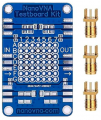
Next you will need a $10 board like this. I connect directly to the VNA and use short coax.
1745332832016.png
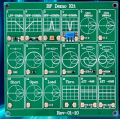
You should probably get this board also. $12 It has many examples of R, C, L circuits. This is better than a manual. You can see what a RC low pass filer looks like.
1745332999844.png
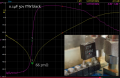
I one of the modes you will get graphs like this. Here is a 0.1uf cap showing its capacitor effect to the left and its inductance to the right. The resonant frequency is at 5mhz. It has 0.66 ohms if ESR.
1745333566320.png
 

MisterBill2

Joined Jan 23, 2018
27,359
Certainly the effective value of a capacitor will depend on the frequency! This means that to select an effective capacitor for an application, there must be an understanding of both the purpose and the frequency range involved.
Fortunately the manufacturers of capacitors , and also some distributors, are able to provide useful data.
This is why it is important for a circuit designer to provide the capacitor selection to the PCB layout drafter person.
 

0ri0n

Joined Jan 7, 2025
167
Here is a 0.1uf cap showing its capacitor effect to the left and its inductance to the right. The resonant frequency is at 5mhz. It has 0.66 ohms if ESR.
To increase the usable frequency range as a bypass capacitor, generate a small, negative series inductance that negates the ESL of the 100nF capacitor.
 

nsaspook

Joined Aug 27, 2009
16,275
To increase the usable frequency range as a bypass capacitor, generate a small, negative series inductance that negates the ESL of the 100nF capacitor.
With what, a gimmick inductor? We would use a gimmick cap from short lengths of wire to neutralize tube PA amplifiers but it was frequency dependent in the VHF or UHF range. Circuit fringe reactance, mainly in the tubes, would make a phase shift network causing oscillations at high power.

 
Last edited:

MisterBill2

Joined Jan 23, 2018
27,359
"Neutralizing" an RF amplifier with capacitors was actually adding capacitive negative feedback to cancel the effect of capacitive (usually) positive feedback. While the theory of neutralizing is quite sound and solid, the implementation was sometimes moore mystical. It is difficult for most of us to see high frequency electric potential fields.
 

nsaspook

Joined Aug 27, 2009
16,275
"Neutralizing" an RF amplifier with capacitors was actually adding capacitive negative feedback to cancel the effect of capacitive (usually) positive feedback. While the theory of neutralizing is quite sound and solid, the implementation was sometimes moore mystical. It is difficult for most of us to see high frequency electric potential fields.
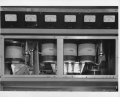
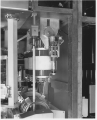
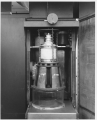
Yes, a little wire from the grid near the plate for negative feedback, if balance to the positive feedback. When we did a PA tube (on a 10KW exciter and sometimes on a much larger power final PA), the second step after the power-on smoke test was to adjust negative feedback via neutralizing capacitors, stage by stage.
1746060314527.png
1746060406056.png
1746060249435.png
A final PA tube.
1746061192787.png
Trying to neutralize (I know it's not exactly the same thing) a bypass capacitor by adding inductance gave me a good laugh.
 

nsaspook

Joined Aug 27, 2009
16,275
That's what happens when you don't pay attention to what you read.


Your "gimmick inductor" gave me a good laugh too.
The entire set of posts was in jest my friend. What's possible and what's practical are often two separate things. It's much easier just to pick the correct component in the first place.
 

dk1604

Joined Jun 14, 2013
1
That's perfectly normal for those types of devices. That's why you use more than one ceramic capacitor for bypass and decoupling applications. Select the needed capacitance (a 10 uf for energy storage and a 0.1 uf for high frequency chip bypass/decoupling) for the application (these capacitors serve different uses, so they might be physically separated on the board design), check the chart, if you need higher frequency specs, at a particular spot, select another to parallel the first so their charts overlap. This is very old stuff we learned in the tube era. You kids don't learn this in Maker school today? Even if the capacitors are perfect, there is still trace inductance and other factors that will require correct placement of each capacitor on the board.

https://www.ti.com/lit/an/scba007a/scba007a.pdf
That's perfectly normal for those types of devices. That's why you use more than one ceramic capacitor for bypass and decoupling applications. Select the needed capacitance (a 10 uf for energy storage and a 0.1 uf for high frequency chip bypass/decoupling) for the application (these capacitors serve different uses, so they might be physically separated on the board design), check the chart, if you need higher frequency specs, at a particular spot, select another to parallel the first so their charts overlap. This is very old stuff we learned in the tube era. You kids don't learn this in Maker school today? Even if the capacitors are perfect, there is still trace inductance and other factors that will require correct placement of each capacitor on the board.

https://www.ti.com/lit/an/scba007a/scba007a.pdf
Reviving a pretty old thread, but since I've not seen it mentioned here, Murata's online SimSurfing tool is an invaluable tool for this type of information.
 
Top