Cascading Low Pass Filter Circuit.

Thread Starter

Elbobboo

Joined Mar 24, 2023
12
IMG_3448.png
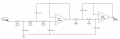
I am required to configure the above filter circuit with a corner freq of 1KHz, from a given selection of capacitors for each of the circuit capacitors.
I have “broken” the circuit into sections,
Being
  1. R1 and C2
  2. R2, R3, C1 and C3
  3. R4, R5, C4 and C5

I used
\[F_{corner}=dfrac\{1}{2\piRC}\]

and

\[ F_{corner}=dfrac\{1}{2\pi(sqrt{R_1 R_2 C_1 C_2})} \]

However the calculated capacitance, don’t fit in within the possible given caps.
What am I doing wrong?
Cheers
 

Papabravo

Joined Feb 24, 2006
22,058
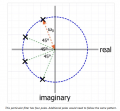
I think you have chosen the wrong formulas. The first stage is a cascade of a 1st order filter (R1 & C2) with a 2nd order filter (R2 & C1 and R3 & C3). The last stage is also a 2nd order stage with (R4 &C4 and R5 & C5). Each stage provides a different "load" to the preceding stage and that must be taken into account. The overall result is a 5th order filter which will require 5 poles located as 2 conjugate pairs in the left half plane and a single real pole on the negative real axis. It would help to know the remaining specifications you are trying to achieve as that would be a clue as to how the poles are allocated. See the following image from this site:

1721048013463.png
 
Last edited:

LvW

Joined Jun 13, 2013
1,998
I am required to configure the above filter circuit with a corner freq of 1KHz, from a given selection of capacitors for each of the circuit capacitors.
Your filter is a 5th-order lowpass in unity-gain Sallen-Key topology.
For such lowpass functions there are different alternatives (approximations) which must be specified before parts values can be chosen: The most popular approximations are connected with the keywords "Butterworth, Thomson-Bessel, Chebyshev,".
More than that, also the definition for the end of the pass region (corner frequency) depends on your choice.
Therefore, we need corresponding details for further help.
For your information: There are filter tables/formulas which can give you the corresponding parts values for the 3rd-order stage as well as 2nd-order stage.
 
Last edited:

Papabravo

Joined Feb 24, 2006
22,058
Note that when you cascade filters, the frequency response is different from that of each individual stage.
That is why the Q of each of the two 2nd order sections has to be adjusted accordingly so the five poles of the filter are properly positioned. The Q of the first order section is fixed at 0.5 because the pole is located on the negative real axis.
 

Thread Starter

Elbobboo

Joined Mar 24, 2023
12
Have you looked up the Sallen-Key filter topology so you can compute prospective values?

Here are some helpful links
RC Low-pass Filter Design Tool (okawa-denshi.jp) <-- first order section
Sallen-Key Low-pass Filter Design Tool (okawa-denshi.jp) <-- second order sections
I did have a look at those calculators, thanks. I did get a little confused however.
I did look at Example 16–3. Fifth-Order Filter (page 19). This example does use a Butterworth filter, as I have no idea if it is Butterworth, Bessel or Tschebyscheff, I assume, I need to calculate for each possibility and use whatever marries up with the given cap values.
 

Papabravo

Joined Feb 24, 2006
22,058
For the first 2nd order section I can tell you that of the nine combinations of values for C1 & C3, three of them will yield valid choices for a Butterworth lowpass response. Unless you have specifications for minimum passband ripple or group-delay I would go with the Butterworth response. I was never able to work through the mechanics of the TI paper but knock yourself out.

What I do know is that the Q's of the sections have to work out as follows:

Section 1, 1st Order: Q=0.5 <-- fixed because the odd pole is required to be on the negative real axis.
Section 2, 2nd Order: Q=0.618 <-- This pair of complex conjugate poles each make an angle with the negative real axis of 36° or 2π/10 radians
Section 3, 2nd Order: Q=1.618 <-- This pair of complex conjugate poles each make an angle with the negative real axis of 72° or 2π/5 radians

N.B. If you simulate each of the 2nd order sections individually, they will not be maximally flat. It is only when they are cascaded in the proper order that the Butterworth characteristic is achieved.

Good luck
 
Last edited:

tonyStewart

Joined May 8, 2012
231
To solve basic filters we find the -3dB points (half power)

But with 5 equal fixed R's and 5 different C's you need 5 equations which is not easy and pointless.

But -3dB BW is not the only quality factor. There are several Q's one for each pole and they may boost or overdamp like the 1st stage such that when cascaded they give the desired amplitude response in both time and f domains.

C1 = 8.2nF, 15nF or 27nF
C2 = 10nF, 22nF or 39nF
C3 = 6.7nF, 12nF or 47nF
C4 = 22nF, 33nF or 56nF
C5 = 1.2nF, 3.9nF or 4.7nF
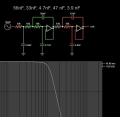
I disagree with all choices. I get this using 10% values for a Butterworth. C4 and C5 are off by 2% or so.
1721111934689.png


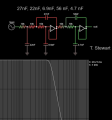
But take 2 is exact using given parts except for 6.8 shud be 6.9 nF.

You can edit with thumbwheel or alt-click edit. This took me just a few seconds to find the right values with the 3 choices.

1721112642760.png
 
Last edited:

MrAl

Joined Jun 17, 2014
13,667
To solve basic filters we find the -3dB points (half power)

But with 5 equal fixed R's and 5 different C's you need 5 equations which is not easy and pointless.

But -3dB BW is not the only quality factor. There are several Q's one for each pole and they may boost or overdamp like the 1st stage such that when cascaded they give the desired amplitude response in both time and f domains.


I disagree with all choices. I get this using 10% values for a Butterworth. C4 and C5 are off by 2% or so.
View attachment 327024


But take 2 is exact using given parts except for 6.8 shud be 6.9 nF.

You can edit with thumbwheel or alt-click edit. This took me just a few seconds to find the right values with the 3 choices.

View attachment 327027
You are not supposed to just hand out the answer in the Homework Section.
 

MrAl

Joined Jun 17, 2014
13,667
View attachment 326972
I am required to configure the above filter circuit with a corner freq of 1KHz, from a given selection of capacitors for each of the circuit capacitors.
I have “broken” the circuit into sections,
Being
  1. R1 and C2
  2. R2, R3, C1 and C3
  3. R4, R5, C4 and C5

I used
\[F_{corner}=dfrac\{1}{2\piRC}\]

and

\[ F_{corner}=dfrac\{1}{2\pi(sqrt{R_1 R_2 C_1 C_2})} \]

However the calculated capacitance, don’t fit in within the possible given caps.
What am I doing wrong?
Cheers
Hello,

If you do a network analysis, you can come up with a relatively simple expression but then you need to solve it numerically because of the higher order.
It looks like there are 243 different combinations of capacitors to try. Once you have the network expression you can try them all. I would use a computer and program the network expression into the program that solves the equation, which at that point is just a matter of having it try every combination. Probably take about 5 seconds or less, but you have to write a program for this first, which is not entirely too difficult either if you can do any programming and a little network analysis.
If you want to do this I can help but you will have to know how to program in at least one language. Even Basic would be ok.
 

Papabravo

Joined Feb 24, 2006
22,058
You could also find the procedure (tables) for placing poles in the left half plane to get a specific response, e.g. Butterworth, Chebyshev, Bessel, etc. This makes solving equations largely unnecessary. You can also find the relevant transfer functions in factored form and do magnitude and frequency scaling on them. Choosing standard values for capacitors and resistors has minimal effect on the outcome as long as certain conditions are satisfied. These are primarily conditions on the capacitor ratios with respect to Q and ζ (zeta, the damping ratio).
 
Last edited:

MrAl

Joined Jun 17, 2014
13,667
This turned out a little more interesting than at first thought.

I found two combinations that come very close to -3.01db. I'll give fictious numbers here just to illustrate.
Note the ideal value would be -3.0103 db (very close to that).
#1: -3.081 db
#2: -3.079 db

Now the question becomes, should we include both of these as possible solutions or just the lowest one.
They are so close it would be hard for me to suggest that only one of them is a good answer.
The percentage error for the actual (non-fictional) raw amplitudes (not db amplitudes) is less than 1 percent for both.

This was using a program to try every single combination of capacitor values. There were 243 different combinations.
 

tonyStewart

Joined May 8, 2012
231
The tweak time challenge
See how fast you are at making a filter with ripple at the wrong breakpoint into a maximally flat response at 1 kHz
My 2st solution came out maximally flat passband in about 3 minutes. It's not just the half-power point but get a canonical response (e.g. Butterworth).

When I randomized the values, the 2nd time I was faster. (learning curve effect)

Falstad uses 10% parts with the std mouse wheel increment so choosing the best part from 3, takes seconds.

I scrambled and hid all values but you can see them when the mouse wheel moves when pointed at the caps.

See how fast you can tweak a 6th-order filter!
 

MrAl

Joined Jun 17, 2014
13,667
The tweak time challenge
See how fast you are at making a filter with ripple at the wrong breakpoint into a maximally flat response at 1 kHz
My 2st solution came out maximally flat passband in about 3 minutes. It's not just the half-power point but get a canonical response (e.g. Butterworth).

When I randomized the values, the 2nd time I was faster. (learning curve effect)

Falstad uses 10% parts with the std mouse wheel increment so choosing the best part from 3, takes seconds.

I scrambled and hid all values but you can see them when the mouse wheel moves when pointed at the caps.

See how fast you can tweak a 6th-order filter!
As this seems to exist in the realm of ad-hoc fidgeting, I can't help but feel it lacks a certain degree of theoretical elegance. This can lead to an inadvertently bad solution. But my personal preference is to understand the theory behind the circuits we look at and try to find solutions that are completely logical even if it takes some time to figure that out. That's because theory gained aggregates and leads to more and more understanding as time goes by rather than how to keep adjusting something to get the result, which has no real theoretical basis as far as circuit analysis itself is concerned. Granted there are probabilistic approaches.

For example, did you check to see if your solution was optimal.
 
Top