Carburetor stuff...

Thread Starter

Externet

Joined Nov 29, 2005
2,628
Good day. Nothing to do with electronics... Just trying my luck here. Perhaps there is someone with the information...
Need to know how to use / route vacuum hoses to a Rochester G2E carburetor from ~1978. Carburetor part number stamped on it is 17058448

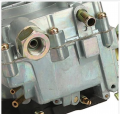
The big top left is fuel inlet. What is the top right for ?. At the bottom left, there is two smaller ports for hoses. Where is the upper supposed to connect ? And the lower one ?
Thank you.
1695750931778.png
 

BobTPH

Joined Jun 5, 2013
11,481
Certainly no expert, but...

The top right looks like a hose connector.

The bottom left look like standoffs that accept bolts. Are the holes threaded?
 

SamR

Joined Mar 19, 2019
5,473
Yup, 2 most likely are vacuum distributer advance and PCV valve connection. If my memory serves me correctly, the PCV valve connection was at the base of the carb. The more gas you gave the engine the greater the piston ring blowby and more vacuum needed to remove it from the crankcase. Never liked Rochester or Autolite carbs. Replaced them with Holleys.
 
Last edited:

LowQCab

Joined Nov 6, 2012
5,101
The largest hex-shaped flare-fitting is, of course, the Fuel-Inlet from the Fuel-Pump.

The large Hose-Barb next to the Fuel-Inlet is a Float-Bowl-Vent, and may be left disconnected and open.
This, however, will depend on weather or not there is also a Float-Bowl-Vent
inside the Air-Horn above the Choke-Plate,
which is subjected to the lower-pressure created by the Air-Cleaner.
In this case, this larger-sized hose-barb should be capped-off.
All Auto-Parts stores sell Rubber-Caps exactly for this purpose.

The 2 Vacuum-Ports coming from the Throttle-Plate area need to be traced to the
areas near the Throttle-Blades that they receive their Vacuum from.
Manifold-Vacuum is not useful for very much if anything.
There are several possible "Ported-Vacuum" configurations.
Assuming that all You really need is Ported-Vacuum for the Distributor,
the larger Hose-Barb is NOT what You want,
it's usually a special-Port for controlling the EGR-Valve.
So, You are left with only one Port.
Attach a Vacuum-Gauge to this last Port and verify that there is little to no Vacuum with the Throttle closed.
As soon as the Throttle is barely cracked-open, the Vacuum on this Port should equal Manifold-Vacuum.
Run a Hose from this port directly to the Distributor-Vacuum-Advance-Canister.

Replace all Spark-Plugs,
Replace all Spark-Plug-Wires,
Replace Distributor-Cap and Rotor,
Replace Breaker-Points if so equipped.

Do not proceed further until all Ignition components have been replaced.
.
.
.
Do not proceed further until all Ignition components have been replaced.
.
.
.

If the Engine is not running properly,
and the Idle-Speed-Screw has been cranked-open to keep the Engine running,
the "Ported-Vacuum" Vacuum-Advance-Port may have vacuum on it at all times.
Make sure that the Ignition-Timing is correct with the Vacuum-Advance-Hose disconnected,
then adjust the Idle-Mixture-Screws for the smoothest Idle,
then reduce the Idle-Speed-Screw for a ~750-RPM Idle-Speed.

Repeat this procedure until the Engine is stable and responsive,
then repeat it again,
when everything appears to be working correctly,
re-connect the Ported-Vacuum-Hose to the Distributor-Vacuum-Advance-Canister.

After this procedure has been completed,
the Vacuum-Gauge can be used to fine-tune the Idle-Fuel-Mixture.
Adjust for the highest Manifold-Vacuum possible at Idle.
This may cause a change in the Idle-Speed,
readjust Idle-Speed and repeat Mixture-Adjustment.

Carefully count the number of turns-out for each Idle-Mixture-Screw,
if the 2 screws are different,
average the difference between them, and then start over.
Both Screws should be the exact same number of turns-out,
or at the very least, within a quarter-turn of each other.

Lather-Rinse-Repeat,

If this Car was made between ~1970 and ~1985,
it will have un-fixable bad-designs and sloppy-clearances built into it.
The Pistons, Cylinder-Heads, and Camshaft are all complete garbage designs,
and can not be made to run efficiently without being replaced with more modern designs.
The Engine will be prone to "Knock" without premium-Fuel,
and will easily over-heat,
and will suck-gas like it's got a hole in the Gas-Tank.
.
.
.
 

Thread Starter

Externet

Joined Nov 29, 2005
2,628
Thank, guys. Went to the public library and as LowQ suggests, found with difficulty in several books, the top right port is just venting of the fuel bowl. Can/should be used/connected to some canister to recover fumes. It is capped.
The bottom left ports are for the distributor advance and for the exhaust gas recirculation EGR actuator. Solved. The car runs well. :)
 
Top