Capacitor lab in "Art of Electronics"

Thread Starter

umichfan1

Joined Jun 16, 2012
32
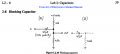
I recently started working through all the labs in Hayes & Horowitz's "Student Manual for The Art of Electronics," and I am a little confused about what is going on in section 2-8 of Lab 2: Capacitors. On p. 59 (of the 1989 edition) they show a schematic of a circuit with capacitors represented by one straight line and one curved line, with a "plus" sign by the straight line. As far as I can tell, they have not used this symbol anywhere else in the book that I can see (though in looking around online it appears that this denotes a polarized capacitor). Furthermore, the "plus" sign is lined up opposite of where I would expect. Shouldn't it be on the "input" side? And why is a polarized capacitor even necessary in this case? It seems like a "normal" capacitor would be just fine. Thanks for the help!
 

wmodavis

Joined Oct 23, 2010
739
Send me your copy of the book so I can see what you are talking about then maybe there would be enough information to help you.

The symbol you mention is a standard for an electrolytic capacitor which is polarized. What is the "input side of a capacitor"?
In what "case"?
A 'normal' capacitor may be just fine in that mysterious case but it depends on some things which you have not told us. Everyone does not have your paticular book and I for one am not clairvoyant and my crystal ball is hazy today.
 

debjit625

Joined Apr 17, 2010
790
Their is nothing wrong with that, the positive side of the cap is the straight line and negative side of cap is the curved line its an old schematic symbol for capacitor ,it was also known as condenser.

Furthermore, the "plus" sign is lined up opposite of where I would expect. Shouldn't it be on the "input" side?

As per JoeJester's schematic, the circuit is just adding AC to DC to level it up, normally these kind of circuits are used in transistor's input to achieve a full wave amplification without clipping. Now the input is quite small and its AC so its both positive and negative.

If you look at the circuit properly then on the right side you can see the voltage divider, between them (accross 4.7K) you will find some constant positive voltage and its where the positive terminal of the cap is connected. So the positive terminal goes to positive with the rules.

And why is a polarized capacitor even necessary in this case?
Its not about polarized capacitor or non polarized capacitor ,the capacitor is been used as a filter, it will provide low impedance (resistance) to AC and high impedance to DC so that the DC doesn’t takes over the small AC signal.

To understand the circuit properly you have to understand superposition theorem first.

Good Luck
 

WBahn

Joined Mar 31, 2012
33,182
Here's what the OP is talking about ...
I have no idea what the (B) figure is talking about. If the resistor there had been 3.2kΩ, then it would have been the small-signal equivalent circuit.

There is no "need" to use a polarized capacitor here. However, it IS a polarized capacitor and so the input voltage must never reverse bias that cap, either because of a sufficiently high DC bias (anything above ~4.8V) or a sufficiently large AC signal, or some combination of both.
 

#12

Joined Nov 30, 2010
18,224
I can confirm that the + sign was always placed on the curved line 50 years ago.
For today, just allow that the + sign is the correct information.
Written labels always have priority over symbols.
 

WBahn

Joined Mar 31, 2012
33,182
WBahn,

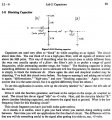
here is that whole secton of the students manual ...
Thanks. It appears that the key sentence didn't scan properly and is a big solid black box. But it appears that they want you to add the second circuit as a filter following the first one.
 

Thread Starter

umichfan1

Joined Jun 16, 2012
32
Thanks, everybody, that was all very helpful. Sorry I didn't post an image of the page myself...I'm make sure to do that in the future. And now I see that it is *assumed* that the input signal never exceeds 5V in amplitude, in which case the voltage on the positive side of the capacitor always remains positive. Again, thanks for the insight.
 
Top