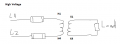
Can you power an AC xenon beacon on 230V using a capacitor drop supply, using L1 & L2 feeds of a 3-phase AC supply (120 deg phase difference)? Would it work ok?
From what I understand, there is 400VAC between L1 & L2 which would mean an overvoltage which would kill the device.
Also, I understand there is 200-230V between L1 & N. Whether my understanding is correct or not is a different question!
I strongly suggest using an AC voltmeter to verify the voltage between a line and the neutral.If you have 400 volts between L1, L2, and L3, then there should be about 230 volts from each line to neutral.
BUT, over here in the USA, in some localities, (the city of Warren, industrial section), the line to neutral is unusual in that one of them is higher than the other two, by about 25 volts.
So the only wise choice is to actually measure the voltage.
Sometimes, "What IS" and "What Should Never Be" are the same.
Use a transformer to change the 400 volts to 230 volts AND provide isolation..
Consider that 400 volts between phases it totally non-forgiving of any minor error.
TS mentioned 50Hz and 400V/230V but not geographic region so this could mean many places and different standards may apply. In Europe, 3-Phase should have neutral present and single phase load is connected to one of phases and neutral...
Thank you all. @MaxHeadRoom, yes, I am aware of that, hence the question, but the beacon is a 50Hz device, not 120Hz. Also, it has a very large charge cap, and I wasn't sure what effect 120Hz would have on the circuit and the charge cap. @MisterBill2, it wasnt a question of what options are available, it was a specific question I was asked. @panic mode, location is West Europe, 50Hz 230VAC.
To be on the safe side, I have decided the answer is no!
Certainly I agree that a transformer, NOT an "autotransformer, though, is the safest choice. It must have adequate insulation between the primary and secondary, of course.
BUT I seriously question the value of tying one side of the isolated secondary to "ground". The only possible benefit would be to bleed off any charge leakage from the high voltage primary. What other possible benefit would be provided? Consider that grounding one side immediately creates a shock hazard from contacting the opposite side. So just what is the benefit of grounding one side of an otherwise isolated voltage source??? Can anybody explain that??
i do not see value in using transformer in this case at all.
about need for grunding....
grounding of the secondary is spelled out in electrical standards. each country will have such standard. and this is required by law. in general, floating secondaries are only permissible in special cases (small power, double insulated etc.). any professional need to get familiar with it. here in Canada one can take a low cost evening course at just about any college.
the idea is that user shall never be exposed to too higher than expected voltage - even when there is a failure. ideally system would detect failures and act accordingly (trip) before Bubba goes to work and find out the hard way that voltage in circuit much higher than listed for transformer secondary - specially since circuit seem to be still working!
your expectation is correct of course... if everything works... but reality is that in long term all things fail...
maybe insulation breaks down. humming of coils could make one speck of dust pierce insulation eventually... or at least lower the insulation degree so that it causes leakage. or maybe some critters chewed through things or build a nest on it, or flood happens... or any other reason...
so if the secondary is not grounded, then HV from primary would end up on the secondary side. and worse - circuit would continue to work without detecting fault. this is not acceptable, this is the main reason why secondary need to be grounded. then even if the HV somehow gets to secondary side, it would result in high current draw and tripping of the overcurrent protection. problem detected and handled - disaster averted.
Bubba will need to investigate and solve the problem but will not be expected to deal with a ticking bomb.
...EDIT....
One thing may not be clear from above sketch - if there is a failure, and secondary is grounded why would primary side overcurrent protection trip? there does not seem to be continuous (closed) path, just one faulty connection.
there is a path, the upstream device (transformer or generator) is also required to be grounded.
Certainly I agree that a transformer, NOT an "autotransformer, though, is the safest choice. It must have adequate insulation between the primary and secondary, of course.
BUT I seriously question the value of tying one side of the isolated secondary to "ground". The only possible benefit would be to bleed off any charge leakage from the high voltage primary. What other possible benefit would be provided? Consider that grounding one side immediately creates a shock hazard from contacting the opposite side. So just what is the benefit of grounding one side of an otherwise isolated voltage source??? Can anybody explain that??
Check out NFPA79/NEC (NFPA70)/CEC if isolation is a result of a control transformer secondary etc, one side of this secondary is (re) referenced to Earth GND. In order to establish a new safety Neutral. etc
Check out NFPA79/NEC (NFPA70)/CEC if isolation is a result of a control transformer secondary etc, one side of this secondary is (re) referenced to Earth GND. In order to establish a new safety Neutral. etc
The discussion is about powering a single device! We ARE NOT DISCUSSING A DISTRIBUTION SYSTEM. That matters a great deal.
ALSO, in all the transformers of decent quality there is adequate insulation between primary and secondary sections. AND, in the totally burned up transformers that I have dis-assembled to re-use the cores, there has not been created a connection between the mains section and other sections.
To give you a little more detail, the xenon beacons are designed for capacitive voltage drop configuration and this is 'normal' and used all over industrial environments and normally passes stringent UL tests and certification. It is housed in a metal housing that is ALWAYS earthed and it is placed up in a tower or somewhere similar, totally sealed and inaccessible to anyone by professional installers. Of course, there are DC versions as well, but we are not discussing those.
OK, now we see a specific setup, with conductive frames attached to a grounded tower. Given that in that sort of installation it is not likely that an unaware fool would be working with the lights. Also likely that reliability and long life are important considerations. So a ground level isolation and step down transformer makes the most sense, to avoid a voltage stress between either side of the power feed and the tower or housing. And possibly a pair of "ground detect" lights at the isolation/step down transformer would be appropriate. That would allow convenient inspection for wiring damage without even touching the tower.
The discussion is about powering a single device! We ARE NOT DISCUSSING A DISTRIBUTION SYSTEM. That matters a great deal.
ALSO, in all the transformers of decent quality there is adequate insulation between primary and secondary sections. AND, in the totally burned up transformers that I have dis-assembled to re-use the cores, there has not been created a connection between the mains section and other sections.
you are obviously educated user but it is the authority that writes and enforces standards (this is what makes things legal). and in this case that authority is in a different country (different continent). you can contact them, report your observations and argue to make changes based on your experiences.
standards also tend to have definitions section and state what can pass as "decent quality" or when is something considered "distribution".
this topic is for a single device but... it is not like that device (beacon) and transformer and going to be placed into one metal enclosure. chances are that someone would place that beacon where it is visible and transformer may be quite some distance away. that means running cables. and not all cables are armored or run separately. i do not know details or time to waste. so i read and recommend others to follow standards instead of argue with authorities. i have found that one can argue to some extent with their representatives (field inspectors) but ultimately they have the final word.

 Facebook
 Google
 GitHub
 Linkedin