can i trigger a relay with less than 1v?

Thread Starter

marktomaras

Joined Aug 8, 2017
12
I have a project that uses a current sensor to sense if a machine is working. the current sensor will be wired to a relay, which will activate an hour counter. The trouble is, the current sensor generates a voltage between 0-1v. Is this enough to activate a relay?
 

crutschow

Joined Mar 14, 2008
38,337
I have a project that uses a current sensor to sense if a machine is working. the current sensor will be wired to a relay, which will activate an hour counter. The trouble is, the current sensor generates a voltage between 0-1v. Is this enough to activate a relay?
You may have a problem finding a mechanical relay that will operate from 1V.
You could possibly use a BJT transistor or comparator to detect the 1V
What is the tolerance on the trip point?
How much current can this 1V signal deliver?
 

wayneh

Joined Sep 9, 2010
18,090
I have a project that uses a current sensor to sense if a machine is working. the current sensor will be wired to a relay, which will activate an hour counter. The trouble is, the current sensor generates a voltage between 0-1v. Is this enough to activate a relay?
By itself, probably not. You will need to amplify the signal with one of the options already named. Any amplifier will require DC power. Do you have that available?Your power requirements depend on the relay specifications.
 

Thread Starter

marktomaras

Joined Aug 8, 2017
12
I am trying to use a current transformer to trigger an hour counter. I found an hour counter that runs on its own internal battery and has extremely low power requirement to trigger it: 3.5v or so and less than 0.05mA. So that looks promising! The current transformer i found that is very affordable is here (data sheet). I am trying to get the absolutely simplest design of this device as possible. If I were so lucky, I could connect the current transformer leads directly to the hour counter and when current is sensed, the clock is ticking. However, i don't know if this is possible, or reliable.

now that you know more about the parts involved, what is the simplest way to design the circuit so that these two devices will work together?

thanks!!
 

wayneh

Joined Sep 9, 2010
18,090
The output of the sensor (0-1V) is going to be proportional to the current sensed (0-20A). What current (and thus voltage) do you want to trigger your timer?

Have you tried to find a sensor with a higher output voltage range, for instance 0-5V? That might allow your simple scheme to work.
 

Thread Starter

marktomaras

Joined Aug 8, 2017
12
Wayneh, thank you for the quick response. So the device I am trying to count hours for is an audio amplifier. the specs on the power consumption of this amp is:

Power requirements 105-125VAC 60Hz (210-250VAC 50Hz) 585 watts at rated output, 750 watts maximum, 380 watts at "idle"

My goal is to have the timer start counting hours the moment (or very shortly after) the amplifier is switched on, and stop counting the moment (or very shortly after) the amplifier is switched off.
 

wayneh

Joined Sep 9, 2010
18,090
Wayneh, thank you for the quick response. So the device I am trying to count hours for is an audio amplifier. the specs on the power consumption of this amp is:

Power requirements 105-125VAC 60Hz (210-250VAC 50Hz) 585 watts at rated output, 750 watts maximum, 380 watts at "idle"

My goal is to have the timer start counting hours the moment (or very shortly after) the amplifier is switched on, and stop counting the moment (or very shortly after) the amplifier is switched off.
Why not just trigger the timer off the amplifier's power switch? Does the amplifier have any output related to the power switch, such as a switched outlet on the back?
 

Thread Starter

marktomaras

Joined Aug 8, 2017
12
of course that would be the smart way, however, I want the trigger to be completely non-invasive for various reasons. In my case, my amp does not have any switched outlets or 12v triggers. It's an old school vacuum tube power amp.
 

phranzdan

Joined Aug 4, 2017
40
I have a project that uses a current sensor to sense if a machine is working. the current sensor will be wired to a relay, which will activate an hour counter. The trouble is, the current sensor generates a voltage between 0-1v. Is this enough to activate a relay?
Hi: I don't know of any relays that will pull in with 1 volt or less with the possible exception of the relays Lionel used to operate the horn or whistle on their postwar locomotives. One possibility would be to use a darlington transistor such as MKSA13 to operate the relay. You would need a separate supply then choose a relay appropriate for the supply voltage. The base of the darlington would be driven of the output the sensor. The relay would be wired in the collector circuit of the transistor. The darlington will turn on with a very small amount of base current since it has a very high DC current gain. I can't comment on the practicality since I am not familiar with the circuitry.
 

ebeowulf17

Joined Aug 12, 2014
3,307
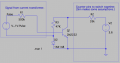
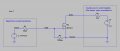
This is going to sound crazy, but what about a logic level MOSFET? A 1V signal won't reach the official threshold voltage, but many of them will pass some small amount of current all the way down to Vgs values well below their threshold. If you only need fractions of a milli-amp through the relay in order to turn on the timer, I think it might work.

You'd need a pull-down resistor on the gate to make sure it's off when it should be off, but I think that's it - two parts.

First plausible looking result on Digikey is the TN0702:
https://www.digikey.com/product-detail/en/microchip-technology/TN0702N3-G/TN0702N3-G-ND/4902376
IMG_2262.PNG
 

ebeowulf17

Joined Aug 12, 2014
3,307
Not crazy but doesn’t solve the problem of no power supply. Once you add that, there’s no shortage of options.

Oh, and a darlington needs two diode drops, or about 1.4V to turn on.
I was imagining a setup that didn't require an external power supply. I was hoping 1V on the gate would activate the MOSFET enough for the tiny bit of current flow required by the counter, with current/voltage coming from the counter. So far LTspice doesn't show my idea working with any of the MOSFET models I've tried, unless I increase the signal voltage up to 3V. Oh well, it was a nice thought, but I knew it was a longshot.

Also, after looking at the current transformer datasheet, I'm not so sure the signal will even approach 1V. It looks like 0-20A scales to 0-1V, in which case 3A max amplifier load would scale to 150mV. Even with my optimistic outlook, 150mV isn't going to do much without an external power source.
MOSFET-as-counter-relay.png
 

Attachments

Thread Starter

marktomaras

Joined Aug 8, 2017
12
You guys really rock. Thank you for helping with this!

Ok, Ebeowulf, I love the idea of no power supply at all! However, I think it is probably not going to happen. I am planning on a 4x AA battery supply in series. I checked the specs on Sanyo Eneloop rechargeable AA cells, and they hold a voltage above 1.1v for most of their charge life, so I can expect 4+ reliable volts from the set of batteries for most about 1800 out of the entire spec'd 2000 mAh. Not bad.

If the current transformer is self powered, and the hour counter is self powered by its own internal battery, am I right to hope that 4v & 1800mAh is enough power to energize the circuit for a good long time?

I will need a very low power consuming relay and an efficient way to amplify the voltage from the current sensor. I think I found a better current transformer. Here is the data sheet. At 1000 ohm resistance (is that feasible?), it can produce in the neighborhood of 500mV to 1000mV with 1A-5A of sensed current.

If that is the case, would my circuit be as simple as the CT connected to a resistor, then some sort of minimal amplification device, and then connected to a relay with the battery power supply?

In terms of the voltage to start the counting device, it can be triggered with as little as 3V and 0.05mA. The data sheet says 5V, but the manufacturer told me they can get it to trigger at 2.8V and they are confident that 3V or 3.5V is plenty with a bit of margin. Here is the data sheet on the latest counter I am planning to use.

If you guys have not noticed, I am not an engineer :)
I completely appreciate this forum help, but I would like to take it a step further: if anyone who feels they have a good handle on this would be interested in a little side job to help me design this circuit, I would be happy to pay them for their effort! As this is a little personal project, I don't have a lot of budget, but if anyone is interested, please let me know! I am a photographer... perhaps a trade deal for an awesome photograph? (www.marktomaras.com) Have a look at my work at Ivanpah Solar, this may be right up your alley!
 

ebeowulf17

Joined Aug 12, 2014
3,307
I don't have time for a more detailed reply now, but we should be able to create a very, very low current circuit for you. My first thought is to use an op-amp comparator to detect the signal from the current transformer, and possibly a MOSFET to act as your relay (it will consume MUCH less power than any relay.) Although, your most recent reference to the counter makes it sound like maybe you're getting one with a voltage input as opposed to the free-contact input. This would make things even simpler. Then you don't need a MOSFET or a relay. You just need the op-amp, your batteries, and a very small number of resistors and capacitors to make the op-amp do what you want. I'm starting work, so someone will probably beat me to it, but if you don't have a working circuit idea by this evening, I'll take a crack at it for you.

Oh, yeah - the op-amp also has incredibly high input impedance, so it won't load down your current transformer. No worries about how much current it can provide.
 

Reloadron

Joined Jan 15, 2015
7,866
of course that would be the smart way, however, I want the trigger to be completely non-invasive for various reasons. In my case, my amp does not have any switched outlets or 12v triggers. It's an old school vacuum tube power amp.
With that in mind and being non-invasive you could just use something like this maybe? Rather than the LED drive an opto-coupler. Additionally older tube type amplifiers could easily have a hour meter adapted to the mains input where it is switched.

Ron
 

Thread Starter

marktomaras

Joined Aug 8, 2017
12
Here is another possible CT for the circuit: data sheet

The manufacturer told me:
"ECS16-50, with 5A input, usually get 2mA or 100MV output, with 1A input, usually get 0.4mA or 20MV output. RL=50 ohm or 100 ohm.
It is cable output, no termination."
 

ebeowulf17

Joined Aug 12, 2014
3,307
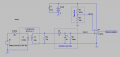
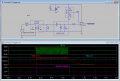
Well, my ideas always seem simple in my head, and they always end up more complicated when I draw them out. Here's what I've come up with for a system that involves less guessing and speculation than my earlier thoughts. Using batteries makes this much easier than my earlier speculations.

The trim pot makes it easy to adjust your threshold based on actual amplifier current consumption and transformer performance so that you can get reliable switching. The "filter" portion of my circuit may be overkill since the counter accepts AC input, but I think the diode and resistor have to be there for single-supply use anyway, so one extra cap isn't much to add at that point. I believe that using a dedicated comparator (as opposed to a generic op-amp) means that you can skip feedback from the op-amp output, but I may be mistaken.

Hmmm.... I just realized the comparator I chose to simulate probably isn't the best choice - easier to use a push-pull output in this situation. Gotta run for now, but this lays out one concept anyway. Because of the op-amp's high input impedance and high sensitivity, and the trim-pot's flexibility, this circuit should be very easy to dial-in to work with whichever current transformer you chose. Selection of that part becomes a little less critical than when we were trying to create a no-battery solution.
Counter_1V-trigger_schematic.png
Counter_1V-trigger_plots.png
 

Attachments

Top