Can i damage my motor controller this way?

Thread Starter

Temeraire

Joined Feb 26, 2019
23
I have a L298N motor driver and a twirl dc motor PG52ZY52.
From the datasheets i read these features: the motor driver's peak current: "2 Amp each bridge",
and the dc motor's stall current: 21.1 Amp.
In my project the dc motor will be stalling a lot (in the safe limit, so probably it won't draw 21.1 amp, but more than 2 for sure) and my battery could provide that current for the dc motor too.
 

Joël Huser

Joined Jun 30, 2019
42
Your H bridge L298 is limited with 2 [ADC].

Stall torque of your DC motor is 21,1 [ADC].

You said that your motor "will be stalling a lot".

So no miracle : your H bridge and your battery should provide 21,1 [ADC] without getting too hot or damaged.

This is like a Tesla car. Tesla car can produce a power of 500 [cv], this means 368 [kW]. If I suppose that the battery is 200 [VDC] (I don't know the voltage in reality) AND that there is 2 brushless motors with its controller each one,

Each controller should be designed to accept a max. current of 368'000 / (200 x 2) = 920 [A] without taking any margin in account !

The 200 [VDC] battery of the Tesla car should provide a max. current of 368'000 / 200 = 1840 [A] without taking any margin in account !

Joël
 
Last edited:

Tonyr1084

Joined Sep 24, 2015
9,744
My first thought was that you'd blow your motor controller. I just don't see how a 2 amp device can withstand 21 amps for ANY length of time. But as always, more details on what you're doing will help us give a more comprehensive answer. LOTS more detail.
 

Thread Starter

Temeraire

Joined Feb 26, 2019
23
Thanks for the help! I Would have guessed the answer for the question, but i asked it to be sure.

I'm working on o project with a dc motor. The motor itself will provide less torque than the torque needed to move the applied load. An external human force is needed to completely move the load. So in other words the dc motor will be stalling a lot. I read that there is a safe limit (at a lower voltage input and lower torque) where you can stall the motor continuously without damaging it.

But looking at the datasheet, if there is stalling, then there will be stall current (21,1 Amp) not just <650 mA (no load current).

So if the motor really needs the 21.1 A to move and can't start with lower currents then i need a better motor controller that can withstand this current, right?
 

MaxHeadRoom

Joined Jul 18, 2013
30,684
Most high quality motors have a manuf. spec showing continuous torque and momentary peak torque.
The LMD18200 controller has a current sense output that could be utilized.
Are you using PWM or?
For that motor it would appear you need a much higher current rating H bridge.
Max.
 

Joël Huser

Joined Jun 30, 2019
42
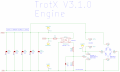
For a 450W 24VDC 18,8A electric scooter engine, I'am using a 60A 500VDC N mos, as you can see attached, to have a good margin.

Because you're using a H bridge and you will probably cut transistors at a "high" PWM frequency, the transistors zone and wires are often highly disturbed. That's why you should take a good margin when choosing the last high current step of your circuit. That's why I have optocoupled the PWM input signal too.

And you can see that I have put a diode bridge 200V 50A directly on the engine and N mosfet to absorb unwanted negative sparks.....

Joël
 

Attachments

Last edited:
Top