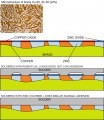
Well known sequence of actions:
1. Pretinning brass thing by solder with zinc-chloride flux.
2. Washing with water.
3. Soldering wire to brass thing with rosin flux.
Well known sequence of actions:
1. Pretinning brass thing by solder with zinc-chloride flux.
2. Washing with water.
3. Soldering wire to brass thing with rosin flux.
This is the first I've heard that zinc chloride flux is needed for brass. I've been soldering brass and bronze for over 50 years now using ordinary 63/37 rosin-core solder, same as for all other electronic work, and never had the least bit of difficulty. They both take tin/lead solder as readily as does copper.
I agree on the soldering of brass. Never had a problem with electronic solder. Of course, if it is a brass fitting as for a valve used in my water supply line, I will use regular lead-free plumbing solder with a more aggressive flux. For structural stuff, like rod ends for model airplanes, I have always used brass and electronic solder.
My concern about soldering bronze was mainly from inexperience with it, particularly some of the alloys with little, if any tin, and aluminum, manganese, silicon or other elements in the alloy. My uses for bronze are mostly as bushings, so there was no need to solder it. However, the link below mentions using solder to help retain a bushing. Apparently, a more active flux will work with it.
The different types/grades of aluminum bronze are a bear to machine, some worse than others. Some will ruin band saw blades and cutters as fast as hardened steel. And it is usually tig welded or brazed rather than soldered.
My plan is to solder the wire to the head of the screw. The flat bottom of the screw's head will be pressing against the acrylic, with an o-ring between them acting as a sealant.
Then why not use a ring terminal on the wire? And then it would be in order, screw head, ring terminal, Oring, then acrylic. If you just solder the wire to the screw head, there is a possibility of some time in the future the screw will get turned by someone breaking the wire off.
The different types/grades of aluminum bronze are a bear to machine, some worse than others. Some will ruin band saw blades and cutters as fast as hardened steel. And it is usually tig welded or brazed rather than soldered.
Then why not use a ring terminal on the wire? And then it would be in order, screw head, ring terminal, Oring, then acrylic. If you just solder the wire to the screw head, there is a possibility of some time in the future the screw will get turned by someone breaking the wire off.
If I did it that way, there'd be a leak between the screw head and the ring terminal, and then into the orifice ... and I'm not particularly keen into using two o-rings for this purpose.
If I did it that way, there'd be a leak between the screw head and the ring terminal, and then into the orifice ... and I'm not particularly keen into using two o-rings for this purpose.
Got another thing to look at then. How about a "Wellnut"? https://www.mcmaster.com/#well-nuts/=1czcjec The rubber bushing in the hole and a longer screw going through the nut(locktite that ) and then another nut to secure the wire.
Copper to brass is a definite yes. I have done it many times, also brass to steel. All with leaded, rosin core solder. I have not tried bronze. Success with that might depend on the alloy.
Still not sure of your exact application, when I used a heat sensing cable in the past for underwater use etc, the manuf. recommend covering the joint for the feed conductors with RTV compound and sliding heatshrink over before heating.
Is there any way you can drill a hole in the end of the screw and pot solder the wire in?
Max.
Still not sure of your exact application, when I used a heat sensing cable in the past for underwater use etc, the manuf. recommend covering the joint for the feed conductors with RTV compound and sliding heatshrink over before heating.
Is there any way you can drill a hole in the end of the screw and pot solder the wire in?
Max.
Unfortunately, I cannot disclose the exact application. But I can say that the head of the screw to which the wire will be soldered is exposed to a corrosive agent. So my plan is to coat the screw head (along with the soldered wire) with epoxy paint before mounting. That's why I don't want to fix the wire to the head using purely mechanical means.
I just bought a few #8-32 x 3/4" pan-head brass screws, and I was also able to find brass nuts and brass washers. I'm going to test them, and see how it goes.
Man, I had forgotten how smelly brass can be ... they stink!
Yeah, I'm sure it's the oils they use when manufacturing it ... but brass does have a smell, as a matter of fact it's a faint smell resembling blood, if I'm not mistaken.
Copper or copper tin they solder fine bronze yellowish-brown alloy of copper with up to one-third tin small screw not a problem.
Now if it has something else in it oil or some ware metal maybe not as easy but I don't see a brass or bronze screw being a problem.
Main thing is flux and heat

 Facebook
 Google
 GitHub
 Linkedin